


 Francais
 Deutsch
 Italiano
Refine Your Search
+"United States USA" +1942 stock footage and images
- Showing 157 to 162 of 520 results more
more Hide
Hide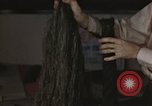
Farm production for war effort in World War 2 with farming and processing of hemp, dried milk and dried eggs in United States
Agricultural progress motivated by the demands of World War II production in the United States. American farmer holding raw hemp for making rope. Farmers in Kentucky or Tennessee harvesting hemp to replace sources lost in the Philippines due to war in the Pacific. Hemp seed harvesting in southern states. A bag of hemp seed. Thick planting of the seeds yields straight, long fiber hemp plants. A boy on a farm stands next to tall hemp plants. A tall harvester attachment is seen cutting the hemp plants at harvest. Workers tie hemp plants in bundles and stack them for breaking. Hands of a man shown tearing and testing strong hemp fibers on a dried hemp plant stalk. Butter and milk bottles stacked closely in a cooler. Large metal bins of eggs are shown. Exterior view of a factory for egg drying. A tank truck parked outside the plant containing broken raw eggs to save space. Large dryers are shown producing a dried golden yellow powder from the eggs. Factory worker sits at a vibrating table that shakes and sifts the dried egg powder and loads it into bags. Scrambled eggs cooked in a pan over a stove. View of raw dozen eggs and packaged box of dried eggs side by side. The small box of one dozen eggs weighs only 5 ounces. View of a wooden barrel that holds the dried equivalent of 5000 eggs. Cows graze on a field. A milk tank truck parked at a drying factory. Cans of dried milk move on a factory assembly line. A machine applies a lid to each can. A wall of 15 gallon barrels of dried milk are shown, each containing the equivalent of 150 gallons of raw milk. Blocks of cheese shown in a dairy case display.
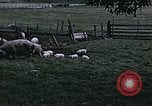
Pork, beef, and sugar crops processed at farms and factories in United States to meet war demand in World War 2
Agricultural progress in the America during World War II, with increased production to meet wartime needs. Pigs, hogs, and piglets on a farm. Trees in the background. Vehicles pass in front of a pork butcher and processing factory. Truck in front says "HH Green" on side. Sign in background of shot says "Morrell" (this is possibly the John Morrell & Co. Packing Plant in Ottumwa Iowa). Butcher workers with cleavers cut and process pork on moving assembly line. Beef cattle graze on a field. Tractor operated on a farm field. View of beef cattle stockyards at butcher and processing factories for meat. Butcher operations for beef cattle seen on moving assembly line. Farmers harvest feed crops for meat production. A feed shed filled to the top. Farmer harvests sugarcane and drives wagon filled with sugarcane, pulled by horses. Farmer on tractor on a sugarcane field. A tall harvesting machine cuts sugarcane in the field at harvest. Farmer on a sugar beet field. A mechanical seed splitting machine is shown. Farmer holding shafts with sugar beet seeds attached. Sorghum plants are shown and described as a new source of sugar. A man feeds harvested sorghum plants into a pressing machine to extract sorghum liquid for sugar.

Seeds, crops, farm, and victory gardens worked to support war effort in World War II in the United States.
Agricultural progress motivated by the demands of World War 2, in the United States. Efforts made to develop substitute crops for foreign products now unavailable. Farmer on a tractor in the farm. Crop planted and harvested with the help of tractor. Man takes seeds in hands from a bag. A 100 pound bag of 0-14-14 fertilizer reads: 'AAA for use only in carrying out soil building practices. Agriculture Conservation Program of the Agricultural Adjustment Agency." Farmer Harry Vetch in Mississippi shown in his field of nitrogen rich legumes that he is growing in order to obtain nitrogen fertilizer since nitrogen is needed in the war effort and unavailable to farmers. View of a field of crimson clover also for use in obtaining nitrogen. View of soybean and clover also used for nitrogen in corn fields. Man on tractor spreads manure fertilizer. A sign board reads: "Emergency Rubber Project. Quail Creek Nursery. Forest Service U.S. Department of Agriculture" outside a building. A man examines a test planting of a Mexican hule rubber plant needed to meet war demand for rubber. Man beside a 'Department of Agriculture' truck bounces a chunk of rubber. Also shown is a test planted row of Kok-saghyz Russian dandelion used to produce rubber. Milkweed and goldenrod plants are shown. Narrator talks about Victory Gardens as images of farmers plowing small fields are shown. Samples of Victory Garden vegetables shown on a table with signs noting the nutrients in each such as calcium, iron and vitamin B. A woman in a home victory garden holds up produce. View of a shelf of canned vegetables from a victory garden. Houses and trees on a farm, as a combine harvester works the fields. Mountains in the background. A row of grain silos. Man plows a field with yoked oxen. A woman works on a farm and drives a tractor. Farmers drive tractors and harvest potatoes or onions in a field.
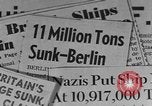
U.S. President Franklin Roosevelt states the position of the United States during World War II.
A newspaper headline: '11 Million Tons Sunk'. A United States shipyard. Workers construct a vessel at the shipyard. President Franklin Roosevelt states : 'Axis powers are not going to win this war'. A newspaper headline from World-Telegram: 'US will patrol seven seas if necessary-Roosevelt'. A man talks over a telephone. A map on a wall in the background.
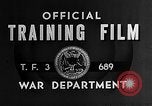
The importance of gas mask depicted through dramatization in United States.
A U.S. Army training film about gas masks. The film is titled 'Defense Against Chemical Warfare'. A soldier lies down removing his gas mask kit. His sergeant tells him not to do so. He tells him a story about a soldier named Joe. He says when the call of joining army came, many people came from different professions. Joe used to think that the training with a gas mask was a joke. Soldiers were tested in a gas chamber but Joe did not learn from that experience. They were sent to the front as advance patrol. Soldiers passed through a chemical contaminated area. The general of patrol had given maps of contaminated area to soldiers. Joe did not pay much attention to this information. During an enemy attack he got hit by gases and fell on ground. Soldiers put gas mask over his face and left him there only. He was then taken on a stretcher. Medical vans pass on road. A bomb explosion on road. Soldiers hide at sides. (World War II period).
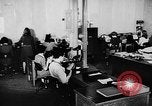
Workers and employees of the U.S. Army Signal Corps work with great care in the United States (WW2)
Film highlights many different ways that American soldiers and civilians contribute to the war effort in World War 2, including on the home front in America. A woman works at the United States Army Signal Corps office during World War II. She answers the phone. A paper containing sensitive information drops from her desk. Soldiers fighting in the Pacific Theater. A Mickey Mouse watch on the wrist of a dead soldier. A woman clerical worker puts a file in a drawer. A soldier runs and throws a grenade at Japanese positions. A screw is tightened on an equipment. A man works on a blueprint. Closeup of hands of a woman typing on a typewriter. Women writing number codes in columns on paper, and stamping documents. A man welds some equipment. A forklift lifts packets and stores. Carts with cables and machines. Cargo trucks in front of a warehouse depot. Logistics loaded on a ship. Smokestacks of a factory. Spools of cable and crates on deck of cargo ship. Cargo ship supplies logistics to different units. Soldiers board a troop transport ship on the way to the war front and they wave from the deck. A landing craft on a beach. Soldiers run on the beach. A closeup view of a German wrist watch with a Nazi swastika symbol on it. Various scenes of United States soldiers firing artillery. Signal Corps women typing, working in factories, signing documents, operates switchboards, and pulls out a file from a drawer.