


 Francais
 Deutsch
 Italiano
Refine Your Search
+"United States USA" +1944 stock footage and images
- Showing 397 to 402 of 489 results more
more Hide
Hide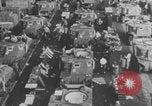
Tanks built, bulldozers, truck and Jeeps parked for transport in USA factory (WW2)
A factory where tanks and other military vehicles are manufactured during World War II. A tank track is laid out on the factory floor. Tank wheels move through tracks. Men install a gun in tank turret. Many bulldozers and trucks parked in an American port. Rows of tanks parked outside. A man drives a tracked bulldozer while parking it. United States soldiers driving hundreds of Jeeps and M3A1 Scout Cars in open fields.
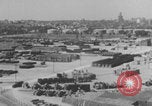
Shipment of war materiel from U.S. ports, scrap metal collection (WW2)
War materiel and construction items to be shipped to United States soldiers and Allied nations fighting during World War 2. Stacks of metal frames in port. Rolls of chain link. Men arrange stacks of rolled barbed wire. Light tanks on flatbed rail cars readied for transport. Men load fuel steel drums into train box cars. Men drive Ford GPA "amphibious jeeps" onto train platform. Jeeps, artillery and war materiel on docks. A field gun is lowered to a ship by a crane. Sign says “Iron SCRAP Steel”. A crane moves a box of scrap metal. Man shears scrap metal. A wrecking ball falls, breaking scrap metal. Men performing use cutting torches and chains inside a factory to break down scrap metal. An obsolete WWI tank is carried by a crane and lowered onto a pile of other WW1 scrapped military equipment. Man uses cutting torch to dismantle a very large artillery cannon. Junkyard magnet crane unloads two obsolete shells onto scrap metal pile.
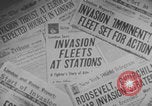
United States and British military officials convene for a high-level meeting (WW2)
Front pages of various American newspapers such as the New York World Telegram and Journal American reporting World War 2 related news with headlines such as “INVASION FLEETS AT STATIONS”, “INVASION “IMMINENT”! FLEET SET FOR ACTION” “ROOSEVELT, CHURCHILL MAP INVASION STRATEGY”, and “INVASION THRUST AT EUROPE EXPECTED HOURLY IN LONDON”. United States and United Kingdom senior military officers gather for a meeting. Two officials read a report together.

Animation depicting flight path of Japanese Fu-Go paper balloon bombs to United States (WW2)
Japanese Fu-Go paper balloon bombs bound for the West Coast, USA during World War 2. A Japanese paper bomb balloon in flight. Fu-Go balloon pass by a small island as winds take the balloon toward the United States. A paper balloon bomb descending. A deflated paper balloon bomb. Animated map depicting the flight path and mechanism of the wind velocity of Japanese Fu-Go paper balloon bombs to the West Coast of the United States.
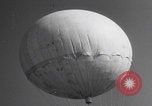
Parts of a Japanese Fu-Go paper balloon bomb (WW2)
A video explaining the components of a Japanese Fu-Go paper balloon bomb- a weapon launched by Japan to drop bombs on the United States during World War 2. A United States Navy personnel inspects the Fu-Go paper balloon on its ballast. Paper bags and sandbags tied to the ballast of the Fu-Go balloon bomb. Payload comprises of incendiaries and anti-personnel bombs. Inflated “Type B” Fu-Go balloon made of 5 ply “washi” rice paper. United States Navy personnel lets go of holding the ballast of balloon bomb. Man unfolds a piece of rice paper. Man ripping a piece of rice paper, demonstrating the durability of the material. Fu-Go bomb inflated with hydrogen gas. Man holding the escape valve of the Fu-Go balloon bomb. Escape valve is shown as made of pressed steel and has a rubber gasket. Pressure is exerted by the rubber ring the escape valve. Spider bracket of escape valve.
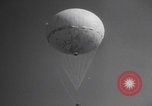
Parts of the so-called Brain Center of a Japanese Fu-Go paper balloon bomb (WW2)
A video explaining the components of the “Brain Center” of the Japanese Fu-Go paper balloon bomb- a weapon launched by Japan to drop bombs on the United States during World War 2. An inflated paper balloon bomb. A man with a pencil points to parts of the “Brain Center” of the balloon such as the electrical source (battery case), demolition block, barometer box, fused jacks, jack switches, blowout plugs, sandbags, and incendiary bombs. Man puts away his pencil. Man pulls back sandbags to show the central payload of the paper balloon bomb. Man demonstrates how ballast falls. Man demonstrates mechanism and release of the pay loads. A sandbag falls. Man attaches sandbag back to the ballast. Man shows a T-hook of the ballast. Man re-attaches a T-hook back in the ballast.