


 Francais
 Deutsch
 Italiano
Refine Your Search
+"United States USA" +1944 stock footage and images
- Showing 403 to 408 of 489 results more
more Hide
Hide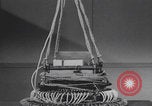
Man demonstrates the parts of the battery and aneroid of a Japanese Fu-Go paper balloon bomb (WW2)
A video explaining the components of the “Brain Center” of the Japanese Fu-Go paper balloon bomb- a weapon launched by Japan to drop bombs on the United States during World War 2. Man holds the ballast of the paper balloon bomb. Man pulls out fuse of demolition block. The plug from the battery to the barometer box is disconnected. Man lifts out the demolition box and battery box from the “Brain Center”. Man demonstrates the battery box and demolition box of the Fu-Go balloon bomb. Man takes out the demolition box. Man opens the battery case. Man takes out the middle box containing a solution of calcium chloride (acting as a thermal overcoat). Man points to a rubber plug in the middle box. Man takes out the battery of the middle box. Man reattaches the battery back to the middle box and returns the middle box to the battery box. Man puts back the lid of the battery box. The barometer (Aneroid) plate is taken out. Man demonstrates the aneroid board of the Fu-Go balloon bomb. Man takes off the lid of the main aneroid. Man points to the aneroid bellows, post, arm, clutch using a pencil. Man demonstrates two aneroid boards. Man points to aneroid before dismantling them. Man touches the contact rod of the aneroid. Man demonstrates pulling a plug on the “Brain Center” of the paper balloon bomb from Japan.
Prisoners of war join the Italian Service Units engineers in the United States (WWII)
Italian prisoners of war (POWs) volunteer for the Italian Service Units, as part of the Engineers Corps. in the United States during World War II. Italian POWs take an outdoor basic English class at a camp in North Carolina. A United States soldier serves as their teacher. Blackboard is written with “English Ciao”. A prisoner of war writes on the portable blackboard. Italian Service Units part of the U.S. Engineers Corps raise their hands. A prisoner of war volunteer salutes and shake hands with a United States Engineers Corps officer. ISUs are wearing American uniforms with the Italian Service Unit insignia (“Italy”) on brassard worn on the left sleeve and stitched onto the standard garrison cap. An Italian Service Unit volunteer uses a jackhammer to crush a block of stone. Two volunteers sawing a log. Other volunteers learn carpentry. Italian Service Units marching and stand at attention on the field inside a camp.
United States troops test new aerial and land military weapons (WWII)
The United States Army tests new weapons during World War II. United States Army Air Force bombers drop 100-pound bombs in a huge concentrated salvo over a field. Shells explode simultaneously. A medium bomber drops an aerial torpedo. Anti-personnel bombs burst in the air shortly after being dropped from a flying bomber. Fighter planes diving and dropping auxiliary gasoline tanks used as incendiaries. This is a WW2 example of napalm use. Gasoline tanks explode and burst into flames upon hitting the ground. Artillery officers fire phosphorus shells from mortars. Explosion from phosphorus shells. Soldiers testing flamethrowers on a tank. A group of soldiers use flamethrowers simultaneously, covering the screen with thick smoke and flames.
General Henry H. Arnold talks about the role of the United States Army Air Force in the Pacific theater (WW2)
General Henry H. Arnold (Hap Arnold) describes the role of the United States Army Air Force in the Pacific theater of World War II. Flags of the United States and the Army Air Force are seen behind General Arnold. General Arnold seated behind a desk with a nameplate bearing his name. A model aircraft is seen on General Arnold’s right side. “The Army Air Forces play an important part in winning the war. It is equally important to ensure our winning the peace and America remaining what it is today a leading the airpower in the world. You and every American play your part in maintaining the freedom and security which we have all fought by buying and holding bonds,” says General Arnold.
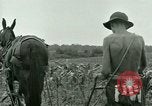
German prisoners at Prisoner of War Camp cultivate corn at a farm in Southern United States in World War 2.
Prisoner of War Camp for German prisoners in the United States during World War II. Prisoners work at camp. The prisoners cultivate corn on farm land with a horse and equipment.
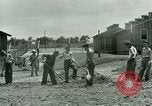
War camp prisoners fill in a road, Southern United States, during World WAr 2.
A prisoners of war camp for Nazi German prisoners being held in the United States during World War II. Prisoners work in Southern United States. The prisoners fill in road area with mud. A man with a gun keeps a check on them. Prisoners stand in a squad. Officer talks to them.