


 Francais
 Deutsch
 Italiano

Refine Your Search
+"United States USA" +1946 stock footage and images
- Showing 31 to 36 of 184 results more
 Hide
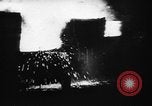
The launching and explosions of various test missiles in the United States.
A review of research and development in guided missiles by the United States Air Force from 1919 to 1948. Interior of a steel mill shows workers performing various duties around an open furnace. The exhaust section of a JB-2, flames erupting from the same. A JB-2 launching. It taxis in a wooded area. A large explosion. The exhaust section of V-2 during launching. Failed test as a V-2 rocket streaks down towards the earth after a launch and slams into a wooded area, with a huge explosion resulting. The first guided missile robot torpedo aircraft crashes at Arcadia, Florida. First successful launching of the U.S. aerial guided missile. Exhaust section of JB-2 starting operation attached to a wing of a B-17. The B-17 launching. JB-2 in flight. PQ-8 target aircraft dives towards the slope of a mountain and explodes. An atomic bomb explosion. Atomic cloud formation rises up in the air from the Trinity test, the first atomic explosion, in New Mexico.
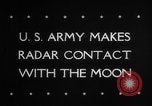
Radar for establishing contact with the moon reflects rays back on the earth from the moon in United States.
U.S. Army radar equipment used to contact the moon. Steel structure of a radar. Men work at controls. Moon in the background of the radar. Animation shows distance of moon and earth being 238000 miles. Radar beam reaches to the earth in 2.4 seconds. Radar rays go to moon and comes back to earth after reflecting. Readings of radar shows signals. Picture of the surface of the moon. Narrator says, "no longer beyond men's dreaming is the possibility of reusable airplane-like space ships to commute between the two planets (the earth and the moon)" as animation shows an aircraft space ship flying from the earth to the moon (foreshadowing the NASA Space Shuttle program).

Sports events like ice skate race, ice shoe race and men's pole vault in United States.
Sports in United States. Men's final 220 yard ice skate race and Women's 230 yard final race in Minnesota, United States. Men's final 880 yard race. Girls race in snow shoes at Lewiston, Maine. Women with ice shoes, a girl falls at the beginning of the race. Men's race and pole vault at Madison Square Garden in New York.
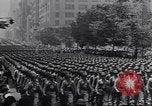
U.S. troops and WACs (Women's Army Corps) including African American soldiers parade along a street in the United States.
From a film about U.S. troops including African American soldiers who battled courageously during World War II. U.S. troops and WACs (Women's Army Corps) including African American soldiers parade along a street. An African American pilot. U.S. Army Major-General Clarence H Kells decorates Sergeant Joe Louis (famous boxer) with the Legion of Merit medal at Fort Hamilton, New York, in 1945. U.S. soldiers perform different tasks. Closing slates include a slate saying the film is not to be shown to the general public, and a second slate stating "Seized Enemy Material...under License Number LM-185"

Dr. Vannevar Bush work at his desk at American Physics Institute at 57 East 55th Street, New York City.
Carnegie institution of Washington D.C. and American Physics Institute in New York. Exteriors of Carnegie institution of Washington Headquarters. People arrive and leave the headquarters. Car arrives at the entrance of the building. Interiors of American Physics Institute at 57 East 55th Street. Reenactment shows Dr. Vannevar Bush working at his desk. He signs a few documents.
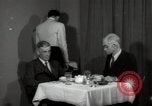
Meeting of Dr. George Pegram and Dr. Vannevar Bush in the United States concerning atomic bomb during World War II.
Reenactment shows a meeting of Head of American Physics Department George Pegram and Dr. Vannevar Bush in the United States concerning atomic bomb during World War II. Dr. Pegram and Dr. Bush talks at dinner. Pregram, just returned from Britain, reports to Bush that the Germans are working on an atomic bomb. He says that the British scientists are of the opinion that a uranium bomb is practicable but big industrial output necessary makes it imperative. Therefore work must be done in America. Bush says he is to see the President the next day, and he is confident they will get all the help they need.