


 Francais
 Deutsch
 Italiano
Refine Your Search
+"United States USA" +1961 stock footage and images
- Showing 133 to 138 of 210 results more
more Hide
Hide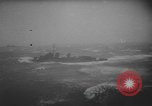
Montage of Hurricane scenes covering various places and times.
Scenes of hurricanes and related damage. A U.S. fletcher class destroyer and then two U.S. Heavy cruisers making way in very heavy seas. Huge waves blowing over a waterfront. Palm trees blowing and deciduous trees falling to hurricane winds. A man attempting to walk against hurricane force winds and rain. Hurricanes battering an airfield. Wind and water driving against a hotel, and downed wires exploding in rain filled street. A man in waist deep water. Scenes of severe flooding, including a flooded convertible car Aerial views of heavy cumulus clouds. Homes and vehicles completely inundated by flood waters. A derailed railroad train. Men combing through debris in aftermath of a hurricane. Completely destroyed homes.
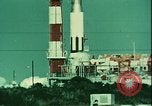
Men and women work on electronic computers for bank book keeping in the United States.
A film titled ' The second revolution in banking' on bookkeeping services and computer improved banking services in the United States. A Titan rocket is launched from a launching pad. Heavy columns of smoke rise as the rocket is launched. Narrator indicates the launching of the rocket implies electronic and technological advancements. The Titan rocket ascends in the sky. The first revolution in banking is book keeping machines during World War I. A man seated at a desk works. Several men and women seated at desks in an office. They work on book keeping machines. The machines are clumsy and use lots of papers. A man empties a sack of bundles of paper on a table. The second revolution is electronic computers. These computers can read, sort, print, process check numbers, record and store customer account information which can be retrieved in record time. The Merchandise National Bank of Chicago installs electronic computers. Men work on the computers in a computer room. Several symbols printed in magnetic ink on a check. The symbols enable the computer system to read information faster and accurately. A man works on a typewriter. He types customer information. Other men work on a machine. The machine reads the information. A reader sorter in operation. A woman at work. The information is read, sorted and interpreted.
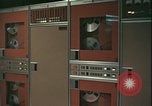
Computer room with tape units of computer systems in operation for book keeping in the United States.
A film on bookkeeping services and computer improved banking services in the United States. Computer system reads and records vital details and information. It records bank checking accounts. A tape unit in operation. The tape unit saves space in addition to operating with a high speed. A woman works on a machine. Several accounts and a detailed information can be stored on a tape. A printing machine in operation.

Parts and systems of electronic computers for bookkeeping, in an early 1960s computer room in the United States.
A film on bookkeeping services and use of early model computer technology to improve efficiency of banking services in the United States. A man seated at a desk while at work. Early model computer central processor in operation. A bank check being placed in the loading mechanism of a "reader-sorter" machine. The machine reads symbols printed in magnetic ink. The bank identification number of the check is checked. After checking the identification number, documents are read. Information contained in the magnetic symbols is checked. The documents are sorted. The information is placed on a magnetic tape. Close-up views and wider views of of computer magnetic tape and magnetic tape drive machines. Next, the information is processed and sent to a high speed printer for immediate examination. Man wearing glasses examines pages from the printer as it runs a continuous feed paper roll. Sorting of the documents. The documents are arranged in numerical order by the machine. A woman works loading magnetic tape reels on the tape drive machine. The master file containing complete data of each account is worked upon. Views of lights on the early model computer. The computer reads an identification number. Several information and transactions of the customers are added to previous transactions. Another master file is created using the information. It records the information of the customer account. Other information like that of overdrafts and closed accounts is also recorded. The customer statement is prepared. Customer information and opening balance is recorded from a tape. Information about the current balance is also recorded. A woman works on a reader sorter machine in operation. It sorts the checks. Close-up view of printer running continuous feed paper and printing transaction information. Tape unit containing complete information of all accounts is printed. View of an analog clock and a hour glass with sand in it. Narrator states that the computer will take 3 or 4 hours to complete the accounting for up to 30,000 daily deposit transactions, which would formerly take 60 man hours for the same operation. Views of the computer central processor unit (CPU) and views of the computer operator's console. A man seated at the console desk works. Three men wearing business suits, who are employees or officers of the Merchandise National Bank of Chicago, are seeing viewing blueprints and discussing.
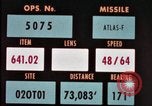
Atlas-F missile launch, view of missile in-flight after launching
Launching of an Atlas-F missile rocket in the United States. Missile launch site is stated as “02OT01”. Atlas-F missile in flight after launch. Atlas-F missile, with missile smoke trail, flies towards the sky.
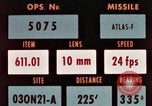
Atlas-F missile rocket launch in the United States
Atlas-F missile rocket launch in the United States, likely in Schilling Air Force Base in Kansas. Missile launch site is stated as “03ON21-A”. Atlas-F missile begins launch after crane in launch tower moved away.