


 Francais
 Deutsch
 Italiano
Refine Your Search
+"Washington DC USA" +1965 stock footage and images
- Showing 25 to 30 of 33 results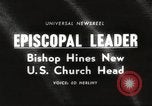
John E. Hines being acclaimed as the new presiding bishop at the Washington National Cathedral, Washington DC.
New presiding Bishop at the Washington National Cathedral, Washington DC, United States. People gather in large number to witness the ceremonies at the cathedral. John E. Hines , the new presiding bishop for the cathedral. Men recite prayer.
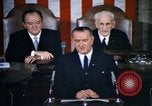
President Johnson addresses joint session of Congress and advocates equal voting rights and end of racial discrimination.
U.S. President Lyndon B. Johnson addresses a joint session of the Congress to urge the passage of new Voting Rights Act legislation in the United States. He references the Emancipation Proclamation. In his speech, a week after racial violence in Selma, Alabama, President Johnson says that this is the time for civil rights, racial equality, and justice and 'It is right in eyes of men and God'. He says that the real hero of struggle is the American African American and equality depends upon moral rights and we should respect the law and its orders. Members of the Congress applaud. He adds in his address that he wants to be the President to educate young children, to help to feed the hungry, to help poor to find their own way and to promote laws. The joint session of the Congress stands and applauds after President Johnson's speech.

U.S. Film maker and Producer Sir Alfred Joseph Hitchcock addresses the American Society of Newspaper Editors in Washington DC.
Film maker and producer Alfred Hitchcock presents tips on movies to newspaper editors in Washington DC. Newspaper editors seated at a dining table during a convention. American Film maker and producer, Sir Alfred Joseph Hitchcock addresses the American Society of Newspaper Editors. Sir Alfred Hitchcock speaks about a few secrets of film making, but makes cogent, points about the difference between his job and that of the editors. The audience of newspaper editors applaud after Sir Alfred Hitchcock's address.
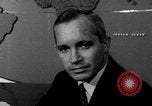
Sargent Shriver talks about goals and functions of the Peace Corps as Frank Reynolds interviews him in Washington.
Robert Sargent Shriver Jr. is interviewed by Frank Reynolds in Washington. Frank Reynolds, television journalist, interviews Robert Sargent Shriver Jr. , the Director of the Peace Corps. A world map on a wall in the background. Sargent Shriver talks about goals and functions of the Peace Corps. He talks about how to solve the problem of hunger all over the world by the Peace Corps. He answers about recruitment and educational programs conducted by the Peace Corps. Shriver is questioned about appointment of volunteers for the Peace Corps.
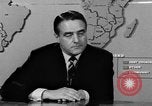
Sargent Shriver speaks about equal enthusiasm of Kennedy and Johnson for the Peace Corps during an interview in Washington.
Robert Sargent Shriver is interviewed by Frank Reynolds in Washington. Television journalist Frank Reynolds interviews Robert Sargent Shriver Jr. , Director of the Peace Corps. A world map on a wall in the background. Sargent Shriver talks about enthusiasm of former U.S. President John F. Kennedy (JK) and U.S. President Lyndon B. Johnson for the Peace Corps. Frank Reynolds questions whether the people of Vietnam can serve in the Peace Corps.
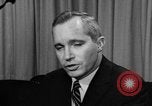
Shriver speaks about the kind of volunteers they need and experiences gained by them during an interview in Washington.
Robert Sargent Shriver is interviewed by Frank Reynolds in Washington. Television journalist Frank Reynolds interviews Robert Sargent Shriver Jr. , Director of the Peace Corps. A world map on a wall in the background. Sargent Shriver is questioned about what kind of volunteers are required. He answers that they are looking for volunteers with qualities required for the work. Frank Reynolds questions what he can offer to the volunteers. Sargent Shriver replies that the Peace Corps offers valuable courses and educational experience by sending the volunteers abroad. He says that the volunteers can learn cultures of different countries.