


 Francais
 Deutsch
 Italiano
Refine Your Search
+"Washington DC USA" +1973 stock footage and images
- Showing 43 to 48 of 125 results
Gerald R. Ford arrives at the White House after being sworn in as U.S. Vice President in the Senate in Washington DC.
Swearing in ceremony of Gerald Ford as U.S. Vice President at the U.S. Capitol building in Washington DC. New Vice President Gerald R. Ford with Speaker Carl Albert arrives at the White House. The security guards open doors for him. He pauses before entering and shows some documents and papers.
New Vice President Gerald R. Ford confers with President Richard Nixon at the Oval Office in the White House, Washington DC.
Swearing in ceremony of Gerald Ford as U.S. Vice President at the U.S. Capitol building in Washington DC. The new Vice President Gerald R. Ford confers with U.S. President Richard Nixon at the Oval Office in the White House. President Nixon reviews some documents produced by Gerald Ford. The two leaders smile together. Nixon and Ford confer sitting alone in a room. They walk out of the White House and sit in a limousine. The motorcade drives away.

U.S. President Richard Nixon's speech on the Watergate incident in Washington DC.
U.S. President Richard Nixon's speech on the Watergate scandal in Washington DC. The White House in Washington DC. President Nixon in his office. The President speaks about the charges against his administrative officials and top-aides members on their involvement in the Watergate issue. He learns that his re-election committee members were also blamed. He orders for investigation and charges are put against 7 defendants. He also receives continuous assurance regarding the non-involvement of any White House official in the issue. The President does not receive any information on the possibility of some charges being correct. He orders the investigating officers to report to him directly. He orders his officials to co-operate with the FBI (Federal Bureau of Investigation), the prosecutor and the grand jury and also to testify before Senate committee. He accepts the resignation of Haldeman and Ehrlichman. The President finds this step being essential in guarding the nation's integrity and to restore public confidence in their President. He states the appointment of new Attorney General and discusses the additional responsibility he has given to him. The President assures citizens of a fair justice.
U.S. President Richard Nixon's speech on the Watergate scandal in Washington DC.
U.S. President Richard Nixon addresses U.S. citizens on the Watergate scandal in Washington, DC. The President questions upon the occurrence of the Watergate scandal and whom should one blame. He finds 1972 as the year of crucially important decisions, of intense negotiations and of new directions in achieving goals for bringing peace to United States. He states that the Presidency stands before politics. He has limited his appearances in campaigns. He believes that the culprits must bear the liability and pay the penalty. He finds it cowardly to blame his sub-ordinates, to whom he had delegated the responsibility, for the improper actions that took place within his campaign organization. Instead he accepts all the charges as he believes that the man at the top of an organization is the one who is responsible for all. The President takes a pledge to ensure a fair justice in the Watergate scandal.
U.S. President Nixon addresses U.S. citizens on the Watergate scandal in Washington DC.
U.S. President Richard Nixon's speech on the Watergate scandal in Washington, DC. The President states that some people will find that the Watergate scandal demonstrates the bankruptcy of American political system, but this is not true. He states that the Watergate issue represents a series of illegal acts and their judgment by people, a system which will bring the guilty to justice and it includes a grand jury, honest prosecutors, courageous Judge John J. Sirica and vigorous free press. The President sates that it is essential to have faith in American judicial system and they should not be distracted to that extent where the vital works get neglected. He states that he will give his complete attention to his office duties irrespective of the case situation. The President expresses his faith in Attorney General Elliot Richardson responsibilities. He mentions about his meeting with the Chancellor of West Germany Willy Brandt which is scheduled the next day. He states that they are preparing for the Soviet American Summit meeting. He talks about the negotiation for mutual and balanced reduction of their forces in Europe in order to reduce the defense budget. U.S. and Soviet negotiators will work on limiting the nuclear arms so as to reduce the danger of nuclear wars. He states that a lot of work has to be done: to maintain peace in southeast Asia, to ensure prosperity, jobs, better life and to control inflation.
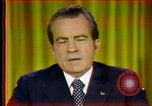
U.S. President Nixon talks about his future goals during his speech on the Watergate scandal in Washington DC.
U.S. President Richard Nixon discusses his future goals during a speech on the Watergate scandal in Washington DC. The President talks about the importance of his office, the nation, and it's people. He mentions the renewed bombing of North Vietnam. He reads his goals for the nation. They are: to make it possible for the children to live in peace, make the country a land of opportunities, to provide jobs, to establish a climate of decency, to make America a land for a person to dare and live his dreams, for all to be proud of the United States. He states that to achieve these goals they have to dedicate themselves to maintaining the integrity of the White House.