


 Francais
 Deutsch
 Italiano

Refine Your Search
-Cebu,-Philippines stock footage and images
- Showing 30049 to 30054 of 58987 results more
 Hide
Color Sound
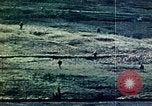
General Simon Bolivar Buckner is killed in Japanese firing during the Battle of Okinawa, Japan.
Activities of the U.S. 1st and the 6th Marine Divisions on the island of Okinawa, Japan during World War II. Marines advance towards south of Naha. Firing and bombarding in the battlefield. Soldiers fire guns from tanks and advance. Smoke arises due to bombardment. Marines fire rifles. Marines carry the dead body of General Simon Bolivar Buckner on a stretcher after he was killed in Japanese firing.

U.S. airplanes carry wounded to the medical aid stations during the Battle of Okinawa, Japan.
Activities of the U.S. 1st and the 6th Marine Divisions on the island of Okinawa, Japan during World War II. A marine waves a green flag and gives signal to a plane to take off. The plane takes off. The plane carries wounded to the medical aid station. Marines take out the wounded from the plane and take them to the field hospital on stretchers. Airplane in flight.

U.S. Marines cleaning out caves using flame thrower tanks and satchel charges during the Battle of Okinawa, Japan.
Activities of the U.S. 1st and the 6th Marine Divisions on the island of Okinawa, Japan during World War II. Marines clean out caves with flame throwers and satchel charges. Some Japanese soldiers committing suicide rather than surrendering. Planes drop fire bombs into wooded areas. Smoke arising due to the bombardment.
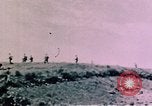
U.S. Marines fire cane fields using flame thrower tanks and grenades during the Battle of Okinawa, Japan.
Activities of the U.S. 1st and the 6th Marine Divisions on the island of Okinawa, Japan during World War II. United States Marines advance on the battlefield. Tank flame throwers and prosperous grenades being used to fire cane fields driving Japanese from cover. Japanese prisoners of war stripped to their loincloths, being marched to the stockade. United States flag flies from a pole after capturing the island of Okinawa.
Beginnings of successful powered heavier-than-air flight. Wright Brothers flights in U.S. and Europe. General Hap Arnold
History of aviation. A balloon in flight. Historic glider such as that which interested U.S. War Department as early as 1898. In 1903, a crew of men moving a Wright Flyer into position. Two men turn over propellers on a Wright Flyer, and the engine starts. View of the Wright-designed water-cooled engine. View of Orville Wright. The famous first powered flight, at Kitty Hawk, North Carolina, with Orville Wright at controls. Animation shows that 120 foot flight juxtaposed against a B-36 wing. Wilbur Wright in Europe, in 1908, gesturing as he converses with interested parties. A gallery of spectators including the President of France, King of England, King of Spain, and King of Italy. Wilbur Wright places a wheel under the right wing of a Wright Flyer and lashes it to the strut. A team of horses pulls the plane across the field. Men maneuver the plane onto a monorail on the ground. Men pull on a heavy rope to raise a weight in a tower, for a catapult. Two men spin the propellers and the Wright Brothers airplane motor starts. Wilbur Wright and his passenger, a French journalist, board the plane. The catapult weight drops, launching the aircraft which flies low over the field. U.S. President Theodore Roosevelt speaking (He is seen on a podium campaigning for the Bull Moose Party nomination at the Kansas State Fair in Hutchinson, Kansas on September 22, 1912.) War department issues specifications for a heavier-than-air craft. Reenactment of a Wright brother signing a bid contract. A Wright Flyer airborne at Fort Myer, Virginia, as the Wrights meet the Army specifications and sell, U.S. Army airplane number 1, to the War Department, in 1908. Gold Aviator wings being pinned on the uniform of a U.S. Army pilot. Photograph of Army Air Forces Chief, General Henry (Hap) Arnold, wearing his original aviator wings on his service uniform. A Glenn Curtis training airplane starting up and taking off. View of a DH-4 airplane and a Wright Flyer taking off together.
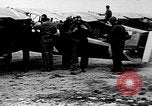
Recruiting and training American fliers for World War I. Support from President Wilson and Secretary of War, Newton Baker
In 1916,The Lafayette Escadrille, a group of American airmen who fought for France before American entry into World War I, with Indian chief's head in war paint and headdress painted on fuselage of their Nieuport aircraft. Newspaper headline reads 'United States and Germany at war'. in 1917, American civilian recruits responding to World War One: training with wooden guns, marching in uniform, and moulding practice bombs of plaster. Airmen train with real Lewis machine guns. Pilots who completed training are issued leather flying coats, helmets and goggles. Pilots make preflight checks by testing tautness of wing struts and cables. Crew takes off in a DH-4 airplane and drops practice bombs. Explosions on the ground. Pilots receive orders for advance training overseas. American troops march and drill. Supporter of airpower, Secretary of War, Newton Baker, speaking on podium, with General John J. Pershing sitting behind him. President Woodrow Wilson, another aviation supporter, signs a document at his desk. Red Cross women distribute refreshments to American troops as they deploy overseas. View of the Ocean Liner, SS Leviathan, converted to a troop ship, and camouflaged. American soldiers seen in French village square. View of Army barracks and muddy streets. Outdoor gunnery practice, using model airplanes. Experienced pilots demonstrating control stick techniques. Pilots taking off, in flight, and landing in Sopwith Camel airplanes. A nosed-over Sopwith Camel airplane with pilot unhurt, in cockpit.
CRITICALPAST.COM: About Us | Contact Us | FAQs - How to Order | License Agreement | My Account | My Lightboxes | Shopping Cart | Advanced Search | Featured Collections | Website Terms & Conditions | Privacy Policy ©2026 CriticalPast LLC.
License Agreement |
Terms & Conditions |
Privacy Policy
©2026 CriticalPast LLC.