


 Francais
 Deutsch
 Italiano
Refine Your Search
1941 hong kong stock footage and images
- Showing 277 to 282 of 1627 results more
more Hide
Hide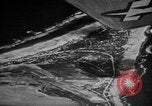
Flag raising ceremonies after surrender of Japanese garrison on Wake Island, Pacific Ocean.
Surrender of Japanese Imperial forces leads to end of World War II. Wake Island on map. Formal Surrender of Japanese garrison on island. Marine officers at Wake Island. Flag raising ceremonies and wreckage of planes on islands. Officers present include USMC General Sanderson, Commander Cross, Commander Masek, Lieutenant Colonel Roberson, and Commander Walter Bayler (who had been the last American to leave Wake Island before its takeover by Japanese forces in December 1941).
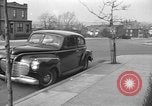
Former American soldier and his English wife greeted by his mother upon arrival of his wife and child, from England
A 1941 Chrysler Plymouth car arrives at curb and former U.S. soldier opens door for his British wife and their child. They go up steps to his home, where his mother warmly greets her new daughter-in-law and baby. View inside home where the couple and baby sit with mother-in-law and family dog. The couple play with their baby boy, and they kiss.
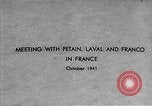
Adolf Hitler meets French leader Philippe Petain and Spanish General Francisco Franco in France
Adolf Hitler in a meeting with Philippe Petain in Montoire, and then with Francisco Franco in Hendaye France. Soldiers stand in lines. Philippe Petain gets out of a car in Montoire-sur-le-Loir. Pierre Laval beside him. Petain exchanging salutes with German officers. Cameramen take photographs. Petain shakes hands with Adolf Hitler. Scene changes to Adolf Hitler and Hermann Goering relaxing and laughing as they ride in Hitler's train car. A sign reads Hendaye, the train's next stop. A bridge in view. A train arrives. 'Espana' written on train. A crowd gathered at the station. Adolf Hitler stands at the station and greets Francisco Franco. Both men walk on the station. Nazi flags hung. They board Hitler's train and pull dark curtain down over window of the meeting room on the train. (Opening slate states 1941, but that is incorrect. This event was October 24, 1940). (World War II period).
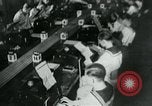
Mine warfare conducted by the German Navy's Northern Fleet during World War II.
Group of German Navy sailors in the communications center of the German headquarters of the Kriegsmarine Northern fleet, work at numerous teletype stations. Next, the Admiral (Generaladmiral) in command, Rolf Carls, is seen pouring over nautical charts and maps and discussing them with officers of his staff. Scene shifts to naval armory where marine mines are being prepared for deployment. They move through the processing lines and then transported by railroad train cars. At a port, a crane lifts a mine, on a wheeled dolly onto the minelayer ship, "Tannenberg," where crew members roll it along the deck. Sailors write on it with white chalk. The Tannenberg seen underway, and then with sailors rolling mines (on their dollys) off the stern of the ship in the Baltic Sea. Sailors moving mines along the deck to the stern for launching. View from another ship of the mines dropping from astern the Tannenberg. Next, officers on deck in cold weather gear, look through binoculars as they sight threat from Soviet aircraft. Interior of the ship as sailors manipulate controls for an anti-aircraft gun. The ship's gun and a machine gun being fired. Soviet bombers seen very high overhead. Camera pans about the deck showing sailors firing at aircraft. Something raises a plume of water astern (a near-miss?). Next, several German patrol boats are seen moving at high speed. Sailor on a speeding patrol boat, stands precariously atop it as he signals with semaphore flags. From a patrol boat, bombs (or mines) are seen exploding behind in its wake. (Note: The Tannenberg was a passenger and ferry built in 1935. On 2 September 1939 the German Navy had her converted to a minelayer. In August 1940 she served as flagship of the minelaying ships, in the North Fleet. She was sunk on 9 July, 1941, off Sweden.)

Funeral, in World War II, for German Major General Adelbert Schulz, Commander of the 7th Panzer Division.
Funeral in Germany for German Generalmajor (Major General) Adelbert Schulz killed in action on January 28, 1944 during World War 2, after taking Command of the 7th Panzer Division, only a month earlier. A brass band can be heard playing the mournful strains of the song, "Ich hat ein Kameraden. Front and rear views of soldiers dressed in black, accompanying a German Panzer III tank, bearing the flag-covered coffin of the diseased. Glimpse of German Field Marshal Erich Von Manstein, saluting with his baton, as pall bearers approach carrying the flag-covered coffin. Brief view of the military brass band playing the funeral music. The coffin resting beside the open grave. Contingent of 7th Panzer Division troops assembled behind the grave. View from rear of Marshal von Manstein and two other officers with bared heads in respect. Soldiers standing in front of the tank. Closeup of some soldiers. Field Marshal Von Manstein salutes with his baton and then with help of a soldier, places a large wreath by the open grave. Banner on wreath includes words "Pz. Rgt. Rothenburg", short for Panzerregiment Rothenburg or Panzer Regiment Rothenburg. (That was the nickname of the 25th Panzer Regiment, part of the 7th Panzer Division, in honor of General Karl Rothenburg, who commanded it until he was killed in 1941.) A large honor guard fires three volleys from their rifles. Film ends with Closeup of General Shultz's military decorations

A U.S. Government background study film about the culture and behavior of Japanese society
Opening slate recounts that the First American Consul to Japan was received on December 7th 1857, and Japanese forces attacked Pearl Harbor on December 7th, 1941 during World War 2. After the slate, Japanese are seen depicted in prints by famous 18th and 19th century artists: Katsushika Hokusai; Utagawa Kunimasu; and Ando Hiroshige. Next are various views of Japanese Type 97 Chi-Ha tanks. An industrial site with numerous smoke stacks spewing clouds of effluents. Momentary glimpse of a Japanese Torii Gate. Crucible of molten steel being emptied. Machine shop powered by driving belts. Closeups of various machine tools in operation. Closeups of Japanese industrial workers. A line of Type 95, 75 mm Japanese field guns produced in Japanese factories. Japanese women engaged in home industries making parts for factories. A Japanese artisans working in pottery, porcelain and metal. Various views of densely populated Japanese city with trolley cars; automobiles; and pedestrians (most in Western style clothing, but some women in kimonos). City buildings of modern design. Men leaving their shoes at the doorway as they enter a house. A woman helps a man don a lounging gown upon arriving home from work. Japanese children in the courtyard of their urban school, performing exercises and calisthenics. Three children walking home from school. A family in traditional Japanese attire, having dinner at home. A steam locomotive pulls a train through rural area of Japan. View from above, of farmers working in terraced area. Closeup of farmer guiding a plow being pulled by oxen. Women sowing seed in a rice paddy. Farmers planting seedlings, and hoeing, threshing, and harvesting crops by hand. Harvested crop being placed on outdoor rack to dry. Exterior of farmhouse with thatched roof. View of family inside, preparing dinner and later sitting around a covered charcoal brazier, to keep warm. The woman of the house turns on a single electric light and the man turns on a radio having an external speaker horn. Two Japanese sumo wrestlers in a ring at an arena. Views of Sumo wrestler going through preliminary movements, followed by two wrestlers battling in the ring. Japanese Jujitsu master demonstrates skill by throwing assistants in a demonstration. Two Japanese men demonstrate kendo dueling before an audience of students in a training facility. (They do not wear protective attire.) A horse race taking place at a large track with many spectators in the viewing stands. A Japanese golfer hitting a ball out of a sand trap. Glimpse of tennis players. Japanese baseball teams march into a stadium and play the game before a crowd of spectators. Japanese office displaying poster for the Marx Brothers movie "Duck Soup." Several Japanese at a home party party with saxophonist playing 1928 American song, "Sweet Sue, Just You." The group joins in singing the song. Patrons in Western style attire dancing in a night club to music of a modern orchestra. Customer smoking cigarette and sampling an American cocktail and a small cup of saki as jazz is being played in the background. A woman dressed as a Geisha plays a shamisen.