


 Francais
 Deutsch
 Italiano
Refine Your Search
1941 hong kong stock footage and images
- Showing 307 to 312 of 1627 results more
more Hide
Hide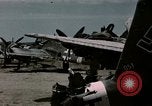
GIs inspect bomb wrecked German and Italian aircraft at El Aouina Airport in Tunis, Tunisia during World War II.
Bomb wreckage at El Aouina Airport in Tunis, Tunisia during World War II. Wrecked German and Italian aircraft on the airport. Destroyed fuel drums. The wreckage of German and Italian aircraft on the airfield. Swastika sign on the tail of the German aircraft. Parts of aircraft on the airfield. Damaged fuselage of an aircraft. A wrecked German aircraft against a retaining wall. Damaged parts of the retaining wall. A wrecked German fighter aircraft. Aircraft parts spread on the airfield. A wrecked French bomber Bloch MB.174 aircraft on the airfield. Name on the side of the Bloch 174 appears to be "Ltt LEFORT" (who was killed September 19, 1941 in Blida). The skeleton of a wrecked German Messerschmitt Me 323 Gigant ("Giant") transport aircraft. U.S. soldiers beside the wrecked aircraft. The wreckage of aircraft strewn on the airfield. A few soldiers inspecting the wreckage. A soldier seated on the wrecked Gigant transport. Soldiers walking among the aircraft wreckage.
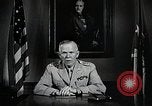
Chief of Staff George Marshall encourages war effort and outlines plan to defeat Japan late in World War 2
U.S. Army Chief of Staff George Marshall narrates film and is shown several times speaking seated at a desk. Marshall praises the Pacific Forces. Close up view of several U.S. military officers including General MacArthur (with a bandage over his right ear). Scene of U.S. Marines in combat on a Pacific Island during World War 2. U.S. marines advancing under fire. An enemy soldier is fallen in the distance, followed by a group of Japanese soldiers running for cover. Gun camera footage of a strafing attack by a U.S. aircraft on a Japanese ship, followed by strafing of parked Japanese airplanes at an airfield. Mid air dogfight scene is shown as a U.S. warplane hits and downs a Japanese aircraft. View on deck of a U.S. Navy aircraft carrier ship as a Japanese kamikaze aircraft bears down toward the ship, is hit by ship's guns, loses a wing, and, in flames, crashes into the ocean just off the ship. Scenes at Pearl Harbor after the Japanese attack in 1941, as medics care for wounded U.S. sailors in stretchers. Japanese soldiers seizing control in Bataan, with U.S. soldiers holding their hands up in surrender. Also U.S. soldiers in Corregidor standing by as they are addressed by Japanese captors. Scenes of Japanese soldiers in drills and training. Japanese Emperor Hirohito on horse back during a military parade. Scenes of dead Japanese soldiers laying on battle fields after battle. View of industrial smoke stacks of a factory in Japan. Japanese workers producing steel and munitions for war effort. Japanese soldiers cheering at a military rally. George Marshall speaks urging commitment by every American citizen in the war effort. Caricature image of Axis leaders Hitler and Mussolini with "X" marks over them, beside a non-marked image of Japanese General Hideki Tojo. Clip closes with several scenes of American flags being raised on flagpoles of military bases all over the world, as soldiers, sailors, marines, women WACS soldiers, and airmen salute the American flag.
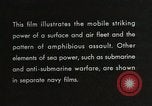
2nd Sino-Japanese war, precursor to World War II in the Pacific. Pearl Harbor attack. Early phase of Pacific conflict between Japan and the U.S.
The film 'Sea power in the Pacific' showing Japanese dominance in China and at start of World War 2. Then it chronicles U.S. efforts to build Navy and fight back on sea and in the air. Opening scene shows Japanese Mitsubishi G3M (Type 96) bombers high overhead, and then closeup in formation. View from bomber of bomb bays open with bombs falling and view from ground of explosions and destruction. Overlay on film says: "China---1931." (This is not correct. The G3M bomber was not yet in service.) This film depicts Japanese attacks during second Sino-Japanese War, commencing 1937, Chinese civilians running to escape Japanese bombing of Singapore. Buildings destroyed and on fire. Next, Japanese troops, carrying the Rising Sun flag, are seen establishing a beachhead in an Amphibious assault. More scenes of Japanese infantry advancing through Singapore, ad it is being destroyed and burned. Soldiers charging along an alleyway, with pagoda in background. Next, Japanese soldiers are seen attacking Nanking, and committing atrocities and killing Chinese during the so-called "Rape of Nanking," in December, 1937. Chinese civilians being summarily shot and dumped into a large open grave after execution. Two Chinese prisoners with hands bound, being executed by rifle fire. Jubilant Japanese troops celebrating their victory. Map shows areas of China occupied during second Sino-Japanese war and the East Indies to the South. View of oil tanks; an open pit tin mine; a native cutting rubber tree bark to collect latex. Flags on map show regions of English, French, and Dutch colonial interest. It also shows Islands to the East, fortified by the Japanese. Cartoon shows Japanese soldier opposed by and American sailor (representing U.S. Sea Power). Next, famous images of the Japanese attack on Pearl Harbor, Hawaii, December 7, 1941, are shown, including the USS Arizona burning and sinking. Hawaii, Midway, Wake, and the Philippines Islands, are highlighted on a map and Japanese control of the Pacific is illustrated. Japanese soldiers are seen displaying a captured American flag. U.S. Lieutenant General Jonathan M. Wainwright is seen surrendering the garrison at Corregidor, on May 6, 1942. View of Japanese General Masahara Homma discussing surrender terms with Wainright. Map shows interlocking web of Japanese fortified bases in Pacific and need for seapower to oppose it. View of American shipyard with hundreds of workers, employed to build ships for the war effort, in World War 2. Views welding, metal fabrication, and other shipbuilding activity. A new ship going down the ways and a woman christening a new ship with splash from bottle of champagne. A new "Liberty Ship," the Richard Bassett, going down the ways at Bethlehem-Fairfield Shipyard Inc. Baltimore, Maryland. Closeup view as the stern of another ship enters the water upon launching. View of it from a distance. Shipyard workers knock supports from under what may be a landing craft, as it is launched. Japanese warships underway in the Pacific and firing their naval guns. Explosions on a shoreline from naval bombardment. Japanese infantry wading ashore during an amphibious assault. Map shows where Japanese forces attempt an amphibious assault on Southern New Guinea, thwarted by the U.S. Navy in the battle of the Coral Sea of May, 1942. In June, 1942, a Japanese attempt against Midway Island, was again checked by the U.S. Navy in the Battle of Midway. View of USS Wasp (CV-7) carrier deck filled with airplanes, including Grumman F4F Wildcats. A Douglas SBD Dauntless dive bomber being cleared for takeoff from the Wasp. Gun camera film showing Japanese airplanes being shot down by pursuing U.S. aircraft.
Franklin Delano Roosevelt retrospective - FDR with Winston Churchill, Chiang Kai-shek and Joseph Stalin at different events in different continents.
Life of the President of the United States Franklin Delano Roosevelt in the United States. U.S. President Franklin D Roosevelt is greeted by British Prime Minister Winston Churchill aboard HMS Prince of Wales during the Atlantic Conference for signing of the Atlantic Charter off Newfoundland in 1941. The ship approaches the harbor. Soldiers present arms aboard a ship. Prime Minister Churchill and President Franklin D Roosevelt talk. President Franklin Roosevelt addresses U.S. Congress with declaration of war after the Pearl Harbor attack by Japan in World War 2. The President signs a document. President Roosevelt reviews troops in Casablanca. The troops march. Franklin Roosevelt salutes troops. Vehicles driven in the foreground. Cairo: Franklin D Roosevelt and Winston Churchill with the Chairman of the Nationalist Government of China Chiang Kai-shek. Tehran : Franklin D Roosevelt, Winston Churchill and General Secretary of the Communist Party of the Soviet Union Joseph Stalin pose. United States: The exteriors of the White House. People enter White House. President Franklin Roosevelt with Vice President Harry S. Truman at the 1945 inaugural ceremony. Yalta : President Franklin D Roosevelt, Winston Churchill and Joseph Stalin pose. Franklin D Roosevelt addresses a conference. (World War II period).
Workers manufacture ammunition in a factory and U.S. Army soldiers advance towards a battlefield in the European Theater.
Use and manufacture of artillery during World War II. German Chancellor Adolf Hitler giving Nazi salute and German troops marching. A newspaper headline reads 'Poland Invaded'. Japanese zero aircraft in flight and bomb strikes on U.S. Navy ships at Pearl Harbor. Scenes from water of the devastation in Pearl Harbor after attack by Japanese aircraft on U.S. Navy ships. A flight of U.S. Navy Douglas TBD torpedo bombers dropping torpedoes. U.S. President Franklin Delano Roosevelt seated at a desk signing declaration of war, in 1941. U.S. war production workers manufacturing tanks, guns, ammunition, artillery, shells, and jeeps in arms and munitions factories. War materiel including Army jeeps and tanks loaded with soldiers on parade. U.S. troops firing artillery in North Africa. U.S. forces advancing through wet jungles in the Pacific Theater of World War 2.
Soviet forces launch major offensive from Stalingrad, against German forces during World War II
At film start, the city of Munich is seen decked out in swastika flags to welcome Italian dictator, Benito Mussolini, during his visit to Germany in 1941. Adolf Hitler and Benito Mussolini stand in an open automobile as it drives followed by other motorcade cars through the streets of Munich. Enthusiastic crowds line the sidewalks and cheer the axis leaders. They wave and render the Nazi salute. Scene shifts to views of Stalingrad during World War 2, from camera panning along the Volga River. Smoke is rising from several places. Destroyed and burning German Marder III Panzerjaegers (tank destroyers) are seen and heavy smoke rising behind a wrecked railroad marshaling yard. Destroyed German 7.5 cm Pak 40 artillery guns and other pieces of German artillery sitting in snow. View from boat (unseen) in the Volga river of fires burning in shore facilities and smoke clouds covering the sky. Dense black smoke rising behind apartment buildings near the shore. River is identified as the Volga (in Russian). Here begins views of advancing Soviet troops superimposed over a succession of roads and rivers marking their advance. The first river seen is the Don. The Dnieper is another. The superimposed Soviet forces advancing include cavalry, troops rowing boats and moving artillery field pieces. Tanks move approaching the Dvina river. Forces passing the Neman river. Film ends as Soviet advance reaches the Oder river.