


 Francais
 Deutsch
 Italiano
Refine Your Search
2nd-Rangers-D-Day stock footage and images
- Showing 859 to 864 of 13613 results more
more Hide
Hide
British forces advance through the area of Oisterwijk and Moergestel, on the way to Hertogenbosch, Netherlands, in WW II
Map of the Netherlands with town of Hertogenbosch highlighted. Infantry move through the town of Oisterwijk, Netherlands, transported in "Kangaroo" armored personnel carriers of the 1st Canadian Armored Carrier Regiment. They are followed by armored vehicles of Squadron B,15th (Scottish) Reconnaissance Regiment. 15th (Scottish) Infantry Division Commander, Major General Sir Collin Muir (Tiny) Barber consults with two of his commanders at a river crossing in Moergestel (He is good-naturedly called "Tiny" because he is the tallest officer in the British Army. One of the officers with him may be Major Gordon or Major Mills.) British troops set up a battery of artillery and fire at German positions. British troops cross a canal in boats, while Churchill tanks and bren guns provide supporting fire. Soldiers climb the canal bank and proceed toward town of Boxtel. Several columns of the British 2nd Army proceed towards Hertogenbosch. A British Sherman tank firing. Buildings on fire due to bombardment. British forces employ a flame-throwing (Crocodile) Churchill tank. Members of the 15th (Scottish) Reconnaissance Regiment rescue civilians trapped in an air raid shelter. Fire and smoke rises. British tanks enter the town of Hertogenbosch. Liberated citizens come from hiding after the battle. (World War II period).
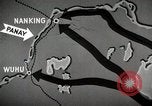
Battle of Nanking in China during second Sino-Japanese war
Japanese forces attack city of Nanking in 2nd Sino-Japanese war. Animated map shows Japanese forces moving from Shanghai towards Nanking. Arrow points to the American gunboat, USS Panay, in the Yangtze River. View of the USS Panay in the river, with large American flag displayed on its covering. A Japanese Navy Nakajima E8N reconnaissance plane in flight overhead. Explosions on shore of river as viewed from the USS Panay. Sailors firing anti-aircraft gun from the Panay. Wounded and dead U.S. sailors being evacuated from the gunboat as it sinks from bombing. The evacuation launch pulling away from the Panay. View of the Panay sinking by the stern in the Yangtze. Scene shifts to Chinese troops entrenched in defenses of Nanking. Chinese troops running to defensive positions from their fort. View from above of Japanese artillery crews firing field pieces. View from Japanese lines of shells striking Chinese fortifications on hill in distance. Closeups of Chinese infantry defending from wooded area in hills. Closeup of Japanese soldiers firing 75mm field artillery pieces and infantry advancing as their bugler sounds charge on his horn. View from fortress wall as Chinese army defenders stand ready to meet the charge. Japanese gunners firing 75mm field gun (Model 94). Japanese infantry breaching Chinese defenses and using scaling ladders to climb them. Japanese infantry charging toward the camera. They break open an entrance gate to the Chinese fortress and charge inside. Carrying Rising Sun flag, the Japanese infantry begin attacks within the Nanking city proper. some huddle behind a 75mm gun firing down a street. City buildings falling to shellfire. Infantry running through the city. Dense smoke rising from shelling. Japanese infantry running down an alley, with Pagoda in background. Field piece firing point blank at a building. Fires burning. Japanese troops celebrating victory as the city falls to them.
China builds Burma Road to carry war materiel and supplies and creates flood of Yellow River to thwart Westward expansion of Japanese occupied territory
Japanese officials meeting in strategy session. Japanese infantry on mission to cut Chinese supply lines during 2nd Sino-Japanese war. Black smoke rises as they move along a river bank. Chinese prisoner-workers are forced to rebuild railroads destroyed by the Chinese people during their great Westward trek. Japanese soldier closely guards workers. A Japanese army armored train underway on the rebuilt railroad, as Japanese soldiers cheer. Animated map shows China's supply lines by sea, to Tsingtao, Hangchow, and Amoy, cut off by Japanese naval blockade. Japanese Navy launch with officers and crew moving near commercial ships as they take over Chinese river ports. War materiel and other supplies destined for China, including trucks, sit idle, unable to be transported to their destinations. Large oil tanks and drums of gasoline are shown, as well as gun barrels and a flightline filled with parked Curtiss P-36 Hawk aircraft. The Imperial Japanese Navy destroyer Asakaze (DD-3) and another, next to it, in a Chinese river port. A Japanese freighter with anchored weighed, secured by long lines to a wharf. Small boats flying Japanese Naval ensigns are next to it. View of map showing china, Burma, Indo-China, and Chungking, with Japanese blockading fleet stationed in the South China Sea. It traces path of narrow gauge rail line from Indo-china to Kumming,China, where it connected to an overland road to Chungking. Next it traced the old Camel Caravan route, across China, from Russia. Narrator notes these were to small to be useful and too close to Japanese-occupied territory. Next, the map traces a railroad that from the port of Rangoon to Lashio, Burma. It is separated from the road to Chungking, by mountains and gorges. Views of the actual mountainous terrain. Animal pack trains moving through the area. Construction engineers in a large drafting room designing a road to transit the area. View of modern road-building caterpillar tractor equipment of the type needed to accomplish this. View of Chinese laborers using manpower instead. They push large rollers and employ pickaxes and other hand-held tools to carve away and dig road beds. Masses of Chinese laborers at work, carving a road along the edge of a mountain. Two-men teams using manual tampers to pound down the roadbed. Children are employed along with adults. A woman with a baby on her back, pounding large rocks into gravel, surrounded by other children doing the same. View from above of the "Burma Road," the product of their labors, winding its way through the mountains and gorges. Many scenes of trucks moving along portions of the Burma Road. P-40 airplanes flying past white cumulus clouds, overhead. Animated map shows continued expansion of Japanese occupied areas to encompass two thirds of the rail lines in China with goal of controlling the remainder, starting at Chengchow, in Summer, 1938. View of Chengchow region, on banks of the Yellow River. Map illustrates flow pattern of the Yellow River. View from past of the Yellow River's Spring floods toward the Sea, with Chinese people throwing rocks onto dikes that keep the river flowing in a more Northerly direction than its former course. Illustration shows how with Japanese encrouching on Chengchow, the Chinese decided to destroy those dikes and allow the river to flood over its former more Southerly course. Japanese soldiers being inundated by the flooding river. Japanese infantry and tanks regrouping on their occupied side of the new (old) path of the Yellow River. Local Chinese residents of Chengchow, wade with belongings as they leave their flooded homes.

Japanese-American recruits get training of rifles, hand grenade and artillery at Camp Shelby, Mississippi in United States.
Japanese-American recruits at Camp Shelby, Hattiesburg, Mississippi, United States. Japanese-American soldiers march with rifles. Soldiers exercise in field and an instructor demonstrates steps to them. Guard stand past Headquarters Company 2nd Infantry Combat Team. Combat team boys stand in line. Boys from relocation center (internment camp) are the volunteers. Hawaiian boys go for broke in training. Soldiers march and get training with rifles. They get training to throw hand grenade and use gas mask. Crew of 37 mm gun gets training. (World War II period).
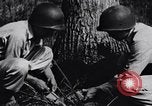
Japanese-American engineers get train for tying TNT to a tree and blow it down at Camp Shelby, Mississippi in United States.
U.S. Army Japanese-American soldier recruits at Camp Shelby, Hattiesburg, Mississippi, United States. Company 2nd Infantry Combat Team. Combat team engineers get training of blowing a tree down by the use of TNT to stop enemies' tanks. Engineers tie a belt around tree's trunk, straighten the wire and blow the tree under the instruction of Nisei engineer Sergeant. Combat team watches the blow from a distance (World War II period).
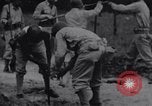
Japanese-American soldiers get trained to hide dynamite on a road and blow it at Camp Shelby, Mississippi in United States.
Japanese-American recruits at Camp Shelby, Hattiesburg, Mississippi, United States. Company 2nd Infantry Combat Team. Combat team digs the road enemy may use and hide dynamite into it. A soldier throws a stone over the road from distance while others watch. The road blows. A soldier climbs down the exploded area and other soldiers watch him. (World War II period).
CRITICALPAST.COM: About Us | Contact Us | FAQs - How to Order | License Agreement | My Account | My Lightboxes | Shopping Cart | Advanced Search | Featured Collections | Website Terms & Conditions | Privacy Policy ©2026 CriticalPast LLC.
License Agreement |
Terms & Conditions |
Privacy Policy
©2026 CriticalPast LLC.