


 Francais
 Deutsch
 Italiano
Refine Your Search
Adak Alaska USA 1943 stock footage and images
- Showing 11851 to 11856 of 27381 results more
more Hide
Hide
An army airplane lays a smoke screen over water in the United States.
Development of air power. An army airplane in flight in the United States. Aerial view of a ship underway at sea. The early model aircraft lays a smoke screen over the water.

U.S. airship Los Angeles in flight and being moored to a mooring mast in the United States.
Development of air power. U.S. Navy airship USS Los Angeles in flight in the United States. The airship is taken out of a hangar and to an airfield. The airship takes off and in flight overhead. It is being pulled down to the ground by cables. The airship is attached to its mooring mast with its elevator in the mooring mast going up and down.
Airship USS Los Angeles is moored to USS Potoka underway at sea in the United States.
Development of air power. Mooring of U.S. Navy airship USS Los Angeles in the United States. The airship comes in and is moored to USS Potoka out on the water. The ship underway at sea. Interior of a helium producing plant at Fort Worth in Texas.
Bombs are dropped by aircraft on USS Alabama during bombing tests in the United States.
Development of air power. Bombing tests on USS Alabama in September 1921 in the United States. USS Alabama anchored in water. A soldier arms and works on fuse mechanism of a large bomb swung underneath a large bomber. A standard-Handley Page 0/400 bomber in flight to the right over water. A United States Army Air Corps Dayton Wright DH-4 aircraft in flight to the left dropping a bomb. The bomb explodes on the ship. A phosphorus bomb explodes on the ship and engulfs the entire ship in smoke. The ship explodes. Part of the superstructure topples off into the water. The ship lists over a side with one of the towers bent over and lying in the water.
A large crowd gathers to watch air races held in Dayton, Ohio.
Development of air power. The National Aeronautics Association (NAA) annual races in Dayton, Ohio. A small aircraft flying at high speed around pylons at an air show. A large crowd in the grandstands to watch the races.
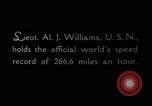
A Curtiss R2C-1 racer flies over and lands on an airfield in the United States.
Development of air power. U.S. Navy Lieutenant Al J. Williams in the United States. He holds the official world speed record at 266.6 miles an hour. A United States Navy Curtiss R2C-1 racer parked on an airfield. Lt. Williams in the cockpit of the aircraft. U.S. Navy Rear Admiral W. A. Moffett shakes hands with Lt. Williams. Cameramen and officials in the background. The Curtiss R2C-1 racer flies past and overhead around a pylon. The aircraft comes in for a landing.
CRITICALPAST.COM: About Us | Contact Us | FAQs - How to Order | License Agreement | My Account | My Lightboxes | Shopping Cart | Advanced Search | Featured Collections | Website Terms & Conditions | Privacy Policy ©2026 CriticalPast LLC.
License Agreement |
Terms & Conditions |
Privacy Policy
©2026 CriticalPast LLC.