


 Francais
 Deutsch
 Italiano
Refine Your Search
Adak Alaska USA 1943 stock footage and images
- Showing 469 to 474 of 27381 results more
more Hide
Hide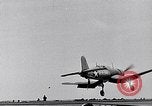
A Chance Vought F4U Corsair of Navy Squadron VF-17 noses over during landing on USS Bunker Hill during World War II
An F4U Corsair airplane of U.S. Navy Squadron VF-17 is seen in slow motion as it attempts to land on the flight deck of the USS Bunker Hill (CV-17) during its shakedown cruise in 1943. The aircraft displays 17-F-28, on its fuselage. The pilot rounds out high, bounces, apparently missing restraining cables, and ends up nosing over into tail-high vertical position, falling slightly toward its right wing. It settles in about a 70 degree tail high position, as sailors run toward the aircraft as they respond to the emergency.
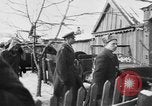
German 6th Army surrenders to Soviet forces at battle of Stalingrad in World War II
German Field Marshal Friedrich Paulus, enters a wooden building near Stalingrad where he surrenders the German 6th Army. He, and Arthur Schmidt, General-lieutenant, Chief of the 6th Army Staff; take seats,surrounded by Soviet Army officers. Scene shifts to the twenty two Divisions (300 thousand men) of the 6th Army trudging through the snow as they surrender. Most of them are seen in open fields near Stalingrad, Russia. Closeups of some make their way along a street in the city. Many wear makeshift shoes and other contrived clothing. They are clearly suffering from their lack of any cold weather equipment. Aerial view of a long line of surrendering German soldiers making their way on snow-covered street in Leningrad. Closeups of some of the German soldiers. One soldier walking slowly, alone, across a stretch of snow. He wears woven homemade coverings over his feet.He heads, alone, toward an open stretch of barren snowy land. Camera focuses on ice strewn Volga River. A dead German soldier lies on its bank. View of Russian countryside, the following Spring. An animated map depicts the extent of the Soviet advance in the previous winter with the occupation of 185 thousand square miles of territory (more than previously occupied by the German forces). Film shows weapons captured during the 6th Army surrender, including German aircraft, tanks, heavy artillery guns, light machine guns, rifles, artillery shells and small arms ammunition. Glimpse of dead German soldiers in the snow. Aerial view of rail cars containing captured German military supplies. Lines of surrendering German soldiers making their way in the snow. Numerous dead German soldiers in body bags, in the snow. Animated film reviews the German operation Barbarossa and subsequent events in the German invasion of Soviet Russian in 1941, 1942, and 1943. Glimpses of Russian troops dressed in white and British troops advancing. Film concludes with artistic representation of United Nations flags and troops marching to victory.
Operation of United States Coast Guard in Tarawa, Pacific Theater during World War II
Overseas activities of United States Coast Guard in World War II. November 20, 1943, U.S. Marine Corps invade Tarawa Atoll. Naval warships bombard Tarawa. Transport ship USS Arthur Middleton underway. Only 1 out of 5 U.S. troops reach the beach in first wave of attack. Firing and explosion. U.S. troops wade. Many U.S. Marines injured during the landing on Tarawa. The U.S. Coast Guard brings back the wounded to the transport ship. Wounded soldiers lifted on stretchers.
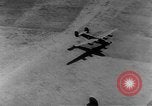
Highlights in career of U.S. Air Force General Hap Arnold. Final phase of air war in Europe, World War II.
Scenes of the August 2nd, 1943 Operation Tidal Wave low-level bombing raid on Ploiesti or Ploesti oil facilities, in Romania, by U.S. Air Force B-24s. B-17s dropping bombs. B-17s escorted by P-47 fighters. War plants in the U.S. building B-29 bombers. U.S. B-17s over Europe, escorted by P-38 Lightning fighters. Allied air superiority established over Europe.
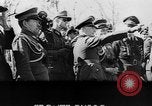
Japanese and Turkish military missions tour Eastern Front at German invitation, in World War II
Opening scene shows German Field Marshal Wilhelm Keitel gesturing as he hosts members of a Japanese military mission and a Turkish military delegation (headed by Colonel General Cemil Cahit Toydemir). At Adolf Hitler's invitation, they are on a tour of the Eastern front and English channel coasts between June 25th and July 7th, 1943, during World War 2. Here, they are seen inspecting German positions and witnessing firepower demonstration on the Russian Front near Kharkov (also Kharkiv) just south of Kursk. They observe a German artillery gun crew as they demonstrate rapid firing of their field piece. Shells explode raising black smoke. Closeup of a senior Japanese military official. Turkish and Japanese delegation visitors board two small open train cars driven by German soldiers on motorcycles adapted for the purpose. Following a pause, the scene shifts to the visiting officers inspecting German armor, including a small armored personnel carrier; a Tiger Tank of Pz.Abt.503; and other armored vehicles. They watch a Tiger tank moving along a muddy berm rotating its turret and 88mm gun as it moves. Another tank races past the camera at high speed, raising clouds of dust. A German gun crew, in a trench, fires an MG 42 heavy machine gun. They look up and camera focuses on formations of German JU 87 Stuka dive bombers flying overhead. Visiting officer peers through a periscopic viewing device, as Large explosion occurs in the field. German, Japanese, and Turkish officers converse as a huge plume of smoke rises in the background, capturing their attention.
The Seabees construct an airstrip at Munda Point in the Solomon Islands during World War II. Daily progress seen over 5 days.
Activities of the Seabees at Munda Point in the Solomon Islands during World War 2. Views of utter destruction from the U.S bombardment of Munda. Destroyed buildings, facilities, Japanese airplanes and dead Japanese soldiers. Leafless trees and damaged wooded area. Seabees commence cleanup and construction. They cremate and bury the dead Japanese. Trucks and bulldozers move over muddy terrain to level the land to construct an airstrip. Views of the steady progress of construction over the period from August 8 to August 12, 1943. The airstrip is completed within 5 days. On the 5th day a Navy F4F aircraft lands on the coral runway. . The pilot in the cockpit smiles. The Spirit of 76 is painted on his airplane. Views of other F4Fs landing on the coral runway.
CRITICALPAST.COM: About Us | Contact Us | FAQs - How to Order | License Agreement | My Account | My Lightboxes | Shopping Cart | Advanced Search | Featured Collections | Website Terms & Conditions | Privacy Policy ©2026 CriticalPast LLC.
License Agreement |
Terms & Conditions |
Privacy Policy
©2026 CriticalPast LLC.