


 Francais
 Deutsch
 Italiano
Refine Your Search
B-24-Burma stock footage and images
- Showing 709 to 714 of 3692 results more
more Hide
HideColor Sound
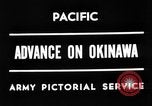
Southwest coast beachhead established by U.S. 19th Army and Marine units, 24th Army Corps advance in Okinawa in World War II.
U.S. troops advance on Okinawa. Beachhead established by 10th Army. U.S. landing crafts on South West coast of Okinawa. Warships at the coast. Small landing crafts and DUKW (Six wheel drive amphibious trucks) move in water carrying supplies. Troops and trucks move along road on island. Marine units move toward north, while 24th Army Corps move toward south for Naha. Aerial view of seized airfield on Okinawa. Countryside shows farms and open lands. Army advances towards Japanese emplacements on hillside. Troops attack Japanese caves on hillside. U.S. marines clear caves with grenades. A U.S. soldier drags a dead Japanese soldier out of a cave. Other Japanese soldiers are shown surrendering and being led away from caves with hands raised. Native civilians are evacuated. They cooperate with troops. Women and children walk along pathway. A civilian woman and young boy child smile.
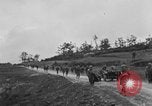
U.S. 24th Army Corps advance and 382nd Infantry, 96th Division battling at Table Top Ridge in Okinawa.
U.S. troops in Okinawa. U.S. 24th Army Corps in Southern Okinawa Front. Troops move along road. Troops along pathway in fields. U.S. artillery shells enemy positions on hills. American plane overhead makes bombing run. U.S. 382nd Infantry Regiment fighting at Table Top Ridge. Artillery fires enemy positions on side of hill. Japanese fortifications on hillside are shelled by artillery. Medics carrying wounded across field. Wounded man transferred on weasel. U.S. 381st Infantry Regiment supported by tanks fighting in Kakzu Ridge. Tanks fire at enemy positions on hills in the background. U.S. troops rushing toward deep fortified cave on hillside. Japanese coming out of cave. Flamethrower firing flames on hillside Japanese caves. Troops of 382nd Infantry, 96th Division advance up hill and place bombs in Japanese caves clearing pillboxes. Explosion in cave. (World War II; WWII;World War 2; WW2)
United States Marines and 24th Army Corps land on Okinawa in Pacific Theater.
Amphibious assault on Okinawa, Pacific Theater. Landing Ships underway. Mountains in the background. United States 1st and 6th Marine Divisions and 24th Army Corps land on beach. Tanks float ashore on pontoons. Troops advance on beach. They disperse on the beach. Rifle grenades are used in capturing a Japanese command post. Artillery fired. Troops approach installations. (World War II period).
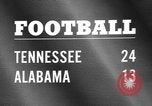
Team Tennessee Volunteers wins the football match against the Alabama Crimson Tide by a score of 24-13 in the United States.
Football match in the United States. The football match between teams Tennessee Volunteers and Alabama Crimson Tide begins. Spectators cheer the players. Tennessee wins the match against the Alabama Crimson Tide by a score of 24-13.
Progressive aggression leading to the take over of Tibet and fleeing of the Dalai Lama.
Progressive aggression leading to the take over of Tibet and fleeing of the Dalai Lama to India in exile. Men raise the People's Republic of China flag on a mountain as armies of Communist China conquer Tibet. 1950: The Dalai Lama and Panchem Lama are brought to Peking in China. They are received by Chinese officials, presented with bouquets. A function at their arrival. 1955: African and Asian delegates at the Bandung Conference in Indonesia. China agrees to the 5 principles of peaceful co-existence. Delegates including Chinese Premier Zhou Enlai and Indian Prime Minister Pandit Jawahar Lal Nehru. 1956: The Dalai Lama and Panchem Lama are permitted to visit India to celebrate the 2500th birth anniversary of Lord Buddha. They are greeted by Pandit Nehru, Premier U Nu of Burma and other Indian officials an arrival. The Lamas with Indian officials seated for a meal on the ground in a hall. The Lamas are welcomed in a ceremony and Dalai Lama addresses the gathering. Tibet: China begins to impose Communist system on Tibetan borders. Construction work and forced labor. March 1959: Communist bombardment over Lhasa. The Potala monastery. Tibetans take up alms. Handcuffs and confinements. Demonstrations and protests outside the Chinese Embassy in Delhi. Former Prime Minister Of Tibet, Lukhangwa and other monks pay their respects at Mahatma Gandhi's samadhi (mausoleum) in New Delhi. Indian government officials and members of the international press reach Tezpur in Assam. They welcome the Dalai Lama. Photographers take pictures. The Dalai Lama addresses a gathering. Statues of Lord Buddha all over India and Asia. Tibetan monks pray. People sing Indian devotional song.

USIA film describing the ways it conducts its world-wide operations
Segment of U.S. Information Agency film describing its world-wide operations. Map shows 217 overseas posts in 17 countries, of the USIA (also known abroad, as the U.S. Information Service). Animated map zooms in on one post, in Rio de Janeiro, Brazil. Aerial view of Sugar Loaf Mountain overlooking the harbor and city. Street scene in Rio. USIA Public Affairs Officer, William A. Wieland, is seen walking along a sidewalk in the city. Next he is seen in the office of Ambassador James S. Kemper, briefing him about USIA activities. View of the Brazilian Foreign Office building. Mr. Wieland meets with the Chief of the Cultural Division there. Book stacks in the USIA Thomas Jefferson Library in Rio de Janeiro. Mr. Wieland conferring with a librarian. He is also seen at the USIA broadcast facility in the U.S. Embassy. Film shifts to street scene in Cebu, the Philippines. A building displaying American and Philippine flags, is labeled: " United States Information Service." Inside, and American and a Filipino worker give bundles of literature to local workers for distribution. One, a bus driver, carries his bundle onto his open-sided bus, displaying the name, "Cebu, Autobus." He waves as he drives away. The USIA Public Affairs Officer is seen visiting the Mayor of Cebu City, Vincente S. del Rosario; giving a news release to the editor of a newspaper; broadcasting on local radio;and socializing with local editors. USIA drive a mobile movie van into a remote village where many children are playing. They set up a screen and projector. Almost everyone in town attends the showing. Scene shifts to USIA headquarters building at 1778 Pennsylvanis Avenue,in Washington, DC. Director Theodore Streibert holds a staff meeting. View of President Eisenhower addressing U.S. public media leaders about confronting the Soviet Union with truthful information about the U.S. and the West, on April 16, 1953,in Washington, DC. A USIA technician transmitting text of the speech to its public affairs officers around the world. Views of newspapers carrying the story in Paraquay, Ireland,Algeria, and Burma. The President's speech was printed in a pamphlet entitled "The Peace We Seek," ahd sent abroad where it was translated into Arabic,Japanese, Persian, and 20 other languages. Four million copies were distributed. Posters about the speech were also distributed.
CRITICALPAST.COM: About Us | Contact Us | FAQs - How to Order | License Agreement | My Account | My Lightboxes | Shopping Cart | Advanced Search | Featured Collections | Website Terms & Conditions | Privacy Policy ©2026 CriticalPast LLC.
License Agreement |
Terms & Conditions |
Privacy Policy
©2026 CriticalPast LLC.