


 Francais
 Deutsch
 Italiano
Refine Your Search
B-24-Burma stock footage and images
- Showing 775 to 780 of 3692 results more
more Hide
HideColor Sound
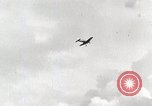
United States 1st Marine Division troops bomb Peleliu Island, Palau.
U.S. 1st Marine Division operations on Peleliu, during World War 2. U.S. F4U Corsair aircraft, flying low and slow, with gear down, drop napalm incendiary bombs on Japanese troops dug in on a ridge. Huge explosions seen. A C-47 transport airplane taxis on airfield. F4U Corsairs are seen parked and tents are pitched nearby.Several C-47s are parked on a ramp. Three F4Us taxi past them headed to the runway. F4Us take off and one is seen bombing Japanese positions on the ridge. Slate notes 1st Marine Division and D+24. Major General William Henry Rupertus,kneels on one knee, in sand, as another officer (shirtless) briefs him. They briefly discuss tactics and then walk away. Marine rifleman firing into burning wreckage of a Japanese position. Marine firing grenade from his rifle. Two Marines stand on beach with LVT (landing vehicle tracked) on the sand, nearby. They point at large ship offshore. Views of the Peleliu beachhead, with numerous ships and landing craft beached, including the second USS Seaward (LST 278) that collided with LST-129 and suffered considerable damage, On October 2, 1944. (LST-129 may be the LST seen next to LST-278.)
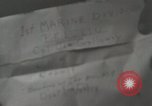
Marine situation map shows Japanese force locations on Peleliu Island, Palau, during World War II.
1st Marine Division situation map of World War 2, shows Japanese pockets of resistance on Peleliu Island, Palau. D+20 to D+25 marked on it. Another chart with D+24 location indicates by an arrow and points at D+25. Markings of enemy strong point on a ridge.
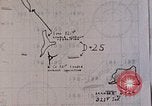
Situation map showing key events and dates during battle of Peleliu, Palau Islands, during World War II.
Map showing progress of battle for Peleliu, Palau Islands, during World War 2. D+25 and D+24. (commencing with start of campaign on September 15th, 1944) are shown on map.
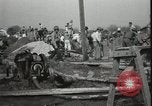
Los Angeles County Relief Administration (LACRA) workers build 12 foot Bell sewer trench in Los Angeles, California.
Los Angeles County Relief Administration (LACRA) workers build a 24 mile long Bell sewer, 12 deep in Los Angeles, California. They dig and brace the sides of the trench using pounded stakes. They add a gravel bed and then lay pipes into the trench. Engineers gather to inspect the pipe, led by LACRA chief engineer Ralph Smith. By hand, workers operate a giant pump handle with a massive hook on the end, which pulls massive timbers from deep buried positions along the line of the trench.
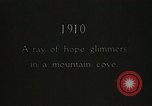
Rural water mill and the rise of Kenneth Killinger as a preacher in the southern Appalachians
Depicts life near the southern Appalachian region of Marion, Virginia in Smyth County, and specifically the path of Kenneth G. Killinger from being a mill operator to becoming a mountain missionary of the Lutheran Synod of Virginia. Man carries sack of corn to a water powered mill. Sign "Corn Ground." Young man actor portraying Kenneth G. Killinger weighs the corn with a simple scale and then pours it into the stone grinder. He gives the ground corn to the customer, along with a booklet that reads, "The Augsburg Sunday School Teacher, 1910." Close view of the contents page of the booklet. The young man standing at the edge of the mill, water wheel turning beside him. Scenes portraying two memories from his youth: A woman taking a paddle to a boy as punishment. Next scene is a group of teenage and younger boys gathered together and taking drinks of moonshine whiskey alcohol from a bottle. They cringe from the taste and pass the bottle around. Scene of men digging a grave in a graveyard beside a rural church. Killinger reenters the mill. Scene of young Killinger sitting on the porch of a rural home, reading to young children. Killinger counseling a bed-ridden elderly woman. On screen text reads, "Kenneith G. Killinger. 'The Mountain Missionary' of The Lutheran Synod of Virginia. Marion, Virginia. July 24, 1921." View of Killinger in 1921, preaching to congregation sitting under a tree. The congregation entering a small makeshift church building. The congregation entering an abandoned rail car turned into their church. The congregation later in a larger church building. Killinger preaching. Rural children singing from hymnals. Churchgoers exiting the church.

Increase in egg production in Berlin.
Scenes of local poultry farm at Berlin. Machines for grading, weighing and crafting eggs are synchronized to speed up incubation and hatching. Production carried on 24 hours on scientific basis. 23 March 1931.
CRITICALPAST.COM: About Us | Contact Us | FAQs - How to Order | License Agreement | My Account | My Lightboxes | Shopping Cart | Advanced Search | Featured Collections | Website Terms & Conditions | Privacy Policy ©2026 CriticalPast LLC.
License Agreement |
Terms & Conditions |
Privacy Policy
©2026 CriticalPast LLC.