


 Francais
 Deutsch
 Italiano
Refine Your Search
B-24-Burma stock footage and images
- Showing 205 to 210 of 3692 results more
more Hide
Hide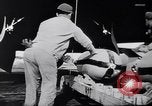
Final bombing mission of the B-17 "Memphis Belle" during World War 2
Ground crew loads bombs into a B-17. Pilot, Captain Robert K.Morgan and his crew, arrive by jeep and jump off in front of their aircraft, the "Memphis Belle." at an airfield in England during World War II. Captain Morgan gives final briefing to the crew as they stand in front of their aircraft. He and his crew then climb aboard, take up their positions and start engines. View of the nose and fuselage of the "Memphis Belle" shows artwork, including 24 bombs painted on its side. Views of other B-17s included in this mission shows names and artwork on their fuselages. Among them are: 'Dame Satan',' Hitler's Gremlin','Heavyweight','Royal Flush','Old Bill' ,'In Der Fuehrer's Face','Helno Gal' , 'Peggy my little Waaf', and 'Desperate Journey'. Group of B-17s take off, one at a time, for the mission. View from the undercarriage of one B-17 as it takes off and the landing gear is raised. Aerial views of English countryside and of several British airbases, as the B-17s fly at relatively low altitude on their way toward the English Channel.
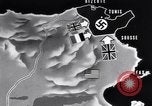
Allied Forces defeat Axis forces in Tunisia during World War II
The final battle of Tunisia, North Africa during World War 2. An animated map shows Allied Forces moving on all sides pressing forward against German forces still remaining in Northern Tunisia. in World War 2. Map outlines battles of Hill 609, Longstop Hill, Goubellat Plain, and Dejebel Mansour, and Takrouna. U.S. forces move 200 miles from the south to confront German forces in the north. Views of U.S. soldiers in trucks and M3 half-tracks, and towing heavy artillery with a tractor. Views of hills where Germans are positioned, west of Tunis and Bizerte. Allied guns firing. French forces sweeping for mines and digging some up with bayonets. French General Alphonse Juin confers with his staff as they review a large map laid out on a jeep. Brief view of French infantry in the field and gunners firing artillery. German Panzer IV tanks moving to counter British attacks. German tanks and artillery firing barrages against the British. Camera pans over destroyed German armor. British 78th Division attacks Longstop Hill. A long line of British infantry moving single file up a hillside. British soldiers firing Vickers machine guns from protected positions and infantry moving uphill, carrying small arms and Bren light machine guns. British troops scaling steep hills, using ropes, as shells burst close to them. One throws a hand grenade that explodes on the hilltop. After reaching the hilltop, the infantry scamper down the other side and continue moving forward, firing their weapons. Several dead German soldiers are seen as the British troops overrun the German positions. British engineers and pioneers working with caterpillar tractors and shovels to build roads. Later, trucks are seen using a new road. In the meantime U.S. troops are seen arriving to commence their assault on Hill 609. It begins with long range artillery firing from camouflaged positions and shells exploding all over on Hill 609. It continues into the night. View of soldiers in artillery headquarters, under a tent illuminated by lanterns. Long sequence of nighttime artillery fire. Medical Corps doctors treating wounded as the nighttime artillery barrages continue. U.S. infantry digging in after taking Hill 609. View of American soldiers walking up Hill 609. View of British Field Marshal Bernard Montgomery consulting with staff officers in the field. British 8th Army commander, Lieutenant General Sir Oliver William Hargreaves Leese, looking through binoculars as he stands with staff members at the front. Scene shifts to U.S. airmen arming machine guns on a parked P-38 fighter plane. Others roughly handling bombs to be placed into U.S. bombers. Bomber with nose art of devil riding a bomb and name "Hell a Poppin." Air crews arrive by jeeps at their B-25 Mitchell bombers and others arrive at their B-17 bombers. View of B-25 number 41-13202 named "Idaho Lassie" of the 321st BG, 445th BS, 12th Air Force. Engines running on bombers and on a British spitfire fighter plane. Formations of Allied aircraft, including B-24 liberator bombers, Martin B-26 Marauder bombers, British spitfire fighters, and B-17 Flying fortress bombers. British and American armor moving forward firing guns. French artillery firing and French infantry advancing. French machine gunners in white hats. U.S. B-24 Liberator aircraft dropping bombs. German fighter planes attacking allied bomber formations. Gunners in the bombers firing at them. Gun camera view of German fighter being shot down. More views of Allied aircraft bombing and strafing. Map shows American forces reaching Bizerte, the British capturing Tunis and German forces split and defeated.
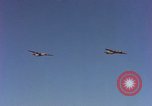
Confederate Air Force showing historical aircraft and simulated atomic bomb blast at air show in Harlingen, Texas
Confederate Air Force showing historical aircraft at an air show (Airsho '76) in Harlingen Texas. United States fighter planes of World War II in show. B-17 and B-24 bomber planes in flight. Formation of three B-25 planes. Lead B-25 (tan) is the "Laden Maiden," one of many aircraft owned by John Stokes and flown down from San Marcos, Texas, to support Airsho '76. Formation consisting of F4U Corsair and F6F Hellcat in flight. B-29 Superfortress in flight piloted by Paul Tibbets drops a simulated atomic bomb complete with mushroom cloud. Tibbets was the pilot of the Enola Gay that dropped the atomic bomb on Hiroshima Japan. Following this air show, the U.S. government apologized to Japan for the re-enacted bombing. P-38 Lightning and P-47 Thunderbolt taxiing. B-17 and B-24 bomber planes landing and taxiing, including "Texas Rangers" and "Diamond Lil," the latter carrying a full "crew" looking out as the aircraft taxis past.
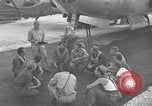
Major Robert Morgan, Aircraft Commander, briefs his B-29 crew as they sit on the tarmac prior to takeoff on a mission
Major Robert Morgan (well-known as the pilot of the B-17, "Memphis Belle," first to complete 25 missions over Germany, in the European Theater and now a B-29 Aircraft Commander with the 73rd Bomb Wing) briefs his crew. They sit on the tarmac near their aircraft, the B-29, "Dauntless Dotty," which was lead aircraft on the first B-29 bombing mission over Japan, on November 24, 1944. The Crew enters the aircraft after the briefing. (World War II period).
U.S. 5th Army Air Force aircraft raid Japanese airfield targets in Wewak, New Guinea.
U.S. P-38 Lightning and heavy bomber aircraft in flight approaching the Wewak airfield. Close-up aerial views of P-38s and B-25 Mitchell aircraft. Aircraft attacking Japanese Fourth Air Army targets. Several B-24 liberators, B-25 bombers and P-38 lightning aircraft flying over the airfield. Aircraft rolling, circling and flying low over airfield and dropping bombs. A B-24 Liberator on its side in a pond. Appears to have crashed off edge of Allied airfield on returning from Wewak raid. (World War II period).
Allied Forces Build up in Algeria to prepare for Spring offensive against German forces in Tunisia during World War II
At start of film, Allied forces are digging in after retreating from counterattacks by German forces in Tunis, during World War 2.. Rains create mud everywhere. A Lockheed P-38 fighter plane parked in foreground. Ground crews use shovels to free nose wheel of a B-24 Liberator bomber with engines running. A truck tows a C-47 transport plane from mud. Army trucks travel over road inundated by running streams. Soldiers standing in a jeep submerged in water. M2 tanks stuck in mud. Airmen huddled around an outdoor fire. P-38 fighter aircraft parked in the background. Soldiers eating around an outdoor fire. Animated map shows Allied battle lines stabilized in Algerian mountains, while German forces occupy the plains in Tunisia. German artillery batteries firing. British troops sheltering in damaged building. Allied wounded being transported atop, as well as inside a field ambulance. Interior of a transport plane configured for evacuation of wounded on litters. U.S. airmen including a woman in leather flying jacket, presumably an Army flight nurse, tend to the wounded aboard the medical evacuation flight. Wounded being transferred from an airplane to an ambulance. British patrols moving through the night. Heavy artillery firing. British soldiers silhouetted at dawn. They return carrying a wounded comrade on a litter. The British soldiers ("Tommies.") trying to clean mud from themselves and their weapons before heading out on patrols again at dusk. Allied soldiers moving on mules in a long line to obtain needed food and supplies. More views of the interminable mud. A British Hawker Hunter fighter plane taking off. A formation of Hawker Hurricanes peeling off to engage German aircraft. Closeup of one rolling over. A German Heinkel 111 bomber being attacked and trailing smoke. Pilot pressing gun firing button in cockpit and a German Dornier Do 17 bomber hit as British fighter plane passes it in cloud of black smoke. The German plane diving to crash in a fireball on the ground. U.S. B-24 Liberator bombers taking off and flying in formation. Formation of American B-17 bombers in flight. The American planes dropping bombs on Italy, Sardinia, and Sicily. Gunners in the bombers firing machine guns at attacking German fighter planes as their bombs keep dropping. Back on land in Algeria, mud still halted any Allied advance. Animated map showing both Allied and German forces building up on their respective sides of the front. Supply lines illustrated all the way back to factories in the United States and Britain. Allied war plants making bombers and munitions. Allied Soldiers assembling Army vehicles at a port. Lockheed lightning fighters being rolled out of a factory. Sign reading "Railroad Equipment Assembly Plant No. 1." Complete trains from locomotives to freight cars being completely assembled, loaded with freight and sent on their way. A formation of P-38 aircraft equipped with long range fuel tanks being ferried in flight from Brazil. It is led by a B-17 flying fortress bomber providing navigation. British Spitfire and Hawker Hunter airplanes heading to the front are seen taking off from an airfield in Gibraltar. A caterpillar tractor moving earth for a new road at the front. Trucks dropping materials for the road bed as soldiers with shovels smooth them on the surface. Soldiers installing Mardsen Matting pierced steel planking for an airfield surface as C-47 transport planes operate on the field. Crates of food supplies being unloaded at a port. War materiel stored in a large yard at a port.