


 Francais
 Deutsch
 Italiano
Refine Your Search
B-24-Burma stock footage and images
- Showing 217 to 222 of 3692 results more
more Hide
Hide
U.S. Army Air Forces operations at Nadzab Airfield Complex, New Guinea, during World War II
The U.S. Army Air Forces Nadzab Airfield Complex, New Guinea, during World War 2. USAAF P-38 aircraft on the flightline. A P-38 on takeoff roll passes the camera. Camera pans across the runway to a line of parked B-25 bombers. A B-24 Liberator bomber of the 90th Bomb Group (Skull and Cross Bombs on its tail) takes off, followed by two P-38s,and another B-24. Closing segment shows several Japanese prisoners of war.
United States Army Air Force make use of Norden bombsight to bomb German targets in Germany during World War II.
Use of Norden bombsight by United States Army Air Forces during World War II. Shows Norden bomb sight being unloaded from an aircraft. U.S. planes in flight. A bombardier at a bombsight aboard a U.S. bomber plane. U.S. pilots being briefed in England. Bombs are loaded on planes. United States Army Air Force B-24J Liberator bomber planes in flight. The bombardier at a bombsight aboard a USAAF B-17G Flying Fortress bomber plane. B-24Js under attack by German Messerschmitt planes. Bombs are released from a plane. The bombs explode over targets on the ground.
United States 8th Air Force using B-17 bombers attack Ehrang and Bingen in Germany during World War 2
United States B-17 aircraft drop bombs to destroy railroad marshalling yards in Ehrang,Germany on December 24, 1944. Bombs impact causing a pillar of smoke to rise up from oil storage center. B-17 bombers unload bombs over marshaling yards in Bingen on December 30, 1944. Large area is covered with flickering light of bomb strikes seen from gun camera.
U.S. Army Air Corps B-2 aircraft in auto flight in Sacramento, California.
U.S. Army Air Corps B-2 aircraft in flight in Sacramento, California . U.S. Army Air Corps B-2 bomber aircraft in auto flight on April 24th, 1930. Pilot of the aircraft sitting with his arms crossed in the cockpit. Aircraft in flight as it returns from San Francisco. Aerial view of the Capitol in Sacramento, California.
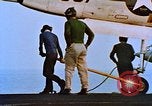
Navy deck crews display teamwork as they catapult 24 aircraft in 12 minutes from deck of the USS Franklin D. Roosevelt (CV-42) in the Mediterranean Sea in 1964
Scene opens aboard the U.S. Aircraft Carrier, USS Franklin D. Roosevelt (CV-42) as crews position several Douglas A-4 Skyhawk aircrafton steam catapults under the direction of a yellow shirt aircraft handling officer. Next, the aircraft are seen being launched. Camera follows one leaving the flight deck and proceeding over the water. Closeup of deck crew working down under an aircraft as it moves into position for launch. View from above the flight deck shows two A-4 aircraft on catapults. Tail code AB on the closest one identifies it as belonging to Carrier Air Wing One (CVW-1). Scene shifts to a catapult crew preparing an Vought F-8E Crusader aircraft for catapulting. Three crew work at the front and two at the back of the aircraft. They fasten the bridle cable. View of the aircraft being catapulted. Narrator identifies Kenneth Wilson, launch crew hold back man who is fastening the tension bar to the tail of the plane while men at the front are hooking up to the catapult shuttle. Closeup of the tension bar holding the aircraft back, while engines are set at full power. View of catapult control panel, as it is fired and the holdback bar releases. Next an F-8 of Squadron VF-11 taxis into position, and is likewise prepared for catapulting. An F-8E viewed from the front as it launches. Cables sliding back across the deck after launch where green shirts viewed through steam rising from catapults attend to them. View from cockpit of an aircraft taxiing onto the catapult. An F-8E taxied into position and readied to launch. View of pilot in cockpit. deck crew members signaling. Aircraft is launched. An E-1B propeller-driven early warning aircraft of Squadron VAW-12 taxis onto a catapult. Views of the green shirts setting its cables for catapulting. Remainder of film is a montage of catapulting from viewpoint of green shirts setting cables and aircraft launching. At end, the launches are completed (24 planes in 12 minutes) and the deck crews get a well-earned respite.

General Doolittle and General Spaatz honor the USAAF389th Bombardment Group for completing 200 heavy bombardment missions during World War II in Europe
Ceremony honoring the USAAF 389th Bombardment Group, on completion of 200 missions in the European theater during World War 2. U.S. Lieutenant Generals Carl A. Spatz, Commander of the U.S. Strategic Air Forces in Europe, and James Doolittle, who is about to assume command the 8th Air Force, stand together with officers representing several World War 2 Allied nations. A large formation of B-24 Liberator bombers flies overhead. Closeup of two soldiers looking up at the formation. Aerial view of the B-24 formation, from an accompanying aircraft. A color guard with the American flag. Representatives of various Bombardment Squadrons stand holding their unit flags. General Doolittle makes brief remarks on the merits of the 389th Group, which draw chuckles from the audience, including a smiling Soviet officer, Standing to the far left in the picture, behind Doolittle. (He has been identified as Major Timofey Samarin, assigned as Air Force assistant to the Soviet Ambassador, and also as Military Attache to the United Kingdom.)
CRITICALPAST.COM: About Us | Contact Us | FAQs - How to Order | License Agreement | My Account | My Lightboxes | Shopping Cart | Advanced Search | Featured Collections | Website Terms & Conditions | Privacy Policy ©2026 CriticalPast LLC.
License Agreement |
Terms & Conditions |
Privacy Policy
©2026 CriticalPast LLC.