


 Francais
 Deutsch
 Italiano
Refine Your Search
B-24-Burma stock footage and images
- Showing 229 to 234 of 3692 results more
more Hide
Hide
As the United States enters World War II, U.S. military forces are seen, deployed in various places throughout the world.
American troops are seen in arctic gear moving on skis through blustery snowy weather in Iceland, during World War 2. They were sent in 1941 to relieve British troops occupying Iceland since 1940, during World War II. A guard post at the American camp, with Quonset Hut in background. Closeup of U.S. sentry in arctic gear holding rifle with bayonet affixed. View from above, of numerous tents partially covered with snow in the American camp. Change of scene shows U.S. troops disembarking from transport ships at the British Isles. They march with their combat gear onto a square where Army trucks wait to transport them inland. Another scene shows the American troops, viewed from behind, parading in London. Other scenes show them marching in various areas of London. Saint Paul’s cathedral is seen in the background of one scene. A large number of American M3 Stuart Light tanks move on a railroad train in Britain. Scene shifts to the Middle East, where railroad cars and various military supplies for Russia are be offloaded from American ships. A Russian officer is seen signing receipts for war materiel, from a U.S. Army Technical Sergeant. A row of American Army trucks are lined up behind them. The Russian and American exchange salutes, and shake hands. Next, a troop ship carrying American troops is seen arriving at a port in India, where they disembark with their gear. An American Army Sergeant in a pith helmet pays attention to a little Indian girl. Scene shifts to China, in 1942, where Brigadier General Claire Lee Chennault, Commander of the China Air Task Force, of the Tenth Air Force, that replaced the American Volunteer Group (Flying Tigers), is seen with Brigadier General Caleb V. Haynes, Commander of the India Air Task Force. A colonel joins their discussions. A Consolidated B-24 Liberator bomber is parked behind them. View of Curtiss P-40 Warhawk fighter planes, with Flying Tiger markings, parked on a flight line. A B-24 bomber landing on a runway, between hills, deep in China. Closeup of Nationalist China Generalissimo Chiang Kai-Shek, saluting. Huge numbers of Chinese troops assembling in a formation. Next, an expeditionary force of American troops is seen arriving on a troop ship in Australia. They line the ship’s deck and wave. General Douglas MacArthur arriving in Australia to assume the office of Supreme Commander, South West Pacific Area (SWPA). .Glimpses of U.S. Navy activities in Australia: setting up defenses of islands; unpacking a Kingfisher float plane and making it ready for use on a desert island. The final segments of the film show American forces in August ,1942 sailing to Adak in the Aleutian Islands, to strengthen American defenses there. Troops seen descending by rope ladder from the American transport ship USS J Franklin Bell (PA-34), into her landing craft for deployment on Adak Island. Scenes of landing craft reaching the beach and offloading troops, vehicles, and supplies. View of beach filled with supplies. One landing craft is clearly marked with ""P34" showing that it belongs to the USS J Franklin Bell ( later reclassified as APA-16).

United States Army Air Corps film "The Truth About Ploesti."
Formations of B-24 Liberator bombers are seen in flight, headed for Ploesti, Romania, on August 1, 1943, during World War 2. Next, vertical columns of bombs are seen falling from the planes. Animated map of Europe shows Romania and Ploesti. It show paths of oil from the Ploesti oil fields to Germany. (Narrator states Ploesti provides 30% of Axis oil.) Map show path of 9th Air Force bombers from Libya to the Ploesti oil fields. Scenes shift to captured German films from 1944, showing the fires and destruction resulting from the constant B-24 raids. Huge black clouds rise from the area. Firefighters rush to combat flames. They direct streams of water on the conflagrations. (Commenter states: "Delayed action bombs prevented firefighters from rushing in, until too late.") Nighttime views of large fires and heavy smoke from 6 of Ploesti's 7 refineries ripped wide open. Film advances to August, 1944, showing Ploesti with the fires out, following Rumania's capitulation. Next, with some fires still burning, King Michael I of Romania, tours the site with military officers. They walk amidst the debris. Smoke rising near a rail marshaling yard. Against a background of dense smoke rising, a Slate is displayed showing the cost to the United States of the Ploesti raids, as 300 bombers and 3000 American airmen were lost.
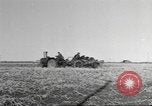
Food and rations supplied by New Zealand to U.S. Army Quartermaster South Pacific operations during World War II.
Cooperation between New Zealand and the U.S. Army Quartermaster Corps during World War II. A tractor on a farm in New Zealand. A tractor plows the field. The Pukekohe Golf Club, near Wellington, converted from golf to farm to grow crops for the war effort. New Zealand farmers works in the field. Farmers load a truck with sacks of potatoes. Close up view of potatoes on a sorting belt and farmers sort potatoes and bag them. Women workers sort cabbage and package the cabbage for shipment. Men and women farmers picking fruits and vegetables in farm fields. A factory shows apples being moved on a belt driven machine, and peeled and cored by a machine, cut into very small pieces and dehydrated in order to conserve shipping space. Canning operations are shown as the dehydrated fruits and vegetables are packed in moisture proof tins in packing houses. Meat and vegetable are mixed in proportions to prepare Quartermaster combat rations. Combat ration cans being filled and sealed at a factory plant. A machine re-generating chocolate bars from old chocolate by melting them down and reprocessing them. Soldiers unloading cartoons from the truck. Rations from New Zealand are loading on to ships by cranes with nets at large shipyards, with ships bound for the Solomon Islands. A dairy warehouse of the New Zealand Co-op Dairy Company (later Tatua) is seen at an airport near Auckland (Possibly Tatuanui or Pauanui). Milk is loaded into a specifically converted B-24 aircraft at the airport. Soldiers loading the aircraft with milk containers. The B-24 aircraft takes off. The aircraft arrives at the Tontouta Air Base in New Caledonia. A nurse serves milk to a wounded soldier patient in a hospital. Sign over the patient's bed says "Pappy Shooter, 27th Division; Saipan; Oahu, Hawaii". The patient drinks milk. Bread being made in Quartermaster bakery. A group of Army bakers working together to form loaves of bread dough on a large work surface. Workers making bread. A worker opens an oven revealing many loaves of baked bread. Ice slabs being formed at an ice plant, and soldiers picking up ice blocks for use in preserving meats and other foods, and in making ice cream. A soldier making ice cream using an ice cream churn in the field. View of a larger Quartermaster ice cream plant that was setup at a large base.
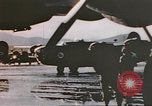
U.S. Air operations from Adak, and views of.the island's defenses during the Aleutians campaign of World War II.
As film begins, two U.S. B-24 bombers are seen taxiing across the Adak airfield to takeoff on a bombing run against the Japanese airfield at Kiska Island. Closeup of B-24 with engines running. About an inch of water covers the ramp. The two bombers take off (followed by others unseen). Airmen on the ground watch them depart. Scene shifts to the port of Adak. A cargo ship and a tugboat moving a barge are seen in the water. Trucks drive along the beachfront. Mountains loom in the background. Military supplies, including munitions are seen piled along the beach. Soldiers carry some goods over their shoulders. Closeup of items piled on the beach. A dog trots along with soldiers walking the beach. Change of scene highlights guns installed as coastal defense on the island, including fixed heavy guns, anti-aircraft guns and machine guns. A sailor viewed through a life safer buoy, paints part of a warship. A Navy PBY Catalina on patrol is seen overhead. U.S. gunboats patrol the harbor. Crew members are seen aboard a U.S. destroyer patrolling deep waters off Adak. They exchange blinker light messages with a Bancroft-class (four-stacker) destroyer. Glimpse of the Bancroft-class destroyer flashing blinkers lights. Sailors on a destroyer respond to alarm of sonar sound contacts and man battle stations. Closeup of a Bancroft-class destroyer, followed by views of depth charges being launched from a destroyer underway. Exchanges of blinker light messages between camera destroyer and a Bancroft-class destroyer.
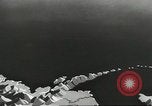
U.S. forces launch attacks against Japanese targets from the Aleutian Islands during World War II
Film opens showing animated map of Pacific and avenue of attack against Japan via the Aleutian Islands in World War 2. . Scene shifts to the Aleutian Islands, where American P-47 aircraft are seen parked on an open ramp in severe winter weather. Next, American Army truck convoys are seen traversing subarctic Canada on the Alcan highway, with supplies to sustain U.S. forces in the Aleutians. U.S. soldiers and airmen are seen obtaining various items and playing volleyball on a ramp at an airbase. Fog shrouds the Aleutians keeping aircraft grounded. Soldiers look at maps and plan targets. Aircrews are briefed about their mission and targets. U.S. Army Air Forces B-24 Liberator bombers fly in formation over snow-covered peaks. View looking down on a B-24 headed toward Japan. Airmen in a headquarters plotting the disposition of aircraft reporting to them by radio. View above thick clouds with nothing in sight. (But exploding bombs are heard.) (World War II; WW II; World War 2; World War Two)
Tests of non-persistent gas on ship targets are carried out by U.S. Army at San Jose Island during World War II.
Tests of non-persistent gas munitions during U.S. chemical warfare tests near San Jose Island, Panama during World War II. Tests of non-persistent gas on ship targets are carried out. A stationary ship in water on which tests are to be carried out. Goats are loaded aboard the ship to represent Japanese personnel. Testing stations are set up at the bow, the stern and on varying heights by U.S. Army personnel. A man works with a gas concentration sampling instrument at a testing station aboard the ship. Goats wearing gas masks fitted with Japanese canisters are placed on the testing station. Bombs are loaded on U.S. 6th Air Force B-24 Liberator bombers at an airfield for carrying out the tests. The bombs are dropped from the B-24s near the test ship. Gas clouds cover the target completely after bursts on water. A man examines protected and unprotected goats killed by gas concentration. Attack on various vessels.