


 Francais
 Deutsch
 Italiano
Refine Your Search
B-24-Burma stock footage and images
- Showing 223 to 228 of 3692 results more
more Hide
Hide
U.S. Army Air Forces experiment with inflight refueling of a towed P-38 fuel tank equipped with fins.
Views of P-38 drop tank, equipped with tail fins, under the wing of a B-24 aircraft. Views of the tank being towed beneath the B-24 as fuel is pumped through it. Fuel seen streaming from back of the tank.
Donald Nelson and party visit the Ford Bomber Plant in Detroit, Michigan (WW2)
Chairman of the War Production Board Donald Nelson and party visit the Ford and Chrysler plants in Detroit, Michigan during World War II. A C-45 military transport aircraft lands at the new Ford Bomber Plant. The visitors get off the plane. They are greeted by the Ford Motor Company founder Henry Ford and others. W. Averell Harriman converses with Henry Ford. Nelson, Harriman and Oliver Lyttelten pose. Photographers take pictures and cameramen record the event. A stationary U.S. bomber B-24 Liberator with engines running. Civilian guard patrolling in the foreground. Hangar and civilian cars in the background. The visitors and hosts near the first bomber built by the Ford Bomber Plant. Henry Ford has trouble being heard because of the aircraft engine noise. The B-24 engines are shut down. Aviator Charles Lindbergh, in civilian clothes, with two U.S. military officers. Henry Ford and others get into a car.

American aircraft taking off for Canada and England.
Chief of Air Corps Ferrying Command Colonel Robert Olds talking to pilots. Shows American planes, Lockheed Hudson taking off and in flight to Canada. Royal Air Force officer examining map. American bomber plane B-24s taking off and flying to England for use by British forces as part of lend-lease program in World War 2. Point of view shot inside cockpit of B-24 aircraft flying low.
Air-Sea rescue and accident during World War II in the Pacific Theater of operations
Celebes, Netherlands East Indies (NEI). Air-Sea Rescue June 11, 1945. View from low flying aircraft of a 13th Air Force B-24 ditched in Japanese-controlled waters off the coast of Celebes, NEI. A Catalina PBY flying boat of the Jungle Air Force's 2nd Emergency Rescue Squadron, lands and picks up the B-24 crew. However, as it takes off on the water, it founders and crashes, killing three men. An accompanying PBY lands immediately and picks up all survivors who are aboard a rubber raft. Crew members on the wing of the PBY, help survivors aboard.
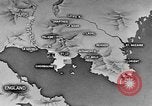
Allies advance following the invasion of Normandy, France, during World War II
Film opens showing map of Normandy, France. Next, U.S. General Dwight D. Eisenhower is seen seated in a jeep, conversing with an officer, standing nearby, who makes notes in a pad. Lieutenant General Omar Bradley sits in the back of the jeep, and a Major General stands beside the jeep. Other officers stand around in the background. Eisenhower converses with the Major General. Scene shifts to closeup of Lieutenant General George Patton. U.S. B-24 Liberator bombers fly overhead, part of a two thousand plane bombarding the Saint-Lô area on July 25, 1944. Closeup of a B-24 dropping bombs and views of bombs exploding on the ground. American M4 Sherman tanks and infantrymen advancing after the bombardment. U.S. troops riding atop an M8 Greyhound armored cars and M4 tanks. Animated map shows the extent of U.S. advance from Saint-Lô encompassing the entire Breton Peninsula. Then, it shows American forces swinging North and around to the West, trapping German forces at Falaise. A German Tiger tank, camouflaged in shrubbery, moving along a road, followed by motorcycle, and trucks full of German soldiers retreating from the trap at Falaise. Brief closeups of German soldiers in some of the vehicles. A German FW-190 fighter-bomber seen flying very fast and low toward the camera. An explosion. View of British and Canadian soldiers coordinating in the field, further South of Caen, working to keep German armor surrounded in the area. A battery of British heavy artillery guns firing from camouflaged positions. An American 105 mm Howitzer Motor Carriage M7 (called M7 Priest by the British) firing from a wooded area. Shells exploding in the distance. German soldiers sheltering from the shelling. Fires burning. Allied jeep driving past knocked out German tanks. A field ambulance leads a long column of German prisoners of war. They march four abreast with hands clasped over their heads. A convoy of Allied heavy duty trucks bringing supplies from beachheads to the front lines. (World War 2; WW II; WW2)
Aviation business and military leaders meet at Consolidated Aircraft; views of aircraft assembly plant operations
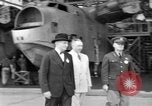
A meeting of business and U.S. military leaders at a Consolidated Aircraft assembly plant during World War II. View of General Henry "Hap" Arnold, Consolidated Aircraft founder Reuben H. Fleet, and William S. Knudsen (President of General Motors, and appointed by President Roosevelt as Director General, Office of Production Management. He developed the "Knudsen Plan" for rapid U.S. war materiel production expansion in World War 2). The three men are walking in front of an aircraft hangar with partially finished PB2Y Coronado flying boat aircraft at the Consolidated Aircraft factory in San Diego, California. Group of American military and industrial leaders gathered talking at the site, including Henry Ford of Ford Motor Company, and James H. "Dutch" Kindelberger, President of North American Aviation. (Consolidated, North American, Douglas, and Ford all produced B-24 bombers during the war.) Change of scene: Men at unidentified location view blueprints for expanded aircraft manufacturing and assembly facilities. View of war production factory workers as they stream out of a factory at end of shift. Views of PB2Y Coronado flying boat patrol bomber, and B-24 Liberator bombers under construction. Views of factory operations with metal forging and tempering work. Views of wing and engine assembly operations.
CRITICALPAST.COM: About Us | Contact Us | FAQs - How to Order | License Agreement | My Account | My Lightboxes | Shopping Cart | Advanced Search | Featured Collections | Website Terms & Conditions | Privacy Policy ©2026 CriticalPast LLC.
License Agreement |
Terms & Conditions |
Privacy Policy
©2026 CriticalPast LLC.