


 Francais
 Deutsch
 Italiano
Refine Your Search
B-24-Burma stock footage and images
- Showing 2359 to 2364 of 3678 results more
more Hide
Hide
United States Army Air Corps winter mission before WW2.
United States Army Air Corps Douglas XC-32 military transport plane in flight after take off from Langley Field before WWII. Major General Frank Andrews and staff including Major George C. Kenny, inspecting a map onboard the XC-32. A radio operator in the XC-32 sends a message via morse code and voice. Ground radio operators in Concord, New Hampshire as command is heard on loudspeaker telling pilots to "simulate an air attack on the New York metropolitan area." View of a loudspeaker. Ground crewmen walking across snow-covered field in Concord New Hampshire with a Douglas YO-31A parked in background. Snow is falling on the airfield as crewmen uncover engine of a Martin B-10 bomber parked in a row with other bombers. A crewman in winter uniform carries a machine gun across snow-covered field toward a parked B-10. A gunner in a B-10 as nose turret turns. Crewmen looking in open bomb bay doors in the snow. Two crewmen turning propeller on a B-10 by hand while it is snowing. Two ground crewmen crank B-10 engine by hand to prime it in cold conditions. Engines on a B-10 are started. The snow is blown off wings of aircraft after the engine starts. Two ground crewmen pulling canvas covering off the wing of a B-10 in heavy snow. A Martin B-10 taxiing on snow-covered field. The B-10 taking off from snow-covered field. A Martin B-10 in flight.
World War 2 U.S. aircraft bombing scenes; Strategic Air Command Headquarters at Offutt Air Force Base, Nebraska
History and scenes related to the U.S. Air Force Strategic Air Command (SAC). Wheat crop blowing in wind and abandoned harvesting machinery in fields of Nebraska. World War II aerial view of several U.S. Army Air Force B-17 bombers in formation flight. Tail Codes of "triangle C" identify them as belonging to the 303rd Bomb Group (H), 1st Air Division, 41st Combat Wing Eighth Air Force, based at RAF Station, Molesworth, England. A closeup shows B-17,tail number, 41-24416 of the 358th Bomb Squadron. (Its name, "Black Diamond Express,"is not seen.) Lettering on side of one of the B-17 aircraft includes word, "Doodle". View of bombardier using bomb sight in aircraft during bombing run.. Aerial view of buildings on ground. Close up as bombardier completes settings and pulls lever. Bombs away view as bombs are dropped from open bomb hatch toward industrial target. View from aircraft as bombs hit industrial buildings and massive explosion as buildings in target zone are destroyed by B-17 bombing during World War II. Dramatic view of smoke, and rubble soaring upward toward camera on aircraft. View on ground of bombs hitting target and workers in an oil tank and marshaling yard area rushing to assist after damage from U.S. bombing campaign in World War 2. Fire fighters try to extinguish fire. Wreckage due to bombing. Damaged rail lines and trains. U.S. Army Air Force B-29 aircraft in flight as seen from air. POV B-29 bomber from pilot seat area looking forward at bombardier and nose of aircraft. View of bomb door hatch open on B-29 and release of an atomic bomb similar to "Little Boy" atomic bomb that destroyed Hiroshima. View of a massive atomic bomb explosion. Smoke rises from nuclear bomb blast. Views from cameras used in atomic tests showing buildings and equipment at moment of impact. Massive wind and immediate destruction from atomic blast wave. Sweeping views of undeveloped land near SAC HQ at Offutt AFB, and views of the Headquarters of Strategic Air Command, United States Air Force. A Minuteman missile standing near the building. Point of view from visitors entering the headquarters, as an an air policeman directs them. Insignia of SAC (Strategic Air Command) on the wall. Identity card of visitor matched. Model of airplane. Guards checks the Identity card of visitor and opens door
U.S. Air Force aircraft take off from the Eniwetok Atoll in Marshall Islands; atomic explosion
B-52, B-47 and B-66 RATO take off from a runway at the Eniwetok Atoll in Marshall Island. Pilot being assisted into an F-84F cockpit and seated in cockpit wearing a helmet. F-84F on ramp with pitot tube in nose section. F-84F taxiing out of parking area while a F-101 taxiing. F-101 takes off on a wet runway. Views of B-52, B-66, B-47, F-84F in flight. Scene of atomic bomb explosion burst over water at Eniwetok Atoll during nuclear testing by the United States. A F-101 in flight. A B-57 flies over on wing at high altitude.
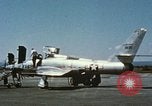
A modified RF-84F Thunderflash being used in flight testing for the F-105 fire control system in the United States.
Development progress report of U.S. Air Force F-105 Thunderchief fighter bomber. A modified RF-84F Thunderflash being used in flight testing the F-105 fire control system. The modified RF-84F with a pointed random nose. The aircraft taxis out on flight line past U.S. Air Force B-29 Superfortress, F-84 Thunderjet and C-47 Skytrain at Eglin Air Force Base. RF-84F takes off from one of the air strips at Eglin Air Force Base. YF-105A performs a wing over and drops away. The data reduction equipment being utilized in the armament system testing at Eglin AFB. A General Electric digital computer in operation. Two technicians test a laboratory model of the AFW-10 automatic flight control system. A civilian points out the AFW-10 automatic flight control system installed in the modified RF-84F. An F-84F in flight. The aircraft does a wingover and drops several hundred feet, then starts a level climb. An Air Force pilot climbs into a cockpit of F-105B. F-105B taxis on the ramp at Edwards Air Force Base, California. Republic personnel grouped around a combination radio telemetry truck and look up in the sky. F-105B takes off and climbs rapidly. F-105B in flight high above a cloud layer. A fuselage of F-105B. F-105B lands on a dry lake bed at Edwards AFB and drag parachute deployed.
Neil Armstrong, Major Robert White, Joseph Walker and other pilots stand beside X-15 at Edwards Air Force Base in California.
Rocket powered aircraft X-15 pilots at Edwards Air Force Base in California. X-15 pilots Lt Commander Forrest S Peterson, Neil A Armstrong, Captain Robbert A Rushworth, John B McKay, Major Robert M White and Joseph A Walker stand in front of X-15. A sign reads 'NASA' Lt Commander Forrest S Peterson and John B McKay talk. X-15 in the background. Major Robert M White and Joseph A Walker talk. Lt Commander Forrest S Peterson, Neil A Armstrong, Captain Robbert A Rushworth, John B McKay, Major Robert M White and Joseph A Walker stand together. Major White and Joseph Walker stand beside X-15 and talk. Lt Commander Forrest S Peterson stands beside X-15. Lt Commander Forrest S Peterson stands beside X-15. John B McKay stands beside X-15. Captain Robbert A Rushworth stands beside X-15. Neil Armstrong stands beside X-15. Major Robert M White stands beside X-15. Captain Rushworth, John B McKay, Lt Commander Forrest S Peterson, Joseph A Walker, Neil A Armstrong and Major Robert M White stand around X-15 nose. Lt Commander Peterson, Neil A Armstrong, Capatain Rushworth, John B McKay, Major White and Joseph A Walker re mill around and talk.
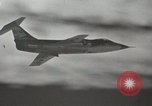
Images recorded from chase plane during the first powered flight of an X-15 Rocket Plane, at Edwards Air Force Base, California
Photograpy from an airborne chase plane, on the occasion of the first powered flight of an X-15 rocket plane. A Lockheed F-104 Starfighter chase plane seen flying in the contrails of the NASA B-52 mothership (NB-52A,52-003) flown by pilots Bock and Allovie, An F-100D fighter flies slightly ahead of the B-52. The X-15, 56-6671, with Scott Crossfield, in the cockpit, is cradled under the B-52's right wing. View from the photo chase plane, as it pulls closer to the B-52. The X-15 and leading F-100 chase plane are clearly visible. The camera plane has dropped back and the X-15 releases, from the B-52 mothership, as its rocket engines simultaneously ignite. It drops and accelerates below and in front of the B-52. It stays below momentarily, without leaving a contrail. Then it accelerates and climbs rapidly out of sight. Sunlight glares as two chase planes are seen.
CRITICALPAST.COM: About Us | Contact Us | FAQs - How to Order | License Agreement | My Account | My Lightboxes | Shopping Cart | Advanced Search | Featured Collections | Website Terms & Conditions | Privacy Policy ©2026 CriticalPast LLC.
License Agreement |
Terms & Conditions |
Privacy Policy
©2026 CriticalPast LLC.