


 Francais
 Deutsch
 Italiano

Refine Your Search
B-24-Burma stock footage and images
- Showing 2485 to 2490 of 3692 results more
 Hide

U.S. Navy aircraft and helicopter come in for landing on the flight deck of USS Ranger underway in the South China Sea.
USS Ranger underway in the South China Sea during the Vietnam War. U.S. Navy A-7B Corsair II touching down and rolling to stop. A man runs out towards the aircraft. A-7B going over edge of the angle deck. A puff of smoke drifts off over the deck. A parachute is seen opening as the pilot disappears over the ship's side. Several men running over the deck. A U.S. Navy SH-3D Sea King helicopter low over water to pick up the pilot. The destroyer escort moving up, several men in the foreground on the flight deck. The helicopter lifts off with the pilot. The helicopter in flight over water. The destroyer escort in the background. A U.S. Navy A-6A Intruder aircraft on fly by. U.S. Navy RA-5C Vigilante aircraft coming to a stop on the deck after recovery. The aircraft taxi forward. The helicopter lands on the deck with the recovered pilot. The rescued pilot of the A-7B walks over the deck after returning to the ship.

United States bombers dropping bombs on practice targets.
Activities of the U.S. Army Air Corps at Langley Field, Virginia. Two armament men sliding 300 lb bombs across ground and under a B-10. Two officers look on, a second B-10 parked in the background. Group of civilians seated on bleachers. Formation of six P-6Es in flight. Frame house in the foreground. Bullets hitting practice targets on ground. Several boats in water in the foreground. B-10s flying in formation. Aircraft dropping bombs. Six 300 lb bombs descending. Train of bombs exploding in field. Smoke and dust from exploding bombs. Small motor-powered launch anchored in water in the foreground.
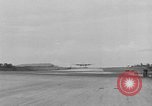
U.S. Brigadier General Emmett O'Donnell, Vice-Admiral John Hoover and Brigadier General Haywood Hansell arrive on Saipan
Us Army Air Forces B-29 Super Fortress of the 73rd Bomb Wing (Tail Code: "V Square 29") comes in for landing. Plane parks on the ramp. U.S. Brigadier General Emmett O'Donnell, Vice-Admiral John Hoover and Brigadier General Haywood Hansell study a map, leaning it against one of the plane's propellers. General O'Donnell walks over to converse with Major Robert Morgan, who is well-known as the pilot of the B-17 "Memphis Belle" that flew 25 missions over Germany in the European theater. He now flies B-29s with the 73rd Wing in the Pacific theater. (World War II period).
Battle of Papua New Guinea in World War II
Animated map shows New Guinea and Papau. Areas occupied by American and Australian Forces , seeking to dislodge Japanese Forces, at Buna and Gona, are shown. General Douglas MacArthur, arrives at Papua. He strolls through an American/Australian milltary camp in the jungle. He is dressed in a perfectly pressed uniform, smoking a cigar. (Narrator states he arrived to take personal charge of the offensive.) Closeup of MacArthur. American troops flown in from Australia, advance toward the Japanese positions at Buna. Another scene shows Australian troops making their way through jungles as they advance over the Owen-Stanley mountain range toward Gona. Australian troops fire mortars and one seen firing a Bren light machine gun. An American soldier firing an M1919 Browning machine gun. More views of Allied soldiers firing rifles and machine guns, including a water-cooled Browning M1917 gun. A bomb or shell explodes at a Japanese position. Scene shifts to Allied Military Headquarters in New Guinea, where staff plot information on large status maps about Japanese reinforcements arriving in the Bismark Sea, to bolster the enemy’s defenses. An Australian pilot runs to his Spitfire airplane, and American pilots rush to their B-25 Mitchell bomber, named “Dirty Dora.” An Australian Douglas A-26 invader airplane taking off. The B-25, Mitchell bomber (Dirty Dora) taking off. A USAAF B-17 Flying Fortress bomber taking off. More Allied aircraft taking off and in flight, including a formation of Australian A-26 invader airplanes. An Australian Airspeed Oxford training aircraft is seen diving . View from cockpit of an A-26 Invader airplane firing machine guns at Japanese ship. View of Allied warplane dropping bombto skip a Japanese ship. Bombs explode. Aircraft strafing Japanese ship. Various views of smoke rising from struck many Japanese ships. (World War II; WW II; World War 2; World War Two)
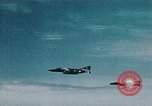
The battle of Khe Sanh in the Vietnam War.
Film begins showing two U.S. Air Force McDonald Douglas F4 Phantom jet fighters in flight. Narrator says American intelligence reports on January 29, 1968, of a 4th North Vietnamese Regular Army Division in the Khe Sanh area, bringing total enemy strength to about 40 thousand regular troops. View of photo interpreter rolling large wet film taken by Air Force surveillance aircraft. Map of Hue, area of South Vietnam, showing disposition of American forces in the region. American Marine Colonel David E Lownds, Commander of Khe Sanh garrison, describes North Vietnamese offensives against some American held positions. Views of North Vietnamese attacks being repelled by artillery and air strikes as well as organic infantry weapons like the A1 millimeter mortars, 3.5 rockets, and M79 machine guns. U.S. aircraft drop munitions on enemy positions. Infantry firing guns mounted on vehicles. An F4 Phantom drops napalm that creates a swath of fire. Closeup of North Vietnamese newspaper warns that the Americans face a defeat comparable to that of the French at Dienbienphu. American newspapers express concerns about the fate of the Marine Garrison at Khe Sanh. U.S. Army General William Westmoreland, Commander of U.S. troops in Vietnam, is seen and heard expressing confidence that American forces would win the battle of Khe Sanh. American troops listen as he speaks. Marines in briefings and in combat, including African American Marines. American artillerymen load and fire a 175 mm field gun at Camp Carrol, and a location called the Rock pile with a network of trenches. Inside that base, are seen Ontos M50A1 multi barrel anti-tank tracked vehicles armed with 105 mm recoiless rifles. A marine fires a 4.2 inch mortar, and another fires a recoiless rifle. Marines firing a 155mm howitzer. Scene shifts to deck of an aircraft carrier. View of Navy F4J phantom fighter aircraft being launched from the USS Ticonderoga (CVA 14) (Note: this may be an anachronism. Reportedly, the F4J was not operating from aircraft carriers in the Vietnam until after 1968). F-4 Phantom fighters taking off from an Air Force base. Aerial view of a U.S. Air Force B-52 bomber dropping conventional bombs on North Vietnamese targets. View from the air of bombs exploding on the ground over battlefield terrain. A C-130 transport plane dropping supplies to U.S. marines on the ground. View from below of the parachutes descending with supplies. Closeup of C-130 dropping mail from above. More views of parachute drops from C-130 aircraft to Khe Sanh. C-123 transport landing at a Marine base and a C-130 taking off. Another C-123 landing. Another having load delivered by low level extraction. Marines on the ground at Khe sanh opening packages of supplies and using a tractor to transport large boxes. On February 13, Marines suffered casualties when a platoon was ambushed just outside the base perimeter. View of Marine on a litter. Heavy black smoke rises at the base from shelling by North Vietnamese artillery. A C-123 aircraft takes off with dense black smoke in the background. Another napalm attack by a U.S plane creates a large conflagration. View from above of a B-52 dropping bombs only yards outside the Khe Sanh perimeter. Marines patrolling close in the base. More views of B-52s bombing North Vietnamese targets. View of nighttime bombing operations. A Marine plotting enemy movements on a plexiglass chart. Marines manning machine guns as enemy rockets and mortars continue to pound the garrison. Officers are seen in CINCPAC Command center. Continued U.S. bombardment and air strikes appear to prevent massing of enemy forces for an assault. Marines controlling hills in the area. A UH-1 Iroquois (Huey) helicopter flying low over the base. During a lull in battle Marines fill sand bags, maintain their weapons, play cards, and keep occupies as they sit and wait. Some play basketball with an outdoor improvised backboard and net. Some marines select books from a library. A marine plays a guitar as some others listen. Closeups of Marines in trenches including white and African American Marines. Marines doing their wash and having a meal of C rations. Marines preparing their own combinations of ingredients into meals being cooked over open fires. Views of many marines eating the various mixes of C-rations they called "casseroles." Marines in trucks pursuing retreating elements of North Vietnamese on Highway 9 that had been opened by Marine engineers. U.S. Army First Air Cavalry reinforcements arrive in operation Pegasus. Marine engineers working to restore bridges and roads needing repairs. Soldiers detecting and neutralizing mines. Bell UH-1 helicopters ferry troops. Captured enemy arms and ammunition. Surrendered North Vietnamese soldier prisoners of war marched under guard.
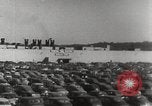
The new (circa 1951) GE jet engine plant at Lockland, Ohio. Engines being assembled. Various aircraft using GE engines
Views of the new (1951) GE jet engine assembly plant at Lockland Ohio. Animated description and U.S. map showing numerous suppliers across the country that contribute parts for the jet engines assembled at the GE Lockland plant.Views inside the plant, with engines being assembled. GE staff members, including chief engineer, Donald F. Warner, are seen in the plant. Various U.S. jet warplanes taking off, including: Hughes XF-91; North American F-86D Sabrejet ; Martin XB-51; North American B-45 Tornado; Boeing B-47 Stratojet bomber; and Convair B-36.