


 Francais
 Deutsch
 Italiano
Refine Your Search
B-24-Burma stock footage and images
- Showing 2869 to 2874 of 3678 results more
more Hide
Hide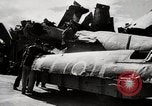
Downed British airplanes recycled for metal in Germany during World War 2.
German workers bring in scrap wreckage of downed American aircraft and British aircraft for recycling of metal. SK logo on body and B on wings of a plane clearly visible. Wreckage dumped into hot furnace. Melted aluminum ingot poured into molds to form brick shaped metal bars.
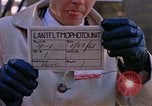
Keel laying of the Polaris submarine USS Lafayette (SSBN-616) in Groton, Connecticut.
Keel laying of the polaris submarine USS Lafayette (SSBN-616) in Groton, Connecticut. Shows electric power cable running from the USS Nautilus (SSN-571) to the dock. Thus, the nuclear reactor aboard the Nautilus is providing electric power to operate the crane for laying the keel of the USS Lafayette and also for welding, later on. Sign on dock, reads Atomic Power, SSN-571 Nautilus. The worker on the dock turns the power on. The keel of the USS Lafayette is put in place by the crane. Several yard worker in foreground. Sign reads, "USS LAFAYETTE (SSBN-616), Keel laid January 17, 1961". The keel hangs from a crane hook. French Ambassador Herve Alphand, Secretary of U.S. Navy (SECNAV) William B. Franke; President of General Dynamics' Electric Boat division, Carleton Shugg; and Vice Admiral(VADM) Hyman G. Rickover, all appear on a stand as the keel is being laid onto the blocks. The bottom section of the keel is lowered to the keel blocks as the dock watchers observe. Press officials gather at the ceremony. SECNAV Franke at podium speaks to the group in the yard. A worker puts a welder's apron around the SECNAV. VADM Rickover watches as SECNAV welds his initials into the keel of the USS Lafayette. Ambassador Alphand welds his initials onto the keel of the USS Lafayette. Alphand speaks from the platform to the group, completes his speech, and Carleton Shugg steps to the microphone at the close of the ceremony. The VIPs leave the platform.
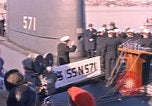
Admiral Hyman Rickover receives Distinguished Service Medal, aboard the USS Nautilus in Groton,Connecticut.
U.S. Navy Admiral Hyman Rickover is honored aboard the USS Nautilus in Groton,Connecticut. Participating VIPs include: French Ambassador Herve Alphand; Secretary of US-Navy(SECNAV) William B. Franke; President of the Electric Boat Division of General Dynamics Corporation.Carleton Shugg; and Vice Admiral(VADM) Hyman G. Rickover. They arrive aboard the USS Nautilus (SSN-571) for the ceremony. Vice Admiral Rickover is saluted by Navy officers. standing on a podium set up on deck of the submarine. Officers and men on the Nautilus stand at attention. LT. J.F. Laboon, JR. Chaplain, gives a short invocation. Commander of Nautilus, Lando W. Zech, introduces Vice Admiral Grenfell who steps up to the mike. French Ambassador Alphand gives remarks. SECNAV gives his address and presents the Distinguished Service Medal to VADM Rickover.
Activities on the Enewetak Atoll just before the Operation Sandstone atomic bomb tests.
Covers the events just before the atomic bomb tests (Operation Sandstone) on the Enewetak Atoll (sometimes spelled Eniwetok or Eniewetok) in the Marshall Islands. U.S. parachute troopers board a transport plane. Scenes of men working on communication systems. Tests and experiments are conducted in the laboratories and valuable data collected. Light aircraft is used to ferry scientists from one point to another. An air laboratory inside a plane to collect valuable information. Men prepare to leave Eniwetok. Scientists and technicians make a last minute inspection of all the necessary instruments before leaving the island. U.S. ships loaded with men move to safer water. Unmanned B-17 drone aircraft takes off to capture traces of the atomic cloud. Men prepare to trigger the atomic bomb on the Eniwetok atoll.
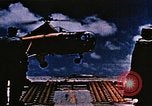
American outpost built at the Enewetak Atoll in Marshall Islands for atomic testing.
Covers events relating to the Operation Greenhouse atomic tests. Shows U.S. troops and men at an American outpost at Enewetak Atoll (sometimes spelled Eniwetok or Eniewetok) in Marshall Islands. A water pumping station on the island. Boats and small planes provide transport facility on the island. The test island serve as a learning ground to U.S. Army, Navy and Air Force. Tanks fitted with measuring instruments are stationed near the Zero Tower to measure the radioactivity ,heat and pressure generated at the time of blast. Reinforced concrete buildings are build to withstand the atomic blast. Test objects like an airplane wing and fuselage section are positioned to study the effect of blast on them. U.S. parachute troopers stand beside a transport plane. Commander and his crew at the Joint Task Headquarters in Perry Islands,USA, make final decisions before the atomic test on Enewetak. Unmanned B-17s and fighter jets take off at night to collect valuable information during the blast. View of the atomic bomb explosion and its effect on the buildings at the test island.
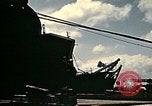
U.S. Sailors unload heavy auxiliary generator from a landing ship tank (LST) at Port of Tunis during World War II
Glimpse of American sailors; derricks; and a landing ship tank ( LST) at the Port of Tunis in World War 2. Sign on building reads: "A.S.T.B. Tunis." A sailor seen in the cab of a derrick at the controls. Sailors guide a large auxiliary generator down the ramp of the LST. The sailor-operated derrick lowers a cable with hook that sailors fasten to the generator and the derrick begins to lift it.
CRITICALPAST.COM: About Us | Contact Us | FAQs - How to Order | License Agreement | My Account | My Lightboxes | Shopping Cart | Advanced Search | Featured Collections | Website Terms & Conditions | Privacy Policy ©2026 CriticalPast LLC.
License Agreement |
Terms & Conditions |
Privacy Policy
©2026 CriticalPast LLC.