


 Francais
 Deutsch
 Italiano

Refine Your Search
B-24-Burma stock footage and images
- Showing 3145 to 3150 of 3692 results more
 Hide
Color Sound

Colonel Paul Tibbets, Pilot of the Enola Gay, describes his mission dropping the atomic bomb on Hiroshima Japan.
Crew members of the B-29 Enola Gay are interviewed about their atomic bombing mission over Hiroshima Japan by the United States Army Air Force, during World War II. In this interview at North Field, Tinian Island in Marianas Islands, Public Relations Officer, Major John F. Moynahan (not seen) interviews Colonel Paul W. Tibbets, Jr., Pilot of the Enola Gay Among things Colonel Tibbets mentions, he recounts that he took a steep turn to avoid radiation from the explosion. When he saw the explosion he was surprised about its intensity. The cloud from explosion covered the whole city of Hiroshima.

Major Thomas Ferebee, the bombardier aboard Enola Gay shares his experience of the Hiroshima atomic bombing mission
Setting: North Field, Tinian Island, Marianas Islands. Major Thomas Ferebee, the bombardier aboard Enola Gay (B-29 that bombed Hiroshima) is asked about his experiences, by Public Relations Officer John F. Moynahan (not seen). He recalls - His navigator aligned him correctly with the target. Hiroshima was clearly visible to him and so he was able to deliver the bomb. (World War II period).
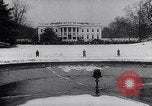
Harry Truman sworn in after death of Roosevelt and surrender of Germany to Allied Nations in World War II during 1945.
A review of significant events that occurred in the year 1945. Scenes from fourth inauguration of Franklin D. Roosevelt as President. Wide view of snow covered lawn of the White House, and guards positioned on the south White House lawn. View of President Roosevelt as he is sworn in as President of the United States, on the south portico of the White House due to wartime austerity measures, on January 20, 1945. Roosevelt, Winston Churchill and Joseph Stalin pose at the Yalta Conference. Death of Roosevelt in April 1945. Burial procession and funeral ceremony of Franklin Roosevelt. Men and women weeping. An African American woman waves her handkerchief as she mourns. Wreath on grave of President Roosevelt. Harry S. Truman sworn in as U.S. President on April 12, 1945. Surrender of the Germans signed by General Jodl and General W.B. Smith in Reims, France. Representatives of Russia, Britain, France and United States at the surrender. General Dwight Eisenhower smiles.
Soldiers, equipment, airplanes, training centers, commanders and others forming the organization of the United States Army.
Organization of the United States Army in World War 2. Massive group of soldiers doing exercise calisthenics on a parade field. Large groups of soldiers march and salute the U.S. National Flag. A tank production factory with war production workers. Soldiers boarding a troop transport ship. View of the USAT Edmund B. Alexander troop ship (formerly USS America, ID-3006) at a harbor filled with U.S. Army troops in transport. Graduation ceremony underway at a military service academy (possibly Westpoint) and awards given. Selection of soldiers for the U.S. Army. Infantrymen and artillerymen fighting in a battle. Generals and Chiefs of Army staff at a discussion and facing the globe in U.S. Capitol. Animated flowchart showing various levels of service and departments in the U.S. Army. Secretary of War is the Supreme Commander, followed by Chief of Staff and a Deputy Chief; general staff succeeds the hierarchy. Operations division has three major constituents: - Strategy and Policy group, Theater Group and the Logistic group. Nine theaters of operations are shown on globe. Military officials at work. Soldiers working in clerical duties and message centers. Personnel typing and filing papers. A soldier emptying a bin of shredded papers. Soldiers in intelligence operations listening to message transmissions and wearing headphones. Letters of soldiers transported in a bomber aircraft seen taking off. Commanders discuss, training to ground, air and navy soldiers. Westpoint cadets in a training exercise with transit sighting devices in a field. Officers including a U.S. Army 4 star general (possibly General Malin Craig) review a map. Trucks ready to supply equipment at war front. Construction site of the Pentagon, with dirt, trucks, and buses in the foreground. Pentagon in the background and Washington Monument in the distant background. Four groups of general staff, G-1, G-2, G-3 and G-4 are there to look after various departments such as induction, promotion, information, policy, mobilization, size, conflicts, transport and supply.

Officers of British Physical Damage Team, visit Nagasaki Prison destroyed by atomic explosion in Japan during World War II.
Allied forces in Japan after atomic explosion during World War II. A group of British military officers, members of British Physical Damage Team, examine damages by atomic explosion. Officers visit the destroyed Nagasaki Prison at approx 1000 feet distance from the ground zero. Officers examine effects of immense heat from explosion, on a discolored steel piece found in debris. Team of British officers, one of them smokes a pipe. Members of British delegation are shown in close ups: Captain W.N. Thomas, Professor of Engineering at Cardiff College, who led the team; Flight Lt. H. Elder; Squadron leader R.G. Whitehead; Squadron Leader J.B. Hawker; Special Duty Officer O.C. Young.

Famous castles and Royal residences in Denmark
The Klampenborg Hermitage, also known as the Eremitageslottet or The Eremitage Castle, in Dyrehaven (Eremitageslottet, Dyrehaven 4, 2800 Kongens Lyngby, Denmark), North of Copenhagen, Denmark. Various animals are seen moving in flocks and herds. Summer residence of Danish Royal families, Sorgenfri Palace, located in the Lyngby-Taarbæk municipality in Greater Copenhagen. Uniformed guards are seen at the gates. An officer on horseback rides out the gate. Frederiksborg castle, Hillerod, Denmark. Danish Royal Family’s Spring and autumn residence Fredensborg Palace (Slottet 1B, 3480 Fredensborg, Denmark) on the eastern shore of Lake Esrumon, the island of Zealand, Denmark. View of Kronborg castle in Elsinore, Denmark (famous from Shakespeare's Hamlet).
CRITICALPAST.COM: About Us | Contact Us | FAQs - How to Order | License Agreement | My Account | My Lightboxes | Shopping Cart | Advanced Search | Featured Collections | Website Terms & Conditions | Privacy Policy ©2026 CriticalPast LLC.
License Agreement |
Terms & Conditions |
Privacy Policy
©2026 CriticalPast LLC.