Events in 2nd Sino-Japanese War covering late 1930's through 1943 in World War 2 Scene opens with two Chinese army buglers sounding a call. Next, a line of recruits is seen marching on a field. Chinese officers sit at a table with civilian officials. A Huge crowd of army volunteers are seated, each holding a small white flag. Two more buglers sounding a call. Crowd of recruits move through a gate. Northern Chinese soldiers in fur hats march. Recruits are shown from the East and West of China. Recruits in formation. Bugler sounding a call. Chinese cavalrymen joining the army. More scenes of Chinese people joining together to fight the Japanese. Recruits engaged in close order drill and physical training. Uniformed soldiers in helmets, performing Calisthenics with rifles. Platoons of Chinese soldiers practicing marching and tactical maneuvers. Chinese youth training as first aid workers, carrying stretchers and learning first aid techniques. Chinese women in uniform marching with rifles. A Chinese girl kneels down behind a Maxim machine gun, as an officer instructs and other girls sit around in a group. Glimpse of girls training with rifles on an outdoor firing range. Claire Lee Chennault and his American "Flying Tigers" pilots and P-40 airplanes at an airfield. The American flag flying from a flagpole behind them. Pilots scrambling to their aircraft. Chenneult, now a U.S.A.A.F Major General, commander of 14th Air Force in China, in seen congratulating Chinese army aviators. He is accompanied by a Chinese Air Force General. Behind them is parked a B-24 Liberator bomber of the 308th Bombardment Group. A Chinese Nationalist P-40 with tiger teeth logo on air intake, starts its engine and taxis out for takeoff. View from cockpit of a P-40 pursuing and shooting down a Japanese Nakajima Ki-27 aircraft. Chinese soldiers in precision drills at a garrison.
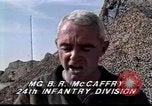
Major General B.R. McCaffry, 24th Infantry Division U.S. Army, stands in the desert of Kuwait and is interviewed . U.S. Army tanks in the desert during Operation Desert Storm. A U.S. soldier fires a hand-held rocket-launcher from top of a tank. Destroyed Iraqi enemy tanks in the desert.
Film begins showing steel framework for a new war plant under construction during World War 2. Next, workers are seen painting aircraft parts at the Vultee aircraft plant in Downey California. A crane at the plant moves an aircraft tail section to mate with the forward fuselage of an airplane. Cranes move wing segments through the plant. Workers, including a woman, lower a radial engine into place at the front of a BT-13 Valiant training airplane. A line of such aircraft is seen behind the one the camera is focused on. Scene shifts to the Lockheed aircraft plant in Burbank, California, where bodies of Lockheed Model 14 Super Electra passenger planes are seen covering the factory floor. A glimpse of Lockheed B-24 Liberator bombers in an assembly line next to men working engines of a partially assembled Electra 14 aircraft. Lockheed P-38 lightning fighter planes being assembled at another part of the plant. A P-38 taxis past a line of parked Lockheed Hudson light bombers and takes off on a test flight. View from below of gleaming aluminum P-38 climbing out. Aerial view from above of P-38 flying over land near some mountains.
World War 2 era film that also includes some World War 1 scenes. Show girls or chorus girls in follies-like show, costumed as U.S. silver dollars and marching to tune and lyrics alluding to dramatic increase of currency in circulation, over the years. Animation with stacks of coins shows increase in national income from $46 billion,in 1933, to $71 billion, in 1939, and $142 billion in 1943. Back to the "follies dollars," a boy asks why, and then scenes of the Japanese attack on Pearl Harbor,are shown, with U.S. battleships being sunk. Wartime arms plants are shown. An M2A3 Light Tank rolls off a production line. Ships being constructed in a shipyard. B-24 Liberator bombers being built in a factory. Artillery shells being produced. Defense workers receiving their pay. The "follies dollars" group themselves to illustrate the fractions of income devoted to taxes and savings. But other spending is curtailed by wartime shortages. A woman talking with clerk in a drug store. U.S. Army troops crossing a pontoon bridge in open trucks, towing 75mm M1A1 howitzers. Infantry on the march. Animation showing industrial production devoted to war materiel and lots of dollars chasing few civilian goods. A grocery clerk offers to sell a woman customer butter for more than the established price, and she agrees. The "follies" performers then introduce the idea of an "inflationary dollar," and some history of past U.S. inflations. Animated examples of price inflation are shown. Glimpses of World War I scenes are seen, circa 1917 -1918, including: a 12-inch railway gun firing; a huge explosion from shell bursting near the camera; various scenes of United States infantry soldiers and French soldiers in battle action, running to bomb craters for cover and emerging from trenches to go up "over the top" into no-mans land during combat. Meanwhile, singing narration refers to the home front inflation due to competition for limited civilian goods. Map shows Europe and singing narration cites rising prices for food in occupied France and other countries suffering ravages of World War II. Montage of scenes showing needy civilians obtaining food in those countries. Animation shows increases, by 1944, in cost of U.S. civilian goods since the Pearl Harbor attack. "Follies" character called "Double-duty dollar," appears explaining he serves the war and curtails inflation on the home front by being saved through investments in War Bonds and stamps.
U.S. offensives against Japan in the Pacific Theater during World War 2. A United States Carrier Task Force in the Pacific Ocean. Fighter planes and dive bombers on the deck of the Task Force. Sailors push trolleys containing bombs. A map shows Marshall Islands. Douglas Dauntless dive bombers take off to strike against the enemy. U.S. Navy fighter planes engage defending Japanese aircraft and down many of them, as seen in gun camera footage. The first wave of Douglas Dauntless dive bombers returns to its carrier for refueling, rearming, and debriefing. Sailors on the aircraft carrier man anti-aircraft guns to defend against attacking Japanese aircraft. Black flak fills the sky and a number of Japanese aircraft are destroyed by the anti-aircraft fire. A Japanese bomb explodes near the flight deck of a carrier. (Narrator notes that 85 Japanese aircraft were destroyed in this one operation.)An animated map shows New Britain Island. U.S. Major General William Henry Rupertus, Commander of U.S. Marines on a ship. He looks through a pair of binoculars as a U.S. planes (B-24 Liberators) drop bombs on Rabaul. U.S. warships launch an attack at the enemy positions. Fire and explosions. The Marines load into landing craft and move towards the shore. They land behind an intense naval bombardment. Marines head ashore from beached LCI-1 Class Landing Craft Infantry (Large), number 343. M 16 tanks, equipment, and artillery roll ashore from Landing Ships Tank (LSTs). . The tanks lead the way through the jungle terrain and the marines advance behind them. Marines fire mortars as they advance. They flush out Japanese from trenches and bunkers. A damaged Japanese Mitsubishi fighter plane and wreckage of others. Some dead Japanese soldiers. The Marines wade through deep water as they push on to Rabaul. Others advance through deep mud. More views of them slogging through mud.
Film begins showing a U.S. Army Air Forces C-47 transport plane in flight over the city of Cairo and Pyramids, in Egypt during World War 2. U.S. President Franklin D. Roosevelt's voice is heard speaking in his 1943 Christmas report to the Armed Forces. He states that following the Cairo Conference, he and Prime Minister Winston Churchill flew to Teheran, Iran. View of city of Teheran from an airplane overhead. View of front of the Soviet Embassy building there. Wider view showing conference principals on the porch with reporters and photographers below the steps. Next, a closer look with Soviet Marshal Stalin, President Roosevelt, and Prime Minister Churchill, seated on chairs, conversing. Closeup of the Big Three with their military commanders standing behind them. Views of ongoing Soviet operations on the Eastern Front. Russian troops firing field artillery from a snowy field. (A transport airplane is in the far background.) Shells bursting on snowy hillside. Soviet soldiers training in white arctic clothing rush through toward tanks and lie down in the snow. Three Soviet aircraft buzz a snow covered field. A huge explosion is seen and then Soviet cavalry charge across snow. View shifts to U.S. Army troops operating in Italy. A jeep filled with soldiers tows an artillery field piece across a shallow river. U.S. soldiers ride across a stream in a truck. Rear view of artillery piece being towed toward an italian town. Glimpses of aerial combat between Allied and German aircraft. General Dwight D. Eisenhower and General Mark Clark are seen riding in a jeep across a bridge in Italy. Glimpse of Italian people trying to clean up destroyed section of a town. Portrait of Benito Mussolini in the debris. General Eisenhower walking with a local British commanding officer and General Mark Clark, in Italy. Eisenhower and Clark at an outdoor briefing by British officers. Eisenhower pinning the Legion of Merit medal on U.S. Army Air Forces Lieutenant General Carl Spaatz, deputy commander of the Mediterranean Allied Air Forces who President Roosevelt says has been selected to be commander of Strategic Air Forces in Europe. Glimpse of B-24 Liberator bombers dropping bombs in Europe. Film shifts back to Teheran and the Big Three Leaders sitting in chairs. Closeups of them. Then their foreign secretaries step being them (Molotov, Hull, and Eden.) Nazi swastika flag. German armed forces marching on parade. German boys playing on artillery pieces under watchful eyes of German soldiers. Children at a playground. European farmers harvesting grain by hand. German troops in black parading. Glimpse of Adolf Hitler giving impassioned speech. Several views of Teheran conferees. President Roosevelt holding a ceremonial sword. Scenes of good will with hand shakes among conferees. Glimpses of British, Soviet, and Chinese troops attacking. Massed flags of the Allies.