


 Francais
 Deutsch
 Italiano
Refine Your Search
B-24-Burma stock footage and images
- Showing 325 to 330 of 3692 results more
more Hide
Hide
World War 2 film promoting public investment in War Bonds and stamps to aid the war effort and temper inflation
World War 2 era film that also includes some World War 1 scenes. Show girls or chorus girls in follies-like show, costumed as U.S. silver dollars and marching to tune and lyrics alluding to dramatic increase of currency in circulation, over the years. Animation with stacks of coins shows increase in national income from $46 billion,in 1933, to $71 billion, in 1939, and $142 billion in 1943. Back to the "follies dollars," a boy asks why, and then scenes of the Japanese attack on Pearl Harbor,are shown, with U.S. battleships being sunk. Wartime arms plants are shown. An M2A3 Light Tank rolls off a production line. Ships being constructed in a shipyard. B-24 Liberator bombers being built in a factory. Artillery shells being produced. Defense workers receiving their pay. The "follies dollars" group themselves to illustrate the fractions of income devoted to taxes and savings. But other spending is curtailed by wartime shortages. A woman talking with clerk in a drug store. U.S. Army troops crossing a pontoon bridge in open trucks, towing 75mm M1A1 howitzers. Infantry on the march. Animation showing industrial production devoted to war materiel and lots of dollars chasing few civilian goods. A grocery clerk offers to sell a woman customer butter for more than the established price, and she agrees. The "follies" performers then introduce the idea of an "inflationary dollar," and some history of past U.S. inflations. Animated examples of price inflation are shown. Glimpses of World War I scenes are seen, circa 1917 -1918, including: a 12-inch railway gun firing; a huge explosion from shell bursting near the camera; various scenes of United States infantry soldiers and French soldiers in battle action, running to bomb craters for cover and emerging from trenches to go up "over the top" into no-mans land during combat. Meanwhile, singing narration refers to the home front inflation due to competition for limited civilian goods. Map shows Europe and singing narration cites rising prices for food in occupied France and other countries suffering ravages of World War II. Montage of scenes showing needy civilians obtaining food in those countries. Animation shows increases, by 1944, in cost of U.S. civilian goods since the Pearl Harbor attack. "Follies" character called "Double-duty dollar," appears explaining he serves the war and curtails inflation on the home front by being saved through investments in War Bonds and stamps.
U.S. campaigns against Japanese in Marshal Islands, New Britain, and Rabaul, in the Pacific during World War II
U.S. offensives against Japan in the Pacific Theater during World War 2. A United States Carrier Task Force in the Pacific Ocean. Fighter planes and dive bombers on the deck of the Task Force. Sailors push trolleys containing bombs. A map shows Marshall Islands. Douglas Dauntless dive bombers take off to strike against the enemy. U.S. Navy fighter planes engage defending Japanese aircraft and down many of them, as seen in gun camera footage. The first wave of Douglas Dauntless dive bombers returns to its carrier for refueling, rearming, and debriefing. Sailors on the aircraft carrier man anti-aircraft guns to defend against attacking Japanese aircraft. Black flak fills the sky and a number of Japanese aircraft are destroyed by the anti-aircraft fire. A Japanese bomb explodes near the flight deck of a carrier. (Narrator notes that 85 Japanese aircraft were destroyed in this one operation.)An animated map shows New Britain Island. U.S. Major General William Henry Rupertus, Commander of U.S. Marines on a ship. He looks through a pair of binoculars as a U.S. planes (B-24 Liberators) drop bombs on Rabaul. U.S. warships launch an attack at the enemy positions. Fire and explosions. The Marines load into landing craft and move towards the shore. They land behind an intense naval bombardment. Marines head ashore from beached LCI-1 Class Landing Craft Infantry (Large), number 343. M 16 tanks, equipment, and artillery roll ashore from Landing Ships Tank (LSTs). . The tanks lead the way through the jungle terrain and the marines advance behind them. Marines fire mortars as they advance. They flush out Japanese from trenches and bunkers. A damaged Japanese Mitsubishi fighter plane and wreckage of others. Some dead Japanese soldiers. The Marines wade through deep water as they push on to Rabaul. Others advance through deep mud. More views of them slogging through mud.
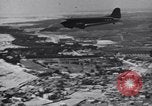
Leaders of U.S., Britain, and the Soviet Union meet in Teheran, Iran, to plan actions against Nazi Germany during World War II
Film begins showing a U.S. Army Air Forces C-47 transport plane in flight over the city of Cairo and Pyramids, in Egypt during World War 2. U.S. President Franklin D. Roosevelt's voice is heard speaking in his 1943 Christmas report to the Armed Forces. He states that following the Cairo Conference, he and Prime Minister Winston Churchill flew to Teheran, Iran. View of city of Teheran from an airplane overhead. View of front of the Soviet Embassy building there. Wider view showing conference principals on the porch with reporters and photographers below the steps. Next, a closer look with Soviet Marshal Stalin, President Roosevelt, and Prime Minister Churchill, seated on chairs, conversing. Closeup of the Big Three with their military commanders standing behind them. Views of ongoing Soviet operations on the Eastern Front. Russian troops firing field artillery from a snowy field. (A transport airplane is in the far background.) Shells bursting on snowy hillside. Soviet soldiers training in white arctic clothing rush through toward tanks and lie down in the snow. Three Soviet aircraft buzz a snow covered field. A huge explosion is seen and then Soviet cavalry charge across snow. View shifts to U.S. Army troops operating in Italy. A jeep filled with soldiers tows an artillery field piece across a shallow river. U.S. soldiers ride across a stream in a truck. Rear view of artillery piece being towed toward an italian town. Glimpses of aerial combat between Allied and German aircraft. General Dwight D. Eisenhower and General Mark Clark are seen riding in a jeep across a bridge in Italy. Glimpse of Italian people trying to clean up destroyed section of a town. Portrait of Benito Mussolini in the debris. General Eisenhower walking with a local British commanding officer and General Mark Clark, in Italy. Eisenhower and Clark at an outdoor briefing by British officers. Eisenhower pinning the Legion of Merit medal on U.S. Army Air Forces Lieutenant General Carl Spaatz, deputy commander of the Mediterranean Allied Air Forces who President Roosevelt says has been selected to be commander of Strategic Air Forces in Europe. Glimpse of B-24 Liberator bombers dropping bombs in Europe. Film shifts back to Teheran and the Big Three Leaders sitting in chairs. Closeups of them. Then their foreign secretaries step being them (Molotov, Hull, and Eden.) Nazi swastika flag. German armed forces marching on parade. German boys playing on artillery pieces under watchful eyes of German soldiers. Children at a playground. European farmers harvesting grain by hand. German troops in black parading. Glimpse of Adolf Hitler giving impassioned speech. Several views of Teheran conferees. President Roosevelt holding a ceremonial sword. Scenes of good will with hand shakes among conferees. Glimpses of British, Soviet, and Chinese troops attacking. Massed flags of the Allies.
U.S. Army battles against fortified Japanese forces during World War II, in Manila, Philippines
Wartime news film entitled: "Manila Cleanup." View of the Pasig River, dividing North and South Manila. American tanks and tank destroyers on North bank, firing at Japanese positions on the South side of the river. Exploding shells on South side. U.S. troops fire 155mm howitzers at low elevation, blasting the walls of Intramuros and adjacent buildings. The 540th Field Artillery fire 240mm guns point blank against the ancient walls. Troops firing machine guns at the Colegio de San Juan de Letran and Manila Post Office buildings. Troops of the 3rd Battalion, 129th Infantry, 337th Division, crossing the river in small assault boats, under covering fire. Landing on the South Bank, troops fan out around and about the walled city. Japanese forces resist from fortified pill boxes and machine gun nests near the public buildings. U.S. troops breach a section of the wall and elements of the 37th Division enter Intramuros on February 23, 1945. U.S. soldiers sheltered behind wall as others employ flame throwers. U.S. Soldiers prepares a TNT charge to blow up walls and seal underground passageways. A destroyed Japanese pill box at base of wall with many dead Japanese soldiers are seen. U.S. artillerymen firing 155mm howitzers directly at Japanese troops holed up in the Legislative, agricultural and finance buildings. Troops of B Company, 148th Infantry Regiment, advance from the Manila City Hall, towards the Legislative building. They direct flame throwers at Japanese fortifications under the wall. Soldier with flame thrower passes through group of riflemen and fires into hole in wall. U.S. soldiers fighting room to room in the walled city. On February 24th U.S. troops defeat the last Japanese resistors of Manila in World War II.

Detroit factory workers visit Camp Atterbury in WW2, and Army officials tour arms plants in Detroit.
Group of United Auto Workers visits Camp Atterbury during World War 2 to get a first hand perspective on what life is like for the soldiers who are receiving the military vehicles and weaponry they build as factory workers in Detroit. The auto workers exit a train car at the camp and run through steps similar to new recruits, including a basic medical check and receiving uniforms from a quartermaster. The auto workers try some of the same training drills as regular soldiers, including an obstacle course, bayonet drills, and crossing a ravine over water on a rope bridge while mock bombing takes place near them. The men clean dishes in a mess hall kitchen and make beds in a barracks. Scene changes to a Detroit factory where officers and soldiers from the Camp tour with the auto workers. They view B-24 liberator aircraft being built, tanks being built as treads are assembled onto vehicles, other vehicles being built. War production workers building and assembling war materiel. Welding and assembly line operations seen. Wide view of factory floor with many newly assembled military tanks and vehicles completed. Newly completed tanks are demonstrated on an open field as officials observe. A war production worker speaks and encourages fellow workers to work hard to support the soldiers.
Worldwide operations of United States Coast Guard in World War 2
Overseas activities of United States Coast Guard in World War II. U.S. Landing Craft Infantry, LCI(L) 617, part of LCI Flotilla 22 in World War 2. She is seen underway in rough waters of the Pacific ocean during 1945. Coast Guardsman ordered to Battle stations. A Coast Guardsman observes approaching enemy aircraft through binoculars. Coast guard gunner fires Antiaircraft guns using foot trigger. Enemy aircraft crashes in ocean. A Coast Guardsman signals using semaphore flags. Beachhead supply operations. Coast Guard Picket Boat, CG-42022, seen patrolling around U.S. transport ships in a Persian port, while they carry lend lease supplies to the Soviet Union. Coast Guard combat patrol in jungle using canines (dogs). The Cactus (A) Class 180 foot buoy tender, USCGC Tupelo placing a buoy at sea. Releasing a weather balloon. A Coast Guard wooden 83 foot cutter ("83 footer"). Loading a Coast Guard B-24 aircraft on Guam. The plane takes off. Invasion task force of U.S. warships underway. Coast Guard crews at various duty stations aboard their ships during the war. The former luxury ocean liner, SS Manhattan underway, her decks crowded with troops, following her conversion into the U.S.Coast Guard-manned USS Wakefield (AP-21). U.S. Navy attack transport USS Arthur Middleton (APA-25) at sea in the Pacific. Coast Guard operating transport ships unloading cargo for Allied invasion forces and running inter-island shipping service in the Pacific, during World War II.Landing Ship Tank (LST-788) arriving at the beach next to Landing Ship Medium, LSM-242, on Iwo Jima. A Landing Vehicle Tracked (LVT) being driven off LST-760. USS LCI(L)-87, Flagship of LCI Flotilla 10. Her Captain, M. E. Imlay, USCG, is seen on her bridge, before departing from England for the Normandy invasion. U.S. Landing Craft Infantry, LCI(L)-668 at beach and troops wading ashore.