


 Francais
 Deutsch
 Italiano

Refine Your Search
Baltimore Maryland USA 1958 stock footage and images
- Showing 469 to 474 of 25463 results more
 Hide
Color Sound
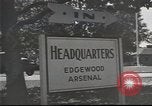
Bombs being manufactured at various chemical warfare arsenals and depots in the United States during World War II.
A film based on chemical warfare and incendiary bomb arsenals and depots in the United States during World War II. Headquarters of the Edgewood Chemical Warfare Arsenal in Maryland. Technicians at work building incendiary bombs in a plant. Plants for the production of mustard gas bombs in the Edgewood Arsenal. A line of mustard gas shells in production. The Pine Bluff Arsenal in Arkansas. View of production facilities at the Rocky Mountain Chemical Warfare Arsenal in Denver, Colorado. Incendiary bombs being manufactured by war production workers in the arms factory. The Deseret Chemical Warfare Depot located in Utah. 70,000 mustard gas barrels in a munitions dump. Eastern Chemical Warfare Depot located at the Edgewood Arsenal. Bombs being hoisted. Gulf Chemical Warfare Depot shows crated bombs being loaded on flat cars.
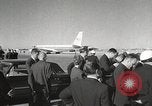
Lyndon B. Johnson becomes the new President of the United States after the assassination of President John F. Kennedy.
Assassination of United States President John Fitzgerald Kennedy in Dallas, Texas. Brief shot of Air Force One aircraft on runway before taking off from Love Field in Dallas Texas, carrying the body of the President to Washington DC. Still image of Lyndon Baines Johnson taking the oath of office en route back to Washington, as he becomes the new President of the United States. Air Force One taking off from Love Field in Dallas. View of Air Force One parked at Andrews Air Force Base in Maryland. Pallbearers and other attendants take out the casket from the airplane and place it in a hearse. First Lady Jacqueline Kennedy follows, holding the hand of Robert Kennedy, and they are assisted down from the lift to the ground. Mrs. Kennedy moves up to enter the hearse carrying the President's body. Brief view of mourners and people gathered behind fences at the airport. President Johnson and his wife debark from Air Force One. The President addresses the people through a microphone. He speaks about the sudden death of former President Kennedy and states that he will do his best for the country. Exterior of the White House at night. President Johnson and his wife debark from a helicopter at the White House. People gather near the White House to greet the new President. View through a White House window of President Johnson and advisors meeting that night.
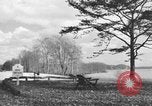
Mount Vernon Memorial Highway, and Rock Creek Park, near Washington, DC
Scenes along the Mount Vernon Memorial Highway, in Northern Virginia, near Washington,DC. Sign at section of the highway, reads: "South Fort Hunt." Automobile seen driving along the parkway that runs 15 miles from the Arlington Memorial Bridge to Mount Vernon. Views of the Potomac River which the highway parallels. Several cars in a parking area along the parkway, where sightseers enjoy the view. Sign warning drivers to slow as they approach George Washington's home at Mount Vernon. Visitors at the entrance to Mount Vernon. View of Mount Vernon mansion from the lawn on the Potomac River side. Scene shifts to Rock Creek Park in Maryland with views of the Rock Creek. Automobiles driving through the park. Views of Water falls,ducks, and an old mill with waterwheel turning. A car drives across the creek through several inches of water at a ford. An automobile approaching the Connecticut Avenue bridge over the parkway. Views of the Lincoln Memorial at Memorial Bridge.
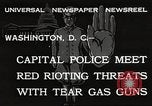
Policemen in the nations capitol stop communist activists' hunger-march truck convoy in Washington DC, during Great Depression
A hunger march by the communist activists in Washington DC. People gather on a street. Hunger march truck trains or convoys drive past on the street. Maryland State troopers on motorbikes drive past along with the vehicles. Posters and placards on the vehicles. A poster on a truck reads: 'Winter Relief Unemployment Insurance'. They are stopped by policemen. An officer with a tear gas gun on the street. People watch the vehicles. The policemen stand at attention on the street blocking the passage of the activists.
Americans voting and electioneering in national election on November 7, 1944, during World War II.
On November 7, 1944, during World War 2, citizens of Marblehead, Massachusetts, United States, are seen entering the Old Town House (built in 1727) to cast ballots in 40th quadrennial presidential election (in which incumbent President Franklin D. Roosevelt is running for an unprecedented 3th term). Scene shifts to inside a polling place, where voters stand in booths to privately mark their ballots. Others are seen depositing their marked, folded paper ballots in a collection box, as they finish voting. Closeups of several aged voters. One, an African American man, the narrator says is old enough that he was sold as a slave early in his life. Scene shifts to a full-blooded Native American Indian voter in Maryland, entering his polling place to cast a ballot. An old man who is a United States Civil War veteran, is shown sitting on a bench in a park in Los Angeles California, with friends. He holds a newspaper and wears a Civil War Union cap. A U.S. soldier wearing field uniform and steel helmet, looks at a bulletin board containing State-by-State voting information. A Technical Sergeant marks his paper ballot and leaves to mail it. A soldier takes an oath confirming legitimacy of his ballot as he turns it in at a military collection site. Sign in commercial establishment window of a U.S. town declares "Election Today." A bank window sign reads: "this Bank will observe Election Day, Tuesday, November 7th, a Legal Holiday." Sign in Bar window reads: "Bar Closed during Election Hours, Tuesday, Nov.7, 1944. Will Open at 9 PM." Republican political party workers advertise for their Presidential candidate, Thomas E. Dewey. Democratic political party workers drive a truck towing a trailer office plastered with advertisements for their candidate, Franklin Roosevelt. Republican and Democratic party voter information booths are seen next to one another where advertise their respective candidates to passersby on the sidewalk. A voting place identified by white wash sign on a window, and another, in a rural setting, by a sign pointing to it on a fence post. More signs and voters showing sentiments for their candidates. One displays a picture of Dewey on his car. A woman wears a large Roosevelt button on her sweater. Views of more imaginative signs for candidates and for ballot issues. People discussing ballot issues on the streets.

National commission of Fine Arts members study sites for the Equestrian statues at Arlington Memorial Bridge in Washington DC.
At time of sesquicentennial celebrations of the city of Washington DC: City development planning underway by the Planning Commission in Washington DC. Animated map of Washington DC by the National Geographic Society. Statue in a park. National Commission of Fine Arts members study sites for the Equestrian statues at Arlington Memorial Bridge. The commission members are seen walking across the Arlington Memorial Bridge from the Virginia side to the Washington DC side. View of the Lincoln Memorial and 1940s era cars in traffic circle and on Arlington Memorial Bridge. Commission members examine mock-ups of equestrian statues atop pylons at the Washington DC entrance to the bridge. (In 1951, the Arts of War Sculptures, named Sacrifice and Valor, by Leo Friedlander, were erected in those positions). National Capital Park and Planning Commission personnel are seen working at drafting tables in their offices in the Department of the Interior building. The Maryland National Capital Park and Planning Commission members meets in the Lord Calvert Mansion in Riverdale for future planning. Exterior view of the Lord Calvert Mansion. Inside, the commission meets and a man points to and explains a chart on traffic control. The chart, dated September 1947, shows traffic flow into Washington DC during the "peak hour" of traffic, during which 58,000 automobiles pass through the area being studied. Elevated, aerial view from the U.S. Capitol Dome looking out across the city of Washington DC and on to the Potomac River and Virginia on the other side of the river.
CRITICALPAST.COM: About Us | Contact Us | FAQs - How to Order | License Agreement | My Account | My Lightboxes | Shopping Cart | Advanced Search | Featured Collections | Website Terms & Conditions | Privacy Policy ©2026 CriticalPast LLC.
License Agreement |
Terms & Conditions |
Privacy Policy
©2026 CriticalPast LLC.