


 Francais
 Deutsch
 Italiano
Refine Your Search
Berlin Germany 1937 stock footage and images
- Showing 5689 to 5694 of 6871 results more
more Hide
Hide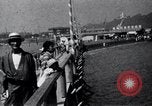
Western tourists visit Enoshima in Japan.
Tourists visit Enoshima Island, Kamakura County, Kanagawa Prefecture, Japan. Western tourists at bridge over Enoshima Seashore between Enoshima Beach and Enoshima Island and look at boats. Boats are moored at the jetty of Enoshima Island. Tourists walk down the bridge. View of Enoshima East Beach and hills in the background. Traditional wooden inns (called ryokan) at both sides of the narrow entrance path to Enoshima Shinto Shrine (2 Chome-3-8 Enoshima, Fujisawa, Kanagawa 251-0036, Japan) at the hilltop of Enoshima Island. A man fanning his daughter inside a ryokan inn.
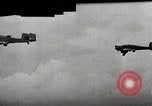
Aerial bombing of Shanghai City by Japanese during Second Sino-Japanese war
Japanese air attack against city of Shanghai, at start of 2nd Sino-Japanese war. Formation of Japanese 93-Shiki Soukei bombers in flight (Mitsubishi Type 93 Twin engine Light Bombers). Bombs falling from aircraft with city seen below. Bomb striking ground with large explosion. Civilians running for cover. Buildings on fire. Bombs striking ships in the Shanghai port. Buildings aflame. Japanese Aichi D3A1 aircraft diving. (anachronistic insert) Panic in the streets as people use any means of escape, carrying belongings in wagons and rushing into the International Settlement, by hundreds, or thousands, moving past British and French soldiers. French soldiers pass an infant to safety, across a barbed wire barrier. Shanghai International Settlement gates are closed as thousands remain outside, pressed against the barriers. Views of Chinese people crammed into the streets. Then they stampede into the center of the city, where some are trapped under falling buildings. More scenes of bomb explosions and burning buildings. A formation of Japanese Mitsubishi G3M bombers in flight overhead. More bombs exploding in the city. Fires burning and heavy smoke rising over the city. Dead and injured Chinese civilians. Firefighters spraying water on burning building. People trying to aid one another amongst dead and dying everywhere. Wounded being carried on stretchers and dead being piled into an open truck. Animated map showing Japanese occupying the entire peninsula east of Shanghai and then executing a coordinated drive through Soochow (Suzhou) and Kahsingfu, toward Nanking (Nanjing).
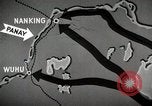
Battle of Nanking in China during second Sino-Japanese war
Japanese forces attack city of Nanking in 2nd Sino-Japanese war. Animated map shows Japanese forces moving from Shanghai towards Nanking. Arrow points to the American gunboat, USS Panay, in the Yangtze River. View of the USS Panay in the river, with large American flag displayed on its covering. A Japanese Navy Nakajima E8N reconnaissance plane in flight overhead. Explosions on shore of river as viewed from the USS Panay. Sailors firing anti-aircraft gun from the Panay. Wounded and dead U.S. sailors being evacuated from the gunboat as it sinks from bombing. The evacuation launch pulling away from the Panay. View of the Panay sinking by the stern in the Yangtze. Scene shifts to Chinese troops entrenched in defenses of Nanking. Chinese troops running to defensive positions from their fort. View from above of Japanese artillery crews firing field pieces. View from Japanese lines of shells striking Chinese fortifications on hill in distance. Closeups of Chinese infantry defending from wooded area in hills. Closeup of Japanese soldiers firing 75mm field artillery pieces and infantry advancing as their bugler sounds charge on his horn. View from fortress wall as Chinese army defenders stand ready to meet the charge. Japanese gunners firing 75mm field gun (Model 94). Japanese infantry breaching Chinese defenses and using scaling ladders to climb them. Japanese infantry charging toward the camera. They break open an entrance gate to the Chinese fortress and charge inside. Carrying Rising Sun flag, the Japanese infantry begin attacks within the Nanking city proper. some huddle behind a 75mm gun firing down a street. City buildings falling to shellfire. Infantry running through the city. Dense smoke rising from shelling. Japanese infantry running down an alley, with Pagoda in background. Field piece firing point blank at a building. Fires burning. Japanese troops celebrating victory as the city falls to them.
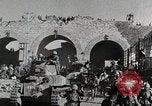
Rape of Nanking during 2nd Sino-Japanese war
Massacres in Nanking during second Sino-Japanese war. Japanese army troops and Type 89 I-Go tanks enter city gates to occupy Nanking, China. they break into a building and take away a Chinese man on a rope tether. Chinese inhabitants confined by the city walls are unable to escape brutal treatment by Japanese soldiers who are seen dragging men, women and children to be shot. Many are herded into a pit where Japanese soldiers standing above, execute them with rifle fire, as others fill the pit with earth, burying any survivors alive. Two Chinese kneeling with arms tied behind them are summarily executed by soldiers with rifles. A Japanese officer follows with a pistol to assure their death. Bodies of dead Chinese civilians litter an alleyway. Many scenes of Chinese killed by Japanese. (Narrator states that Japanese troops murdered 40 thousand men, women and children.) Japanese Field Marshal Count Terauchi Hisaichi is seen stepping from a transport airplane, followed by Field Marshal Shunroku Hata. Count Terauchi looks pleased as he is greeted and exchanges salutes with other officers. Next, the scene reverts, again to the horrors of Chinese peoples' suffering in Nanking, at the hands of the Japanese soldiers. Views of injured and wounded Chinese civilians, at a hospital, in pictures taken by an American Missionary, and smuggled out of china. A woman holding her injured husband as he lies against a cushion in a street. A small child stands near them. Scene shifts to a smiling Field Marshal Shunroku Hata, greeting local commanders, while photographers record the event in background. Views revert to the destruction and human tragedy in Nanking. A picture of Chinese leader, Sun Yat Sen. Chiang Kai-Shek speaking at a podium, and other Chinese political leaders speaking to gathered people, throughout unoccupied China, encouraging them to unite and resist Japanese aggression. Chinese people parading with banners to encourage resistance. Chinese soldiers and political leaders collaborating to raise armies. Chiang Kai-Shek ascending to Political leadership, exhorting Chinese to unite and fight the Japanese. Numerous scenes of rallies calling for unity and resistance. Chinese military officers standing as Chiang Kai-Shek enters a planning session. He sits and then they do. Behind him on the wall is a map of China. Closeup of Chiang as he outlines a strategy to slowly yield territory to Japanese invaders, to buy time for developing and arming Chinese forces. One of his staff goes to a wall map and gestures as he speaks. Next, Chinese soldiers are seen setting dynamite charges and blowing up lines of communication (roads). Chinese people pour petrol on grain fields and set them ablaze. Factory buildings being blown up and similar destruction as China pursues a "scorched earth" policy to hinder the Japanese invaders. Millions of Chinese people on the move to Western parts of China. (Narrator calls this the greatest human migration ever recorded.)
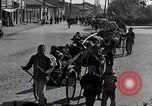
Chinese people migrate towards west in advance of Japanese forces during the 2nd Sino-Japanese war
Millions of Chinese people migrating west and invoking a "scorched earth" policy to slow advance of Japanese forces invading from Shanghai and Nanking, during the second Sino-Japanese war. Long line of Chinese refugees making the trek on foot and transporting their belongings on hand-pulled carts. Chinese entering a library, a school, and a hospital to salvage contents and take them west. Chinese people pulling amazing large loads on carts. Narrator says they salvaged hundreds of millions of pounds of machinery from factories. Trucks and oxen being employed to move goods and equipment on a two thousand mile journey westward. A huge crowd of refugees gathered along a railroad, all rise up from the ground as a steam locomotive appears in the distance. Closeup of Chinese people climbing into rail cars. A glimpse of some intrepid travelers climbing atop the cars. Next, the crowd works to dismantle the railroad, placing rails and ties aboard the train for future use and to deprive the Japanese of them. View of the train, moving slowly, with people occupying every imaginable place. Many crowd the front of the locomotive, itself. Scenes of other trains show many persons riding on tarpaulins that have been tied across the tops of rail cars. Some simply sit on the car roofs. Others are Jam-packed together on open air flat cars. Sampans and barges loaded with refugees and supplies are seen moving westward on China's rivers. Closeups of vessels filled with people. Passengers rowing and working to move the boats. Lines of Chinese crewmen pulling their boats upstream through narrow river gorges. Closeups of gangs of men pulling on tow ropes, as men on the boats assist using long poles to push the boats forward. People walking with backpacks. Narrator speaks of 30 million people moving westward. More scenes of the masses of humanity on the trek.
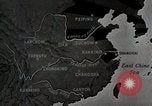
Chungking (Chongqing), new capital of China, is bombed by Japanese forces during Second Sino-Japanese war
The Republic of China establishes its wartime capital at Chungking (Chongqing), China during the Second Sino-Japanese War. Animated map depicts areas of Japanese occupation and highlights cities including Lanchow (Lanzhou), Chengtu (Chengdu), and Kunming. It highlights Chungking (Chongqing) as the new capital of Nationalist China. Generalissimo Chiang Kai-shek is seen leading a group of Chinese leaders as they walk through an arched gate in Chungking (Chongqing). A busy street with shops and apartment houses, in the commercial district. It is filled with pedestrians, cart traffic along the curbs, and automobiles in the road center. Boatmen on the Yangtze River are seen below long steep steps leading up to the streets above. Views of houses clustered along the cliffs, and workmen digging bomb shelters into the cliffs. View from inside a shelter being hollowed out of the rock. Back in the Japanese occupied area, a car brings a Japanese Air Force leader who addresses a large group of fliers at an airbase. Next, Japanese air crews are seen running to their airplanes from their camp on the airfield and taking off in their Mitsubishi G3M bombers, to attack Chungking (Chongqing). Nakajima Ki-27 airplanes take off from the field and join in large formations overhead. A formation of Chinese World War 1 era is seen inflight, ostensibly to engage incoming Japanese bombers. Japanese crew member in a bomber sees the Chinese fighters and gunners in the bombers get ready to fire on them. The Chinese fighter planes dive at the bombers but are intercepted by Nakajima Ki-27 airplanes flying cover. Aerial dogfights ensue with Chinese planes being shot down, and the bombers continuing their way. Air raid sirens sound in Chungking and people run to their shelters, including many school children. Views of bomber crews at their stations and then of bombs falling with the Yangtze River below. Bombs exploding along the riverfront and inland, along the cliffs. View of machinery operating, and Chinese workers occupied in underground factories in Chungking (Chongqing). Fires burning throughout the city, from the bombing, and Chinese fire fighters working to extinguish them.