


 Francais
 Deutsch
 Italiano
Refine Your Search
Bolinas Beach California USA 1934 stock footage and images
- Showing 6229 to 6234 of 26867 results more
more Hide
Hide
Israeli President Shazar and Foreign Minister Meir arrive for the funeral of assassinated President John Kennedy.
Foreign dignitaries arrive for the state funeral of assassinated U.S. President John F Kennedy. U.S. officials await the arrival of Israeli President Zalman Shazar. President Shazar enters the terminal with U.S. Secretary of State Dean Rusk and Israeli Foreign Minister Golda Meir. The President greets the Israeli Embassy staff. President Shazar, Secretary Rusk, Foreign Minister Golda Meir, Ambassador of Israel Avraham Harman and the military attache of the Embassy pose for the photographers. Secretary Rusk escorts the dignitaries towards the waiting cars. Photographers take pictures. A television presenter winds up the report on the arriving dignitaries.
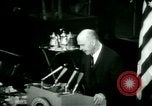
The shooting of President John Kennedy in Dallas, Texas is announced to a gathering at the Dallas Trade Mart.
A man stands at a lectern bearing the Presidential seal and announces the news of the John F. Kennedy shooting at the Dallas Trade Mart gathering, saying "The motorcade has been shot." He says "we will tell you as much as we know, as soon as we know anything." Another man comes to the microphone to lead a prayer. All present stand up and pray. People depart after the prayer. (President Kennedy had been scheduled to speak at a luncheon at the Trade Mart at 12:15pm that day. He was en route to the Trade Mart when he was assassinated.)

USAF Brig. Gen. Pfautz introduces a USAF documentary on Soviet military equipment and its use.
United States Air Force Soviet Awareness Program titled 'Heirs of Victory' depicts Soviet military equipment and its use in terms of purpose and jurisdiction. Introduction by Brigadier General James C. Pfautz, Deputy Assistant Chief of Staff, Intelligence, Headquarters U.S. Air Force. Brig. Gen. Pfautz gives details about the subject, translation, narration, and editing. The Soviet Communist hammer and sickle symbol. A Soviet long winged early warning radar keeps a watch in the sky. Soviet Air Force MiG-25 (Mikoyan-Gurevich) interceptor bombers with air to air missiles. Pilots board aircraft and they take off. The aircraft in flight. Soviet missiles and rockets protect the borders. World War II Soviet Air Force fighter pilot Nikolai Kozmoff talks to highly trained young Soviet pilots at a air base.
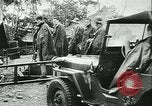
U.S. soldiers watch a film at a foxhole theater and films made for workers by the Signal Corps during World War II.
The role and contribution of the U.S. Army Signal Corps in combat and war. Army Pictorial Service films including screen magazines and GI movies are delivered to war fronts in all Theaters during World War 2. An officer arrives in a jeep with the films. Officers and soldiers around tents at the base. Soldiers in camouflage rain coats and hats seated at a foxhole theater. The soldiers watch the latest Joan McCraken Broadway hit Bloomer Girl. Scenes from the film. US: Pictures shown to workers depict the use of products manufactured by them at the war fronts. A poster reads 'B-52 Super Bombers, Bell Aircraft'. Men working inside the Bell Aircraft Corporation plant in NY. Huge machinery, equipment and aircraft parts being manufactured. Workers near stands piled with equipment and parts. A foreign version of the films made for Chinese allies. A U.S. officer talks to soldiers. The film dubbed in Chineese.
Army Signal Corps receive and send messages via various methods in World War II; Pentagon signal center operations.
The role and contribution of the U.S. Army Signal Corps in combat during World War 2. Submarine cables laid down by the Signal Corps. Soldiers operate field army communication equipment for communication within and between units. Soldiers talk over the radio in a military jeep. American soldiers employ communication equipment seated at a table in a camp. A U.S. Army Signal Officer goes through documents. An officer receives a message in Washington DC. The message is relayed from the State Department to the Signal Center in the Pentagon building. Exterior views of the Pentagon building circa 1943 or 1944. Inside the Army Communications Signal Center in the Pentagon, technicians work using various communication equipment. They receive messages punched on tape as the tapes emerge from machines. Workers encoding and decoding secret and confidential messages that run the war. Workers at the 'Traffic Control, Army Command and Administrative System'. Paper messages seen gliding across a track near the ceiling above a signboard. A man inserts and removes cables from switchboard slots. The plans are then passed on in code through a maze of antennas all over the world. An animated map depicts the sending of these messages by radio multi-channels, radio teletypes, and manual radios to the front lines. A vast network of Army communication system from Washington DC to the rest of the world to carry a message around the world in three and a half minutes.

V-mail procedures including cutting, microfilming, transport, photographic enlargement, and processing during WWII.
The use of V-mail (Victory Mail) by the United States during World War II. V-mail procedures including cutting, microfilming, transport, photographic enlargement, and processing of V-mail letters and post. A poster promoting the use of V-mail. Women in a line at a post office. The post office staff at counter windows serves the customers. A woman collects a V-mail letter, writes her message and then addresses the letter. The preferred use of a softer pencil in V-mails. Cutting: Specially trained soldiers unpack the V-mails and use a cutting machine to open each mail. Processing: The experienced staff sorts mails into the respective destination groups at sorting tables. Soldiers open mails to photograph them. A soldier sorts mail that can't be photographed and are to be sent back. These mails include stamps, enclosures, snapshots and bad writing. The correct mails are then sorted into given numbers in bundles. Microfilming: Women use Airgraph machines to photograph each mail on 16mm films. 1600 mails on 100 feet of film. The complete reels are sent for developing. Women put in new reels of negatives into the cameras. Developers dry the film reels. Stacks of reels on a table containing images of thousands of letters. Soldiers packing and stacking many hundreds of sacks filled with V-mail letter microfilm images. A Boeing 314 Pan American Clipper flying boat sea plane (military designation C-98) is seen taking off to transport V-mail to major destination points. A bag of microfilm reels is delivered to an officer. He unpacks the reels and sends them to the printing room. Enlargement: Enlargement machines are used to enlarge the snapshots. Men and women operate the printing machines. Soldiers with the printed facsimiles on tables. Processing: Women slice the prints into separate letters. Machines used to insert facsimiles into V-mail envelopes and seal them. The mails are then sent to the exact destinations by ordinary post. Soldiers gather around as a comrade distributes mail at a U.S. military base in the combat area.
CRITICALPAST.COM: About Us | Contact Us | FAQs - How to Order | License Agreement | My Account | My Lightboxes | Shopping Cart | Advanced Search | Featured Collections | Website Terms & Conditions | Privacy Policy ©2026 CriticalPast LLC.
License Agreement |
Terms & Conditions |
Privacy Policy
©2026 CriticalPast LLC.