


 Francais
 Deutsch
 Italiano
Refine Your Search
Budapest Hungary 1916 stock footage and images
- Showing 211 to 216 of 876 results more
more Hide
Hide
British troops attack German trenches during the Battle of the Somme in France, World War I
British soldiers during the Battle of Somme, World War I in France. German trenches bombarded on 1st July, 1916. Smoke rises. Soldiers of British Lancashire Fusiliers await instructions. Large group of British soldiers gathered and close-up views of the British soldiers, uniforms, and equipment being readied. Soldiers fix bayonets to their rifles and pass through communication trench to the first line. A huge mine blows up German trenches; view just after the explosion occurs (the Hawthorn Ridge Redoubt mine explosion). Royal Engineers arrive. A soldier looks through binoculars from behind sand mounds. British soldiers set up machine gun at the top of a trench parapet. Men at machine gun. Shrapnel bursts over German trench. British troops "go over the top" and launch an attack on German trenches under heavy enemy fire. Explosions occur but British soldiers continue to advance.
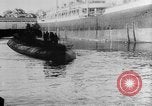
German Commercial merchant submarine Deutschland, departing New London, Connecticut following repairs from tugboat collision
Following repairs after it rammed the tugboat T.A. Scott Jr on November 16, the German merchant submarine "Deutschland" departs New London Connecticut, carrying silver bullion, for the voyage back to Germany, on November 21, 1916. At this time, it was a North German Lloyd Shipping Company merchant submarine evading the Entente Powers naval blockade of shipping lanes.

German Auxiliary Cruiser, SMS Möwe (Seagull) returns home after raiding operations in the Atlantic, during World War I
Officers on bridge of the auxiliary Cruiser SMS Möwe, homeward bound from raiding activities in the Atlantic, during winter of 1916. Small ice floes seen around the wake of the Moewe. As they approach Germany, an armed fishing steamer signals them to halt at once. View of the fishing steamer. A motor launch also approaches the Möwe through ice strewn waters. Numerous prisoners taken by the SMS Möwe are assembled on deck of ship. Her Captain, Count Nikolaus zu Dohna-Schlodien, addresses his crew and then salutes them as he prepares to board the motor launch to report onshore. view of the Count standing aboard the motor launch as it makes way in the harbor. Later, Admiral Reinhard Scheer, Commander of the High Seas Fleet, comes aboard the Möwe to congratulate its Captain and crew for their successes. He is seen addressing them and then exchanging salutes with Count Nikolaus zu Dohna-Schlodien. (World War i; World War 1; WWI; WW1)
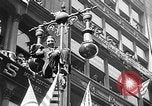
National Guard is mobilized for U.S. Punitive Expedition to Mexico
A spectator sits on a lamp post to watch soldiers of New York's 6th National Guard Division parade on a street in Manhattan, New York City, following their mobilization for the U.S.Punitive Expedition in 1916. Locomobile Armored cars of the 1st Armored Motor Battery, of the New York National Guard move along a roadway, followed by trucks carrying soldiers and automobiles and motorcycles. Spectators, including girls with flowers, watch from the roadsides. Scene shifts to open platform train station, where National Guard troops, with shouldered rifles, march onto the platform, next to a parked empty passenger train The platform is crowded with spectators and well wishers. Another scene shows a train filled with National Guard soldiers leaning out its windows, waving at friends and loved ones. Closeup of soldiers leaning out the windows of a Pennsylvania Railroad passenger car. Two of them lean out to hold babies and kiss them goodbye. Scene shifts to dusty outdoor rail yard, where army horses are being readied to board boxcars. Closeup of fenced corral in which horses are guided for loading. Huge numbers of horses are herded by cowboys into corrals. A group of National guard soldiers stand on a rail bed and wave and smile for the camera. Army wagons are loaded on flat cars in a train parked behind them. Next, a large contingent of National Guard troops is seen marching onto an Army base.
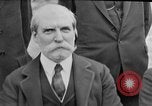
Republican Presidential Candidate Charles Evans Hughes, posing for pictures and listening to wireless radio
Former United States Supreme Court Justice, Charles Evans Hughes, who resigned to become Republican Presidential candidate, in the 1916 elections in the United States. Charles Evans Hughes Posing for photographs and listening to a wireless radio, with headphones, while seated at a table writing a note.
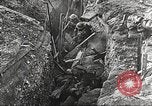
Scenes from British movie about the Battle of the Somme in First World War.
Excerpts from British movie about World War One Battle of the Somme. Map shows area of the Battle of the Somme and points to the region of Montaubon siezed by the British 30th Division on July 1, 1916. British World War I forces are seen entering former German trenches and resting. They clean debris from the trenches under German artillery fire. German troops counterattack out of trenches and cross the battlefield to engage entrenched British infantry. British fire at them with Lewis machine guns. Both sides sustain casualties.