


 Francais
 Deutsch
 Italiano
Refine Your Search
Budapest Hungary 1916 stock footage and images
- Showing 217 to 222 of 876 results more
more Hide
Hide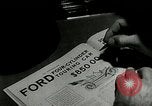
Application of assembly line techniques to production of Ford Model T automobiles
Actors recreate scenes at the Ford Motor Company in Detroit, Michigan during its early days. Ford hunches over a magazine, circa 1909, advertising the Model T Touring car for $850. He tries to figure how to lower prices so Ford workers, themselves, can afford to buy the cars they make. Sequence shows how teams of men first built individual cars, then specialized to build the same parts for all the cars; and finally how the moving assembly line came into being. Later actual sequences show the process adapted to subassembly of parts; and parts are seen being gravity-fed to workers. Finally, actual moving conveyer systems are shown in operation, with radiators, engines, chassis, and entire cars moving through the production lines. The result was that by 1916 a Ford Model T car could be purchased for $350. View of finished cars at end of Ford assembly line.
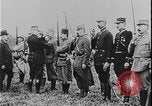
French Commander-in-Chief Marshal Joseph “Papa” Joffre awards ribbons, kisses the cheeks of French soldiers during WW1
Commander-in-Chief of the French forces, Marshal Joseph “Papa” Joffre, awards ribbons to French soldiers during World War 1. Marshal Joffre pins a ribbon on a soldier before giving a “faire la bise” kiss. Marshal Joffre pins ribbons, kisses the cheeks of two colonial soldiers wearing Fez hats (likely of Moroccan descent). This is possibly the award ceremony for Verdun that took place in 1916.
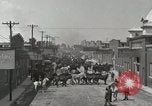
Mule market, Overton Park, and Brooks Memorial Art Gallery in Memphis, Tennessee.
Mule market in Memphis, Tennessee. Men sell mules on street. View from Overton Park in Memphis, with a view of the Brooks Memorial Art Gallery, opened in 1916, (now Memphis Brooks Museum of Art) among the trees, view of a lake with ducks in it, and various trees.
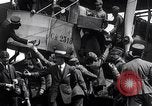
Aerial views of Verdun and Fort Douaumont during World War I
French soldiers and airmen gather around a Caproni Ca.3 bomber preparing for an aerial photography mission in World War 1. The identification number "Ca 2318" is stenciled on the airplane fuselage. The men load camera cases and equipment for the motion picture photographer, as officers watch. The Pilot takes his position in the front of the open cockpit as the photographer and second crewman sit side-by-side behind him. The pilot waves as they taxi out for takeoff. The next sequence contains views from the aircraft as it flies among clouds, and then shows Fort Douaumont clearly below, followed by the city of Verdun-sur-Meuse, and environs, including the Meuse River, bridges, buildings, and roads, without noticeable signs of any battles or damage, since the German offensive would not begin until the following year (1916).

Indian Prime Minister Jawaharlal Nehru passes away, India. Montage of scenes from his life
Huge crowd gathered on the death of India's Prime Minister Jawaharlal Nehru in India. He dies of a heart-attack. Events during his tenure as the Prime Minister: He gives a speech in front of a large crowd. He meets dignitaries of various countries during his career. He meets Shiekh Abdullah and Mohandas Karamchand Gandhi in 1916. He converted to the Mahatma's campaign for an independent India. He comes out of his car and arrives in a hall where he meets other British dignitaries. Crowd gathers at a place. Men on horses. He gives speech in front of the crowd. He meets President Truman in United States. Large crowd greets Nehru. He meets President Eisenhower. He discusses with President John F Kennedy outside a building. Dead body of Prime Minister Jawaharlal Nehru. A large crowd gathers to give tribute to the Prime Minister. The Indian flag lowered.
Events that initiated World War I and animated map showing involvement of nations from 1914 through 1918
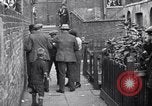
Opening scene shows a man being roughed up by a group of men in an alleyway. A slate comments (in French) that when nations are bellicose, an assassination can cause a world war. Next, a slate shows picture of the world and states (in English) "One murder may start a world war." Another slate (in French) states that In 1914, while Europe's armies and fleets were more powerful than they had ever been, the nephew of the Emperor of Austria (Archduke Ferdinand) was assassinated. A front page is shown of newspaper, "Journal De Geneve" carrying the story. Next scene is a view of the city of Sarajevo. The ancient Emperor's Mosque dominates the scene. A slate appears asking Where is Sarajevo? It is followed by a map of Europe in 1914, which zooms in on Austria and Serbia and identifies and labels Sarajevo,in Austria, close to the Serbian border. Slates (in French) says Austria accused Serbia of War and other nations enter the melee. Animated World map shows the nations getting involved, starting with the German Empire in 1914, including its African colonies, and then successively showing Russia, France, Belgium,Great Britain, Japan, and the Ottoman Empire. Map advances to 1915, showing the Italian empire, Bulgaria,and Central Arabia. In 1916 it adds Portugal, Roumania. Next, the U.S.A. is added in, 1917, along with Central and South America, Greece, Siam, and China. Finally, the slate shows the war ending in 1918. Slate shows Armistice Day, the 11th hour of the 11th day of the 11th Month (November), with time shown on hands of Big Ben in London.