


 Francais
 Deutsch
 Italiano
Refine Your Search
China 1963 stock footage and images
- Showing 115 to 120 of 1923 results more
more Hide
Hide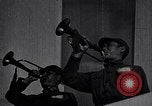
Chinese youth join the Army as Japan advances further in land and isolates China; Colonel Chennault and Flying Tigers.
Japanese invasion of China. Chinese soldiers blow the trumpet. Young men march in a field. Young men register in the Army. Millions of young people answer the call to fight for China. Volunteers from south, north, east and west China to form the people's army. Men and women with their children leave to join the forces. Drumming sound. New recruits train and perform a drill to drum beats. Soldiers practice martial arts, rifle handling, and shooting. Others train to care for the sick and wounded. Women soldiers in uniform. They learn to fire a gun. Pilots crowd around an officer. Planes in the background. Men from other countries prepare to fight for China. U.S. Colonel Claire Chennault of the American Volunteer Group Flying Tigers, talks to his men. The Curtiss P-40 Warhawks with the shark face emblems take off. Chinese soldiers march. Japan: Japanese officials in a meeting. Japanese troops penetrate China along the rivers. They rebuild destroyed rail roads using slave labor. A map depicts the Japanese strategy of cutting off Chinese supply lines. Japanese warships blockade the coast with the aim to isolate China. Japanese occupied ports in China. Japanese warships and boats in a Chinese port. Gas plants, gun factories and planes. Indochina map: The narrow gauge railway from sea to Kunming and a truck road to Chungking. The camel trail from Russia across the Gobi Desert. The railroad from Rangoon to Lashio in Burma. (World War II period).
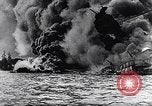
Japanese attack on Pearl Harbor in presaged by a decade of Japanese military aggression in China (WW2)
Opening scene shows the famous image of American battleship USS Arizona as attacked by Japanese forces in Pearl Harbor on December 7, 1941 in World War II. The ship is engulfed in black smoke, and listing. Change of scene to a waterfront in Japan during 1938, where numerous Japanese soldiers board troop ships bound for Manchuria, China. Next, are scenes of Japanese troops marching as they occupy Manchuria. Closeups of some Japanese soldiers. Scene shifts to a train moving on the South Manchurian railway, at a station showing a sign reading,"Chin Hsien." View of steam locomotive pulling a train away from the camera position. (Narrator states that a Japanese train, on the South Manchurian Railway, had been dynamited) This incident triggered a Japanese attack on Mukden, Manchuria. Japanese infantry are seen placing numerous bundles of reeds as a bridge across a wide, shallow, stream and proceeding to cross on their way to invade Mukden. Military supplies are carried on pack animals. In the air, overhead Japanese Mitsubishi G3M Type 96 land-based attack aircraft are seen flying in precision "V" formation. On the ground, Chinese civilians run for cover in the City of Mukden. (The date is September 18, 1931.) Glimpse of Chinese civilians looking at bombing victims on street of Mukden. Brief view of Geneva Switzerland, where League of Nations was housed. A memorial stone monument in that city to Woodrow Wilson, President of the United States and founder of the League of Nations. An entrance to the League of Nations headquarters in the Palais Wilson in Geneva, Switzerland. League delegates in session inside the Palais Wilson. A Japanese Naval Fleet, under command of Admiral Kichisaburō Nomura, is seen steaming toward the Chinese coast and begin a naval bombardment, firing their guns, 15 miles from Shanghai. Japanese Naval biplanes are seen in flight overhead. Japanese troops marching in the streets of Shanghai, as sidewalks of onlookers wave Japanese flags. Next, Japanese troops are seen marching out of Shanghai, at the insistence of the League of Nations. (Narrator states Japan signed a truce with China on May 4th, 1932.) View of Japanese troops entering further, into Mongolia. Japanese soldiers waving flag celebrating formation of the Puppet State of Manchuko in Northeast China and Inner Mongolia, in 1932. Japanese statesmen leaving the League of Nations headquarters, after Japan resigned from the League on February 24, 1933. Japanese infantry moving further into China supported by field artillery fire. Explosions from artillery and damaged buildings, as Japanese troops advance in China. Invaders using tall ladders to scale walls of a damaged fortress in China. Japanese pilots receiving briefing and boarding their Mitsubishi Ki-30 single engine light bomber aircraft at an airfield. View of them taking off and inflight, dropping bombs on Chinese targets. Aerial views of bombs exploding on ground below. Retreating Chinese army marching along the Great Wall of China. Chinese people and military forces moving their military and civilian resources deep into the Chinese interior.
U.S. President Nixon visits a Chinese resort city, during his departure from China and address after arriving United States.
Historic visit of U.S. President Richard M. Nixon and First Lady Pat Nixon to the People's Republic of China. President Nixon talks with Premier Zhou Enlai in Beijing. President with First Lady Pat Nixon, other delegates review an honor guard and shake hands with Chinese dignitaries. Chinese banners are seen in the background. President Nixon with Zhou Enlai and party flies in the U.S. Air Force One aircraft for a resort city. The party visits a public park. Chinese band plays music in the background. President Nixon and Patricia Nixon wave hands during their departure from Beijing. A large welcoming crowd awaits Air Force One and cheers. President Nixon and dignitaries disembark. President Nixon addresses about his visit to China. President Nixon boards the Air Force One to Hangzhou, China. View of the Xi Lake, also known as the West Lake, at Hangzhou. President Nixon and Mrs. Nixon visit the West Lake of Hangzhou and Shanghai, China. Children playing jump rope. Chinese men and women cycling on the streets of Shanghai. President Nixon and Mrs. Nixon wave at the crowd before leaving Shanghai. Animated maps show China and the United States. View of the Air Force One arrival at Washington DC. Nixon’s daughter Tricia Nixon Cox welcomes her parents. President Nixon makes a speech after his arrival from China.
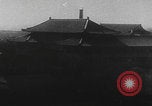
Japanese institutions and buildings in China before the Sino-Japanese War.
Front entrance of the Academy of Oriental Culture Tokyo Institute. The Academy of Oriental Culture building with two Chinese guardian lions or shishi (stone lions) flanking the entrance. The Toa Dobunkai Foundation Japanese Society of Cultural Work for China building (1 Sannencho, Kojimachi-ku Tokyo Japan) designed by Shinichiro Okada in Tokyo, Japan. The Japanese-run Tung Wen College or Toa Dobun Shoin Hongqiao Road School Building in Shanghai, China. Entrance to the Sino-Japanese Educational Association. The main building of the Dojinkai or Japanese Society for Welfare Work in China. The T’ung Ren Hwei Hangkow Hospital in Wuhan (Hankou), China maintained by the Japanese Dojinkai. The Japanese Hospital, Tsingtao (Qingdao, Shandong, China). Kiang-han Middle School building in Wuhan. A sign in Chinese at the entrance of the Peking Library of Modern Scientific Research in Beijing. View of the Shanghai Science Institute, now the Shanghai Institutes for Biological Sciences - Chinese Academy of Sciences (500 Caobao Rd, Xuhui District, Shanghai, China), designed by Japanese architect Yoshikazu Uchida, at the French Concession, Shanghai.
China builds Burma Road to carry war materiel and supplies and creates flood of Yellow River to thwart Westward expansion of Japanese occupied territory
Japanese officials meeting in strategy session. Japanese infantry on mission to cut Chinese supply lines during 2nd Sino-Japanese war. Black smoke rises as they move along a river bank. Chinese prisoner-workers are forced to rebuild railroads destroyed by the Chinese people during their great Westward trek. Japanese soldier closely guards workers. A Japanese army armored train underway on the rebuilt railroad, as Japanese soldiers cheer. Animated map shows China's supply lines by sea, to Tsingtao, Hangchow, and Amoy, cut off by Japanese naval blockade. Japanese Navy launch with officers and crew moving near commercial ships as they take over Chinese river ports. War materiel and other supplies destined for China, including trucks, sit idle, unable to be transported to their destinations. Large oil tanks and drums of gasoline are shown, as well as gun barrels and a flightline filled with parked Curtiss P-36 Hawk aircraft. The Imperial Japanese Navy destroyer Asakaze (DD-3) and another, next to it, in a Chinese river port. A Japanese freighter with anchored weighed, secured by long lines to a wharf. Small boats flying Japanese Naval ensigns are next to it. View of map showing china, Burma, Indo-China, and Chungking, with Japanese blockading fleet stationed in the South China Sea. It traces path of narrow gauge rail line from Indo-china to Kumming,China, where it connected to an overland road to Chungking. Next it traced the old Camel Caravan route, across China, from Russia. Narrator notes these were to small to be useful and too close to Japanese-occupied territory. Next, the map traces a railroad that from the port of Rangoon to Lashio, Burma. It is separated from the road to Chungking, by mountains and gorges. Views of the actual mountainous terrain. Animal pack trains moving through the area. Construction engineers in a large drafting room designing a road to transit the area. View of modern road-building caterpillar tractor equipment of the type needed to accomplish this. View of Chinese laborers using manpower instead. They push large rollers and employ pickaxes and other hand-held tools to carve away and dig road beds. Masses of Chinese laborers at work, carving a road along the edge of a mountain. Two-men teams using manual tampers to pound down the roadbed. Children are employed along with adults. A woman with a baby on her back, pounding large rocks into gravel, surrounded by other children doing the same. View from above of the "Burma Road," the product of their labors, winding its way through the mountains and gorges. Many scenes of trucks moving along portions of the Burma Road. P-40 airplanes flying past white cumulus clouds, overhead. Animated map shows continued expansion of Japanese occupied areas to encompass two thirds of the rail lines in China with goal of controlling the remainder, starting at Chengchow, in Summer, 1938. View of Chengchow region, on banks of the Yellow River. Map illustrates flow pattern of the Yellow River. View from past of the Yellow River's Spring floods toward the Sea, with Chinese people throwing rocks onto dikes that keep the river flowing in a more Northerly direction than its former course. Illustration shows how with Japanese encrouching on Chengchow, the Chinese decided to destroy those dikes and allow the river to flood over its former more Southerly course. Japanese soldiers being inundated by the flooding river. Japanese infantry and tanks regrouping on their occupied side of the new (old) path of the Yellow River. Local Chinese residents of Chengchow, wade with belongings as they leave their flooded homes.
U.S. Lieutenant General Daniel Sultan explains Japanese aggression in China and need for troops in India and Burma during WW2
World War II film about the China, Burma, India (CBI) Theater of Operations. A soldier is seen filling out a form seeking information about him and inviting him to write in questions about anything he hadn't learned through normal information channels. Scene shifts to Information and Education Department of the Burma-India Command, where it is being processed by a soldier. Lieutenant General Dan I. Sultan, commander of Burma-India Theater, is seen next, seated at a desk, with wall map of the region behind him. He is appearing in an information film intended to inform troops under his command. He notes that more than half the troops who filled out the information form, asked why American troops were stationed in India and Burma. He refers to the recent recall of General Stillwell and the splitting of CBI into two theaters (China and India/Burma). He states that the purpose is a path toward Japan. An animated map shows China (that narrator notes has been fighting Japan since 1937). Animation shows Japan walling off China from the outside world, by seizing her ports, and then concentrating its grip on the Eastern part of the country. Without access by sea, the allies had only one option to assist China in the fight against Japan. That was to open the Burma Road. Film shifts to scenes of Japanese bombing of Shanghai and Chinese civilians abandoning the city in 1937 during Second Sino-Japanese War. Wounded and injured Chinese fighting fires while tending casualties in an open area. Glimpse of Chinese soldiers near one of their few large artillery pieces. A gun crew manning one of her few antiaircraft guns. Chinese jam road in trek to the unoccupied provinces of the country. Chinese carrying casualties on stretchers, making do without ambulances. Chinese coping in the face of all kinds of shortages. In contrast, well supplied Japanese troops are shown in formation. Japanese troops, military vehicles and equipment are seen. Japanese firing machine guns and heavy artillery against Chinese positions. Japanese armor and long lines of troops engaged against the Chinese, who continue to resist in spite of shortages and hardship. Chinese soldiers without shoes, marching in a column.