


 Francais
 Deutsch
 Italiano
Refine Your Search
China 1963 stock footage and images
- Showing 121 to 126 of 1923 results more
more Hide
Hide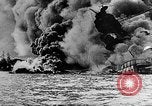
Japan extends its empire into Manchuria, Mongolia, and China in 1931 and 1932
Brief opening scenes show ships being engulfed in flames and smoke from Japanese attack on Pearl Harbor, December 7, 1941 in World War 2. Focus is primarily on the USS Arizona. Scene shifts to Japanese troops assembling on a pier and boarding troop transport ships bound for Manchuria and China, following the Mukden Incident of September, 1931. Japanese troops are then seen marching into Manchuria on September 18, 1931. A formation of Japanese soldiers presents arms. In another formation, they shoulder swords. Closeup of a Japanese soldier in a steel helmet with chin strap in place. A steam locomotive pulls a train into the Chin Hsien station on the South Manchurian Railway. A Japanese train on that line had been dynamited, triggering a Japanese push into Mukden. View from behind a train leaving Chin Hsien on the South Manchurian Railway. Japanese battalions place bundles of straw across a stream to facilitate troop crossing. A column of Japanese troops is seen crossing the water on the makeshift straw crossing. Japanese troops advancing along with supplies carried by pack animals. Troops traverse a sandy berm past an abandoned two-wheel cart. A formation of 12 Japanese G3M bombers flies overhead in a "V" formation en route to bomb Mukden. View of Chinese population running for shelter from the bombing. Chinese walk past some civilian casualties lying in a street. The League of Nations headquarters in Palais Wilson, Geneva, Switzerland. A memorial to Woodrow Wilson at the Palais Wilson reads: "A La Memoire De Woodrow Wilson President des Etats-Vnis,Fondatevr DL La Societe Des Nations, La Ville de Geneve." A car driving away from the entrance of the League Headquarters. Closeup of doorway with sign identifying it as the entrance for delegates and members of the Press. League delegates are seen inside its meeting hall. Japanese warships are seen next, attacking 15 miles from Shanghai with naval gunfire.Three Mitsubishi 2MR4 (Type 10)Reconnaissance biplanes are seen in flight above the barrel of a large naval gun. Japanese troops marching into Shanghai, as people on the roadside wave Japanese flags. Next, they are seen marching out of Shanghai at the insistence of the League of Nations. After signing a truce with China, on May 4, 1932, Japanese troops are seen entering Mongolia, in September, 1932, which they reconstituted as the Puppet State of Manchuko. A Japanese soldier standing atop a building waving a Japanese flag. Japanese statesmen resigning and leaving the League of Nations in protest after it labeled Japan an aggressor. Japanese forces fire a long barrel Type 89 cannon (150mm) as they push into China proper. Group of Japanese artillerymen use range finders, Periscopic viewers and binoculars to guide the gunners. Shell explodes raising large amount of earth. More views of artillery firing and infantry advancing. Infantry crossing a bridge and raising siege ladders to scale a fortress. Engines running on Japanese Ki 30 Type 97 airplanes, as pilots get final briefing and orders. They salute, board their aircraft, and are seen in formation aloft, dropping bombs. View from the air of bombs striking below. View from a bomber of its bombs dropping from the aircraft (bombs away view) and exploding on the ground. A column of Chinese soldiers moves along a section of the Great Wall of China heading into the interior of China. Civilians moving all manner of equipment and machinery into the interior.

The U.S. officers being greeted by and meeting other officials in China.
U.S. officers arrive in China. Commandant of the U.S. forces in China General Albert Wedemeyer makes an inspection tour of the American installations in China. He comes out of an aircraft. Other officials greet him. U.S. Ambassador to China Patrick Jay Hurley arrives and meets Chairman of the Nationalist Government of China Chiang Kai-shek. Prime Minister of the United Kingdom Winston Churchill meets local leaders in Athens, Greece.
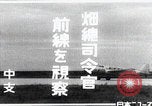
General Hata inspects Japanese troops in Central China (WW2)
A plane takes off from Nanjing, China. Commander-in-chief General Shunroku Hata talks to a military officer in flight to Central China. General Hata and other Imperial Japanese Army officers in Central China. General Hata and other officers inspect Central China Expeditionary Army in China during the Second Sino-Japanese War (World War II).
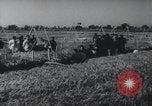
The agricultural reforms and people's communes under Mao Zedong's 'Great Leap Forward' plan in China.
Agricultural conditions in the People’s Republic of China under the Communist regime of Mao Zedong photographed by an Indian delegation visiting the country. Mao Zedong implements the economic and social plan titled 'Great Leap Forward' with Soviet help in 1958. The agricultural aspects of the plan (during which the great famine in China took place). The Chinese countryside. Farmers use tractors, machines, and other equipment for farming. Farmers plow fields, thresh crop and make haystacks using pitchforks. Men and women dig farmland. Millions of Chinese peasant people are organized to work the land, clear land, build dams and dig canals. Peasants working in Communist government-organized People's Communes for farming. Farmers work, cultivate and harvest crops using human labor to make up for lack of machinery. Chinese peasants seen farming barren land also affected by floods and locust. People engaged in construction work. People's Republic of China Chairman Mao Zedong visits the communes. The commune system is abandoned in 1961 in favor of collective agriculture. Small units of 20 farm families cultivate land as directed by local farmers. Farmers cultivate land, harvest crops. Men and women pick cotton. Young Chinese boys and girls attend university in China. Young boys on bicycles. University students in a classroom. The university campus. Children on the playground in a school. They perform the 'Turnip Dance' on stage as other children and teachers watch.
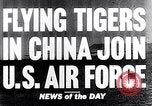
Brigadier General Chennault and Colonel Scott with Flying Tigers and their P-40 aircraft in China
Brigadier General Chennault of 23rd Pursuit Group U.S. Army Air Force, and Colonel Scott standing in front of a map of China. A picture of Chiang Kai Shek. Colonel Scott talking to Flying Tigers personnel and Chinese hosts. P-40 aircraft with shark teeth paintings seen in background. Colonel Scott is welcomed by Captain Wong of China Air force. Pilot R.T. Smith in cockpit of P-40 warplane. The plane has many Japanese kill flags painted on side. P-40s of Flying Tigers lined up. Aerial views of P-40 aircraft in flight. Pilots wearing new flying uniform but with special sign on back 'Free China' written on them. General Chennault inside aircraft as he begins command with his new role under the USAAF leading the China Air Task Force (later the 14th Air Force).
United States Army Air Force planes strafe Japanese ships at a sea in China.
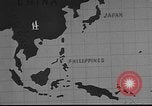
Allied attack Japanese positions in China. An animated map of China shows transportation of oil and other supplies in the region towards south of China. A fleet of ships towards the China Sea. United States Army Air Force planes in flight as they strafe Japanese ships. Explosions occur at sea. Water gushes high up in the air. The ships are strafed. (World War II period).