


 Francais
 Deutsch
 Italiano

Refine Your Search
Colombey-les-Belles France 1918 stock footage and images
- Showing 4717 to 4722 of 6533 results more
 Hide
Color Sound
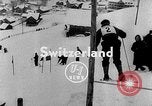
Top skiers compete for the Lauberhorn trophy in Switzerland
Top skiers compete for the Lauberhorn trophy, a top European meet. Participants from France, Germany, Austria and Switzerland compete in the skiing competition. A slalom race and a downhill event ends with the Austrians taking the trophy.
German Operation Barbarossa on the Eastern front in World War II.
View of the city, Pskov, on the Veilakaya river. A steel bridge is seen and city across it with smoke rising. German troops march in loose formation over a bridge in Novogorod. Views of German camouflaged tank (with shrubbery) and other armor and troops entering Soviet cities of Brest-litovsk, Minsk, Mogilev, and Vitebsk. View of German Panzer III tank heading toward the camera as it enters a narrow street in Smolensk. Animated map shows progress of these German advances and highlights German forces under German Field Marshal Gerd Von Runstedt cutting deep into the Ukraine. Headline on Chicago Daily News reads: "Nazis Claim Knock-out Victory" with subtitle line reading,"Moscow line cracks." Other newspapers reflect conviction that Soviet forces face imminent defeat by Germany. Slate shows communique issued by the German High Command, stating: "The issue in the East has already been settled. Smolensk is the last halt on the road to Moscow." More views of marching German troops. A battery of Soviet artillery firing from a snow-covered field. Animated map shows German forces moving close to Moscow. Foreign diplomats are moved from Moscow to the city of Kuibyshev. Hitler speaking on October 3, 1941, saying "This enemy is broken and will never rise again." Animated map depicts 500 thousand square miles of Soviet territory occupied by December, 1941, and compares it to the entire west central United States encompassing the states of : South Dakota, Iowa, Nebraska, Kansas, Missouri, and Oklahoma. Fires raging in agricultural area of the Soviet Union. Destroyed Soviet industrial plants, and huge numbers of Soviet citizens under German occupation. Views of destroyed Soviet armor, aircraft and artillery pieces. As season changes, German forces are seen in rain gear moving slowly through cold rainy weather. Some walk beside horses and other ride on horse-drawn caissons along with artillery pieces. Segments of film show contrast between the German military strategies. The German forces would plunge deep into enemy territory and create an area of conquest. This is illustrated by a slate bearing Adolf Hitler's statement that, "A single blow must destroy the enemy, without regard for losses, a gigantic destroying blow." An animated map illustrates the success of this approach by the Germans in Poland, France, and the Balkans. German Generals seen planning the same "Blitz" strategy against the Soviets. Film shifts to the Soviet strategy, showing their idea of building stronger defense, as they fall back, taking advantage of the great size of their territory. Views of Soviet troops on the move. View of Shells knocking out a German tanks. Panzer III tanks advancing. Panzer VI tanks completely covered by German troops catching rides. Soviet field artillery and machine guns firing in cities, forcing German soldiers to leave their vehicles. Soviet cities bombed out and burning, with debris and obstacles limiting the ability of armor to navigate in them. Montage of battle scenes cities of Rostov, Kharkov, Kiev, Kursk, Smolensk, all thwarting the Nazi blitz into the Soviet Union. Battles being waged in cities. (World War II; WW II; World War 2; World War Two)
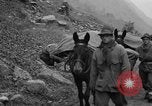
Italian mountain troops (Alpini) recover remains of victims from crash of USAF C-47 in French-Italian Alps
Italian Army Alpini recovering bodies of victims from United States Air Force aircraft C-47 which crashed in French Italian Alps, on October 24, 1954, while on a flight from Rome, Italy, to Lyon, France. The crash site is at 8,500 feet on Mount Carbonè, in Northern Maritime Alps, near Limone Piemonte, Cuneo, Italy. Italian Alpini (mountain troops) lead mules laden with bodies of crash victims, in canvas bags, down a mountain path. They are seen placing one such canvas bag into a coffin. A U.S. and an Italian officer then drape it with an American flag and Alpini pallbearers carry it to a waiting vehicle and gently place it on board. An Italian Alpini honor guard presents arms and its commander salutes.
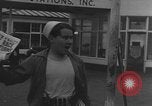
Republcan Thomas E. Dewey and incumbent Democrat Franklin D. Roosevelt, compete in 1944 U.S. Presidential election during World War II
The 1944 U.S. Presidential election in 1944, during World War 2. Newspaper boy hawks newspaper extra edition, with headline referring to "Nip and Tuck" race. View of Times Square in Manhattan, New York City, at twilight, as lights begin to turn on. Wooden barricades seen set up in front of some establishments to protect against damage from large crowds anticipated as election returns come in. Moving illuminated marquee sign on the Times building reads: "Nearly 45 per cent of Bronx and Manhattan voters said to have cast ballots." Two men look up at the sign. Officials open a voting machine and begin to report information. At another location officials remove paper ballots from their precinct box. A radio announcer reviewing results and reporting them over the air. A woman is seen entering voter returns in chalk, on a national tote board. Citizens gathered to watch results. American soldier listening to results over a radio, in Italy and France. Newscasters reporting on radio as the returns come in. Many people listen to radios. An American family of man, woman, boy and girl children seated in their living room listening to vintage console radio reporting voting returns. A fire is burning in the living room fireplace beside the console radio. Another, different scene is shown with a family gathered around a radio listening to election reports. A framed photograph of a U.S. Army soldier is atop the console radio. Scene is shown of crowds surging in Times Square as returns displayed on Times Building marquee indicate likely victory for FDR (Franklin Roosevelt). Crowd in Times Square including many American military service members in uniform.
Nazi leaders speak. Faces of Allied soldiers. Nazi massacres. Victims mourned. German troops surrender. American life.
Nazi leaders in Germany giving speeches during World War 2. Soldiers from various countries like England, Poland, Greece, America and Norway. View of young boy soldiers in Germany at end of World War 2. Earlier scene of Nazi Waffen SS soldiers as they march with goosestep on parade. Victims executed in Nazi massacre in Italy shown with hands tied behind their backs. Nazi victims mourned in France. Bodies of women and children slain by the Nazi SS in Belgium. A large crowd of civilians gathered to pay homage to the dead in Lublin, Poland. Allied military vehicles and personnel trample and walk on Nazi flags and posters in Germany. A pile of Nazi flags burning in the street, as men, women and children walk past. German prisoners of war assembled in a large outdoor enclosure, and moving out in a line. German soldiers surrendering, with white flags displayed. American soldiers look at open mass graves of persons shot dead by Nazis. Emaciated boy children inmates of Buchenwald concentration camp stand behind barbed wire fence around the time of its liberation. The prior scenes are contrasted with ordinary life in the United States. A boy retrieves a ball from a pond, and throws it. Children play on see saws at a playground. A baby take first few faltering steps. A girl hangs from monkey bar. A man and two women share a newspaper article.
Atomic bomb scenes WWII; atomic testing at U.S. Army atomic experiment station 'Camp Desert Rock' in Nevada, United States
Episode of "The Big Picture", a U.S. Army series of news release programs. U.S. Army cameraman recording Nike missile launch. Atomic cannon fires shell creating atomic explosion and classic mushroom cloud.. Army troops spill out of Sikorsky YH-19 helicopters. U.S. Army infantry soldiers ascend hill firing their rifles. Atomic experiments at Camp Desert Rock in Nevada, United States. U.S. Army Master Sergeant Stuart Queen seated at a desk in his office. He speaks about a series of atomic experiments ("Desert Rock 6") held in barren lands of Nevada at Camp Desert Rock. Celebrating victory in Europe, during World War 2, American troops parade down the Champs Elysees in Paris, France, with the Arc de Triomphe behind them. Happy Parisians watch the parade. War scenes in Japan: footage of explosion and mushroom cloud rising after atomic bomb blast over Nagasaki on August 9, 1945. Barren land on the ground in Hiroshima after the August 6, 1945 atomic blast there . B-29 bombers in flight. Atomic bomb test detonation. Atomic artillery gun M65, also called the Atomic Cannon or Atomic Annie, fires and creates nuclear explosion on distant target.Viking missile launch. U.S. soldiers on parade. Headquarters sign at U.S. Army atomic experiment station at Camp Desert Rock, Nevada, displaying 6-pointed star with "A" in center.. Several atomic test explosions. Soldiers on hillside witness a non-nuclear explosion. Buses carry troops along a road past a sign warning of radiation hazard. Army captain, instructor, briefing troops before the start of atomic maneuvers.. Maps of planned maneuvers. Engineer surveyors lay out ground zero target. View of the ground zero area which is the target area for testing. Signal men lay communication lines to receive and transmit teletype messages. Men operate machinery and dig trenches in which troops will take cover. Other men cover them with sand. [Note: According to the U.S. Department of State, Office of the Historian, from February 18 to May 15, 1955, the United States conducted Operation Teapot, a nuclear test series at Yucca Flat and Frenchman Flat on the Nevada Test Site in the continental United States. During the test period 14 nuclear shots and 1 non-nuclear shot were detonated. Several thousand scientific, military (army, air force, navy, marines), and civilian contract personnel participated in the organization, planning, and execution of the test series. Military exercises undertaken during and following the shots took place under the name Desert Rock 6.]
CRITICALPAST.COM: About Us | Contact Us | FAQs - How to Order | License Agreement | My Account | My Lightboxes | Shopping Cart | Advanced Search | Featured Collections | Website Terms & Conditions | Privacy Policy ©2026 CriticalPast LLC.
License Agreement |
Terms & Conditions |
Privacy Policy
©2026 CriticalPast LLC.