


 Francais
 Deutsch
 Italiano
Refine Your Search
Coney Island New York 1898 stock footage and images
- Showing 8437 to 8442 of 11259 results more
more Hide
Hide
Resignation speech of U.S. President Richard Nixon from the Oval Office of White House, Washington DC.
News report and resignation speech of President Richard Nixon from the Oval Office of the White House, Washington DC. Demonstrators in Lafayette Park with majority of women raise banners and demand Richard Nixon's resignation. News anchor Jim Lehrer from the studio previews the speech. President Nixon from the Oval Office in White House delivers his resignation speech. President Nixon speaks about the Watergate Scandal and announces his decision to voluntarily resign from the post of President of United States and he announces that Vice President Gerald Ford will be sworn- in as the new President of the United States.
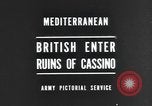
Re-enactment of British forces occupying the town of Monte Cassino, Italy, in World War II
Montage of scenes recorded after the Battle of Monte Cassino in World War 2. Opening scene shows New Zealand 19th RHQ tank in Mignano Montelungo, as the 24th New Zealand Battalion re-enacts its entry into the ruins of Monte Cassino, on March 26, 1944. In this restaging, 24th Battalion infantrymen are shown moving through rubble of destroyed town, firing small arms and one throwing a hand grenade. Narrator identifies "Hangman's Hill," (which was held by the 1st battalion 9th Gurkha Rifles) at Monte Cassino. In this restaging , New Zealanders, scramble over rubble, and dig out a "wounded" comrade, while explosions occur in background. Medics "attend" to him. Other NZ troops fire small arms from behind rubble barriers. A huge explosion occurs in background. A British artillery piece (obscured by debris) fires rounds. Infantrymen fire small arms. A camouflaged British tank fires its gun. In change of scene, other British troops advance cautiously near a damaged building and take several German soldiers prisoner. View of the destroyed Monte Cassino monastery and castle on Castle Heights. Ruins of building adjacent to the "Hotel Excelsior,"below the castle. Several medics with Red Cross flag in distant rubble. Views from destroyed Monastery atop the mountain. (World War II; WW II; World War 2; World War Two)
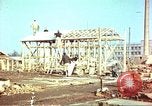
Japanese laborers work on houses under construction in Tokuyama-City, Yamaguchi Prefecture, Japan.
Construction of new houses in Tokuyama-City, Yamaguchi Prefecture. A new house under construction. A Japanese laborer drills holes through roof slats. The laborer picks up pieces he has drilled holes in and climbs up a step ladder and onto a roof. A middle class house recently constructed shows delicate and extension glass. Paneling for out doors and paper paneling for the inner corridor. Construction of a new Japanese house shows a carpenter using a tool to square lumber. Two workers roofing with bamboo. Construction of another house shows a bamboo thatched roof and in the background another house under construction. A man weaves a bamboo lathe for a house wall which is later to be plastered with mud.
Spanish Civil War. Soldiers recruited to fight fascist rebels. President appeals to nation. Irrigation project undertaken
Fascist Rebel bombardment of Madrid, during Spanish Civil War, angers population and promotes recruitment into the Republican Army. A group of men march down a street with a small boy, who appears to be in boy scout uniform, in the front rank, carrying a flag. Recruits are seen being organized into marching groups. Sidewalk in front of a railroad station is filled with new recruits. They march under direction of Republican soldiers. Motorcade of automobiles carrying Manuel Azana Diaz, President of Spain, stops surrounded by an enthusiastic crowd, in Valencia. The President steps from his car, enters a building, and delivers a speech emphasizing the democratic election of the government and decrying the need to defend it and the soil of Spain from fascist rebels. Scene shifts to several men in rural area, discussing the need to complete new irrigation projects in time for new defense of Madrid. They already have their pump and must build the pump house. One man types on a typewriter while another sketches the plan to pump water from the Rio Tajo (Tagus River), to irrigate crops. View of horse-drawn wagon loaded with cement for construction. Two men discussion construction plans. Masons using rudimentary methods to erect a pump house. Later view of pump house as men work on the roof. Men digging irrigationl canal from the river and upward toward the agricultural fields. A soldier who hitched a ride on a truck, jumps off. View of a letter he wrote a few days ago, on May 4th. He arrives at his house and is greeted by his mother. Farmers trimming plants in field to be irrigated. A boy calls one of them, his father, to come home.
American soldiers and WACs prepare for the arrival of Vietnamese refugees in the United States at end of Vietnam War.
Operation New Life and Operation New Arrival in the United States at the end of the Vietnam War. A building in a receiving area of Fort Indiantown Gap (FIG) near Jonestown, Pennsylvania. A sign board near the building reads: 'US Army Task Force New Arrivals Receiving Station'. Members of the 401st Personnel Service Company lining up in formation. Troops and Women's Army Corps (WACs) enter the building to prepare for the arrival of Vietnamese refugees. Members being briefed by an officer. Officer explains the use of paper forms. Soldiers and WACs listen. Officer addresses them. Members look at the forms. I believe the date this was shot was in late April we were there to stock all of the building before the refugees arrived. These solders and WACs were flown in from Ft. Carson. That day the fort was nearly a banded maybe 25 regular stationed there until our plane landed. We stocked every barracks with everything from tooth brushes, toilet paper to sheet and blankets. In a couple weeks we changed a ghost town into a town of about 30,000 people. I was in the second platoon front line next to the shortest WACs in the army.
Life under Soviet domination in Eastern Europe following World War II
Legislators entering a hall in Czechoslovakia, in 1948. Inside,an image of the Small Coat of Arms of the Republic of Czechoslovakia (1920) dominates the scene. New scene shows Gustav Husak, acting Prime Minister, delivering an address urging support for the Communist Party. The next sequence shows violent Communist-led demonstrations, as armed trade unionists riot in the Prague streets, attacking the offices of the political opposition. Police attempt to restore order. On February 25, 1948, the communists achieve a Czechoslovak coup d'état. On February 27th, Czech President, Edvard Benes, receives a delegation including communist Premier Klement Gottwald and the 12 new members of the cabinet, at the Presidential Palace. He is seen signing documents accepting the communist cabinet. Change of scene shows Czech Foreign Minister, Jan Masaryk, giving a speech rejecting the change. (He remained in office, but died under suspicious circumstances on On March 10, 1948.) View of Masaryk in his casket. Mourners at his funeral.The Czech Parliament Building with flag at half staff. President Benes seen strolling, using a cane, accompanied by his wife, Hana Benes, in the garden of their summer home, Benesova vila, in Sezimovo Usti. Narrator notes that he refused to sign a new constitution drawn up by the communists. He died of natural causes at his villa on September 3, 1948. Scenes of his funeral and of him in his casket. Views of Benes' state funeral, with mourners lining the streets. View of British Prime Minister Winston Churchill. Narrator describes circumstances using Churchill's term "Iron Curtain." A communist parade in an Eastern European city. A person who was roughed up on the street. View of East German uprising in 1953, being suppressed with Soviet tanks. Uprising in Poland in 1955 being put down by local police and Russian soldiers. Polish musicians playing and examples of Polish political cartoons permitted under relaxed communist rule.
CRITICALPAST.COM: About Us | Contact Us | FAQs - How to Order | License Agreement | My Account | My Lightboxes | Shopping Cart | Advanced Search | Featured Collections | Website Terms & Conditions | Privacy Policy ©2026 CriticalPast LLC.
License Agreement |
Terms & Conditions |
Privacy Policy
©2026 CriticalPast LLC.