


 Francais
 Deutsch
 Italiano
Refine Your Search
D-Day stock footage and images
- Showing 1411 to 1416 of 4856 results more
more Hide
Hide
Rescued inmates talks about their experiences at concentration camp # 3 in Linz, Austria towards the end of World War II.
Rescued inmates of the concentration camp # 3 talk about their experiences in Linz, Austria towards the end of World War II. The rescued assembled outside a wooden house. Those who were inside the house look outside through a window. The inmates are emaciated. An Italian talks about the adverse living conditions they faced at the concentration camp. He states that they had very little food, they slept 3 or 4 to a bed and there was no way to wash. He said he was also at Mauthausen for a time before being transferred. In total he had been in concentration camps for 8 months and considered himself very lucky to have lived. He said that in Linz there were 50 men in his quarters and each day 3 to 4 men died. He tells how he worked in a forced labor factory in Linz building tanks for the Germans, working 12 hours a day as a welder.
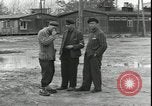
Inmates at concentration camp #3 in Linz, Austria discuss their experiences while held prisoners by the Germans in World War 2
Near the end of World War II, three freed inmates at a German concentration camp in Linz Austria (camp #3) discuss their treatment while at the camp. They speak in English but with varying accents including French. They speak in an open yard of the camp, with barracks in the background. The former inmates talk about lethal injections, cold baths, whippings, hangings, and extermination camps. They also talk about the joy when the camp was liberated by the Americans, which was preceded by the Americans bombing the Nazi forces in the area. They mention that the bombing cut off the water to the camp so the SS forces could no longer subject inmates to the cold baths. They discuss hangings of three prisoners from a scaffold in the yard behind them, and how all the camp inmates were assembled and forced to look at the hung inmates. One of the freed inmates talking is named Alex. They discuss how the jews in the camp had been rounded up and locked in a room with no food. They were in the room two days before being saved by the Americans. They also talk about the camp at Mauthausen where prisoners were subjected to hard labor, torture with heavy rocks, and executed by the SS after 5 days. Also they speak of inmates put in chains and dogs used at Mauthausen.

At the end of World War II in Europe, President Truman speaks and crowd celebrates in New York Times Square.
A film titled 'The war ends in Europe' shows American people celebrating the end of World War II in Europe following surrender by Germany. A crowd in New York Times Square celebrates Victory in Europe Day (V-E Day). People pray in a church. U.S. President Harry S Truman announces the German surrender.
Scenes related to politics and governance in Great Britain. American servicemen and women watch traditional British ceremonies
United States military airman with British civilians discussing politics in The Mother Shipton Pub (Mother Shipton, 1 Malden Road, NW5) in London. U.S. Soldier listens with British spectators to speaker in Hyde Park. British steelworker relaxing at home with wife and daughter, in unfazed by political issues in newspaper of the day. Photo album with family pictures. Queen Elizabeth II riding in Royal Coronation Coach on streets of London, surrounded by cheering crowds, on the day of her Coronation, June 2, 1953, escorted by Royal Guards on horseback. American servicemen and women watch changing of the guard at Buckingham Palace. Queen Elizabeth on horseback during the Trooping the Colour.
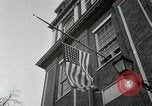
People casting their votes in an automatic voting machine and booths during the 1960 Presidential Election in the U.S.
The 1960 Presidential Election in the United States. The U.S. flag displayed on a building on the election day. Cars moving down a road. Boards displayed in front of banks and other business places declaring the day to be a legal holiday. People gathered outside schools and community halls. People voting through paper ballots. People waiting in a queue to vote using an automatic voting machine. Men and women reading a printed paper to choose the Presidential or the Vice Presidential candidates. A man inside a polling booth enters an area separated by a curtain and casts his vote in a polling machine. Men and women walking past officers seated at a table in the booth. People casting their votes in ballot boxes. A ballot box has 'Town Of Barnstable' written on it. A man turning a lever on the box. A woman placing a ballot paper in the box. 'State Election, Official Ballt, Barnstable' written on the ballot paper. The number on the box changes from 843 to 844. Another man placing a ballot paper in the box.
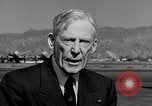
Lieutenant Law and Igor Sikorsky talk about their experiences and experimental aircraft in flight in the United States.
Part of a series of films about the history of aviation in the United States.Retired United States Air Force Brigadier General Frank P. Lahm is seen speaking about his aviation pioneering days, when Orville Wright taught him and Frederick E. Humphreys of Army Engineers (both Lieutenants at the time) how to fly the Wright Flyer airplane. Views of a Wright Flyer maneuvering in the air above Fort Myer, Virginia. Somewhat later, two are seen in flight at Fort Myer. An early Curtiss airplane.is maneuvered on the ground to face away from the camera. Russian, Igor Sikorsky in an early rear propeller airplane. Igor Sikorsky at a desk in a modern engineering office. Sketch of a helicopter on drawing board behind him. He talks about the early days of experimental flight in 1909 and 1910. View of Louis Bleriot sitting in the open cockpit of his airplane, and then of him flying overhead in his famous flight across the English Channel. Obeservers watching his progress through binoculars and a telescope. Sikorsky standing next to his first helicopter (which didn't fly).
CRITICALPAST.COM: About Us | Contact Us | FAQs - How to Order | License Agreement | My Account | My Lightboxes | Shopping Cart | Advanced Search | Featured Collections | Website Terms & Conditions | Privacy Policy ©2026 CriticalPast LLC.
License Agreement |
Terms & Conditions |
Privacy Policy
©2026 CriticalPast LLC.