


 Francais
 Deutsch
 Italiano
Refine Your Search
D-Day stock footage and images
- Showing 1771 to 1776 of 4856 results more
more Hide
Hide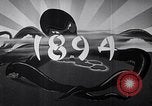
The Rise of Japanese militarism in the 20th Century
Film opens showing reenactment of Japanese attack ostensibly against Formosa, in 1894. Japanese troops and artillery are shown. The event is depicted in a critical political cartoon. Next, Japanese Admiral Heihachiro Togo is seen in 1904, standing with other naval officers. Then, Japanese warships are shown, firing barrages of naval gunfire at the Russian fleet in Port Arthur, Manchuria. Huge black clouds arise from burning ships. Scenes of Japanese people celebrating their naval victory. Date shifts to 1910. Cartoon depicts Japanese annexation of Korea. Cartoon illustrates Japanese actions in World War I when, siding with the Allies, Japan acquired the German-held Shandong (Shantung) Peninsula of China, as well as German-held Marianas, Carolines, and Marshalls islands in the Pacific. Japanese representatives are seen participating in Post World War 1 international activities. They signed the so-called Five-Power,Four-Power, and Nine-Power treaties, and participated in the League of Nations. Glimpse of two Japanese officers, followed by cartoon depiction of the Mariana, Caroline, and Marshall Islands, that Japan insisted on keeping. Cartoon shows them being fortified. A Japanese military marching band parades down a city street while being cheered by spectators on the sidewalks. Next, Japanese military General, Baron Tanaka Giichi, is seen in uniform with other officers. Cartoon illustrates the so-called Tanaka Memorial document that Baron Tanaka allegedly presented to the Emperor, in 1927, outlining a strategy to conquer the world. Cartoon then illustrates plan of conquest by acquiring Chinese manpower; Manchurian iron and coal; Siberian timber, coal, wheat, and metals; Tin,oil and rubber from Malaysia and the East Indies. The United States is shown as the last conquest. Views of ordinary farm and factory activities in the U.S. Cars parked in the Ford Motor Company factory lot. Japanese officials and legislators meeting in the Diet (Parliament). Japanese theater patrons and a Japanese woman singing with an American-style band, are shown as examples of activities the Japanese Government sought to discourage. A Japanese female ensemble in traditional dress, playing traditional instruments, is shown as more desirable. Western dancing and western hollywood movies are shown and narrator states they were forbidden by the Japanese government. Japanese movie scene depicts ancient martial arts. A musical production on stage displays German Nazi swastika flag , Japanese rising sun, and symbol of Kingdom of Italy, celebrating the axis alliance. Japanese men are shown playing the ancient game of Chu Shogi, instead of playing Western card games. People are shown in a library, where Western books are replaced by more militaristic tomes, such as: "If we fight" by Admiral Shinsaku Hirata, March 15, 1930 (shown on film slate). Slate goes on to quote about attack on Hawaii as the first battle in war of the Pacific. Film cites another approved Japanese publication: "Arguments Against American Policies" by Kawashima Seichiro, Christmas Day, 1924. It discusses distruction of the American fleet and subsequent landing on the U.S. West Coast.
Montage of scenes related to 1942 Fall of Corregidor, the Bataan Death March, POWs and destruction of manila, in World War II
World War 2 scenes related to the Philippines. Opening shot shows Japanese troops unceremoniously taking down American flag in 1942, followed by superimposed images of Japanese soldiers boots trampling over U.S. flags. Next, U.S. Lieutenant General Jonathan Wainwright with members of his staff, are seen seated at a table in the Japanese headquarters building on Bataan to discuss surrender with General Masaharu Homma, Commander of the 14th Japanese Imperial Army. Homma has General Wachi at his left and Colonel Nakayama to his right. Repetition of the superimposed Japanese army boots trampling American flags. Next, U.S. defenders of Corregidor are seen surrendering to Japanese troops in 1942, and then being marched under guard to Mariveles, where the infamous Death March commenced. Several views of the American and Filipino prisoners marching under guard. Glimpse of American combat helmets piled up in a heap. Views of the POWs without helmets, using white cloths over their heads to protect from the sun. Huge numbers of POWs held in an open area for the night, and then marching again during the day. One who had fainted is carried in a blanket by several others. Illustrations of POWs being tortured by Japanese soldiers. Views of two POWs, who died during the march, lying on the ground. Next scene shows emaciated Allied POWs in 1945 being freed by American soldiers from a Japanese prison camp. American soldiers speaking with another group is a section of prison behind a sign reading: "Dysentary, Keep Out." Undernourished former prisoners of war eating a meal. One smoking a cigarette. Aerial view showing large swaths of Manila, Philippines, destroyed by Japanese forces retreating from advancing American forces. Smoke rising along a line of destruction in the background. Bodies of numerous Filipinos lying amid rubble in the streets of Manila. Many have hands tied behind their backs. Glimpse of dead children. Cadres of Japanese soldiers raising victory cheers. New Japanese conscripts in large formations during military training for new recruits following draft. Japanese naval trainees in white uniforms, waving their hats. Huge crowd of Japanese people cheering, followed by view of Emperor Hirohito, in Army uniform, saluting as he stands on a balcony. Cheering Japanese people, at a rally in a stadium.
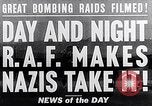
British R.A.F. bombing raids by A-20 aircraft in German-occupied France and over Germany in World War II.
World War 2 Newsreel footage of British air raids on German occupied France, titled "Day and Night R.A.F. makes Nazis take it !" Six Douglas DB-7/A-20 Havoc attack bomber aircraft (American made, but ordered by Britain) take off from England and are seen flying in formation over the English Channel. A-20 Havocs approach beach. A-20 Havocs over French countryside. Point of view footage looking out from cockpit of airplanes flying low over French countryside and approaching German held industrial and chemical plants in Lille making German munitions. View of bombardier pulling bomb release trigger, followed by bombs away view. Damage done by bombing seen. Port and buildings being bombed by A-20 bombers at St. Malo. Explosions seen in dock areas from the air. Back in England, RAF pilots suit-up in cold weather gear for night bombing flights over Germany. View of a line of carrier pigeons each in a box, to be carried in each plane and released if the pilot gets in trouble. A pilot carrying a pigeon in a box. Bomber crews consult together at their planes before boarding. U.S. airmen being trained join together with RAF flyers and board Avro Lancaster bombers for the night raids. Lancaster bombers taxi and takeoff. Halifax III taxiing and taking off. Hawker Hurricane or Spitfire fighters seen in flight ready to engage Nazi fighters. Views of actual bombing raid on a German city by Lancaster bombers. Incoming flak and anti-aircraft fire. Explosions on ground over targets in Germany. [Note: Interestingly, the film uses shots of a German Junkers 88 bomber, instead of a Lancaster, to illustrate the nose of the aircraft at night.]
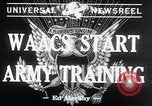
WAACS start Army training in Des Moines, Iowa, in World War II.
WAACS begin their first day with the corps during World War 2. Women exit a clothing warehouse carrying bags of clothing. Women officers of Women's Army Auxiliary Corps (WAACs), seen wearing uniforms. Beds in a row in a barracks during inspection. Two women officers shaking hands. Women stand in line to go into the mess hall. Women officers eating and drinking in the mess hall, including African American women who eat at racially segregated tables. Women stand at attention outside in rows. They march together in line.
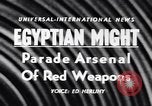
Newsreel ''Egyptian might, Parade arsenal of Red weapons'
Russia's new Foreign Minister Dmitri Shepilov is present in the closing of three days Egyptian Celebration. Egyptian audience clapping during the parade. Egyptians celebrate as the last British Troops are withdrawn from Suez. An impressive parade of newly acquired Red tanks, guns and other war material. Parade presided over by the newly elected President Gamal Abdel Nasser.

A film titled 'The Warning' showing scenes of London as citizens prepare for air raids (WW2)
A film titled 'The Warning' from World War II. Narration in Japanese. Street scenes in London. Factory whistle blows announcing end of work day. People walking on the streets. Houses and city streets in view. Double decker buses and cars seen. Children playing beside a river (presumably the Thames). Boats and swan seen in the river. Newspaper headlines seen, including "War chiefs discuss mobilisation"; "Stocks Slump"; "All Navy Reserve Called Up" and "The Crisis: Latest" seen on The Evening Standard. People playing tennis, cricket and golf. Buildings seen. People sitting in a pub (bar). Antenna of transmitter on radio station. An air raid information message being transmitted from the British government on radio stations during the time of the German Blitz. British people at home and work seated and listening to their radios as the broadcast message is read. British military forces on shore of the English Channel readying anti-aircraft batteries. Japanese narration overlays clip.
CRITICALPAST.COM: About Us | Contact Us | FAQs - How to Order | License Agreement | My Account | My Lightboxes | Shopping Cart | Advanced Search | Featured Collections | Website Terms & Conditions | Privacy Policy ©2026 CriticalPast LLC.
License Agreement |
Terms & Conditions |
Privacy Policy
©2026 CriticalPast LLC.