


 Francais
 Deutsch
 Italiano
Refine Your Search
D-Day stock footage and images
- Showing 2077 to 2082 of 4856 results more
more Hide
Hide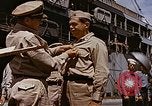
Officers and men of the USS Catfish (SS-339) receive their Submarine Warfare Insignia, near end of World War II
The officers and men of the U.S. Navy submarine USS Catfish (SS-339) receive Submarine Warfare Insignia pins during final days of World War 2. An officer pins the "Dolphins" on the officers while the crew stand in formation on the deck of the submarine. The officer then presents badges to each of the men and shakes hands with them. After the ceremony concludes, a Chief Petty Officer displays his Submarine Warfare Badge.
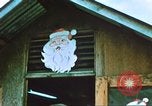
Christmas celebrated by troops in Vietnam and aboard the USS Kitty Hawk
U.S. troops celebrate Christmas in Vietnam during the Vietnam War. A cardboard cut out depicting Santa Claus at the entrance of a barracks. A soldier holds a small white Christmas tree. Other soldiers decorate a tree with ornaments. A Christmas tree and a cross at the entrance of a chapel. United States Navy aircraft carrier USS Kitty Hawk underway at sea. An altar aboard the USS Kitty Hawk. A bible placed at the altar. A Christmas tree decorated with greeting cards. Santa Claus arrives at an orphanage in Vietnam on board a tank that has been painted white and appointed with a sled and reindeers, along with the words, 'Merry Christmas.' A sign at the orphanage reads 'Merry Christmas and Happy New Year' and depicts Santa driving a bulldozer. Vietnamese children wave. The U.S. Navy Chaplains Corp Chief James Kelly speaks at a desk extending Christmas wishes. A Chaplain conducts a prayer service. A patrol boat underway at sea. The American flag waves alongside the South Vietnamese flag. Background music is U.S. Navy Seachanters singing Christmas Carol "I Heard the Bells on Christmas Day".

New recruits enter training at the U.S. Great Lakes Naval Training Center during training during World War II.
A U.S. Navy training film titled 'You're Navy now' about the recruitment and training of sailors in U.S. Navy during World War 2. Opening scene shows a tram at the Inter-urban trolley station near the gate of the Great Lakes Naval Training Center, during World War 2. Arriving military recruits in civilian clothes step from the train cars as U.S. Navy sailors in uniform wait to board. A Petty Officer instructs the newcomers to follow him. A Petty Officer, second class, and his friend, stand on the trolley platform and comment about the new recruits, as they walk past. The recruits follow their guide into the center and walk across the campus. A Wave (woman sailor) in uniform is seen walking on another path. One recruit remarks: "Look at the lady sailor." On their way, the recruits see a contingent of sailors marching in formation. Scene shifts to the barracks where the new recruits are settling in. Interior parts of the barracks are labeled with naval terms, such as "passage way,"instead of hall. One recruit peeks inside door marked,"Crews Head." Recruits make the best of their first night in the barracks, trying to rest, playing cards, and thinking. The next day they are lined up outside a building. Next, inside that building they are instructed to prepare labels to ship their civilian belongings home. They disrobe for physical examination and walk up a stairway to be reviewed by doctors and dentists, who check their eyes, teeth, and vital signs (blood pressure). One stands up for a chest X-ray. View inside the Training Center hospital. Recruits seen donning new white uniforms, and later going "below,"in work uniforms.
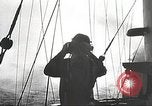
An inattentive sailor results in a ship being struck by a Japanese submarine torpedo (WW2)
A training film about the importance of standing watch duty for U.S. Navy sailors aboard a ship during World War II. Mix of dramatized and period footage. Enactment shows a lookout standing watch aboard a ship as he sights the periscope of an enemy submarine underway at sea. The lookout reports about the submarine to an officer. The officer looks through binoculars and gives out orders. U.S. Navy sailors called to battle stations are seen running under decks to assume positions. Torpedo from submarine detected coming toward ship. Captain gives evasive maneuver order. The Captain looks over the bridge of the ship as the torpedo misses ship. Depth charges being fired from the deck of the ship, and also rolled off the deck into the ocean, directed at the submarine. Explosions occur at sea from the depth charges. The submarine is destroyed. A sailor shows a Japanese and a Nazi German flag painted aboard the ship recording enemy vessels sunk. Next scene is a dramatized scene inside a Japanese submarine showing what would have happened if the crew member on watch was day dreaming and not paying attention. A member of the Japanese submarine crew looks at a ship through the periscope. Point of view shot through Japanese periscope of U.S. Navy ship coming into torpedo firing range. Submarine captain orders torpedoes fired. View of torpedo running in water toward U.S. Navy ship. American sailor aboard the ship executes an order a bit late and the ship gets struck by the Japanese torpedo. Dramatized scenes of Navy crew members abandoning ship and struggling in ocean waters. The sailors in water cry out for help. Dramatization of a dead sailor rising from the sea and speaking about the need to be alert while on standing watch. An inattentive and lazy sailor standing watch in contrast to an alert sailor. A ship underway at sea and sailors sleep in their bunk beds. Dead sailor calls standing watch a sacred duty.
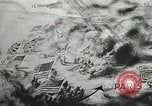
Allied Forces advance and French Army takes Paris in World War II.
Animated map shows American forces advancing toward Paris. Views of German troops disorganized and making their way individually among burning and destroyed military tanks and vehicles. A U.S. Army colonel confers with U.S. Armored unit officers, using hood of jeep as a table. U.S. Sherman tanks and tank destroyers moving along dirt roads toward Paris, at high speed and passing beyond the Orleans region. They move rapidly through groups of cheering French citizens in a French town. American armored units moving to bypass Paris. U.S. Army Air Force airplanes dropping maps to the armored units by parachute, because they were moving too fast to be supplied by ground. French forces, armed with American tanks, vehicles, and arms, are ordered to advance and take Paris. As they proceed, U.S. Army Air Forces support them from the air. Formations of P-51 fighter and B-26 bombers are seen. The French forces advance at rate of 25km per day. They are joyously welcomed as they pass through French towns on their way. Scenes of Paris. Local residents in line at a shop. German occupiers are seen beginning to leave Paris. A line of horse-drawn wagons is seen in the street. On August 14, 1944, Paris Police go on strike. They are seen drawn up in formation. August 15, 1944, the Gestapo left Paris. French citizens and police open fire on German Army vehicle. Parisians begin to hang the tricolor from their windows. French resistance fighters seen running in streets of Paris and firing weapons as they work to find remaining German forces. A doctor and several nurses run for cover. Parisians begin to fill the streets during liberation of Paris as elements of the French Army enter Paris. General Charles de Gaulle walking along a street in Paris.
German officers surrender to Allied Forces at end of World War II
Film begins with nighttime bombardments of rockets and artillery. Then at one minute after midnight, on May 9th, 1945, the guns stop. Next, a day earlier, German Field Marshal Wilhelm Keitel enters a conference room on May 8th, accompanied by German staff officers. He salutes with his Marshal's baton and takes a seat. He signs surrender document. Soviet Marshal Georgy Zhukov stands before being seated. British Air Marshal, Sir Arthur Tedder, is seen signing the document along with Marshal Zhukov. General Carl Spaatz, Commander of Strategic Air Forces in Europe, shakes hands with Marshal Zhukov. Several scenes of battlefield cemeteries are seen next. German officer prisoners are seen from the back as they walk with hands behind their heads. Views of Surrendered German senior military officers, including: German Admiral Erich Raeder; German Marshal Walter Model; German Marshal Wilhelm Keitel; and Marshal Hermann Goering (being disarmed).
CRITICALPAST.COM: About Us | Contact Us | FAQs - How to Order | License Agreement | My Account | My Lightboxes | Shopping Cart | Advanced Search | Featured Collections | Website Terms & Conditions | Privacy Policy ©2026 CriticalPast LLC.
License Agreement |
Terms & Conditions |
Privacy Policy
©2026 CriticalPast LLC.