


 Francais
 Deutsch
 Italiano
Refine Your Search
D-Day stock footage and images
- Showing 2083 to 2088 of 4856 results more
more Hide
Hide
U.S. soldiers being hit by shell fragments and their recovery after surgery in Naples during World War II.
A film titled 'Soft Tissue Wounds' shows U.S. soldiers being hit by shell fragments and their recovery after surgery in Naples during World War II. Bombs stacked on a field. U.S. sailors work around. A battleship's gun firing salvo. Fragments are removed by surgery from battle casualties. Reports of four cases handled in the Italian campaign of January 1944. The first case shows a soldier hit by a shell fragment. U.S. troops carry the soldier hit by the shell fragment in Italy. A truck moves ahead on a road. Wounded being carried into an evacuation hospital tent. A wound just below the buttock of a soldier. Primary infusion is given to the patient. The bleeding is controlled. The wound is dusted. Dressing completes an operation. The healing of the wound after a few weeks of the operation. The patient walks after healing. A U.S. soldier shows a scar under scapula. A U.S. LST (Landing Ship Tank) fires towards Anzio Harbor. [Note: script refers to British Hospital Carrier Leinster (#37) although footage appears to be of (British) Hospital Ship St. David (#27), later sunk by the Germans at Anzio in January, 1944]. A wounded soldier is carried on a stretcher aboard the hospital ship. Surgery is performed on the wounded soldier. The soldier on a bed after the operation. A ship underway at sea. A Red Cross ambulance and a truck transport the wounded soldiers to a hospital in Naples. The wound after one week of injury. The wound margins are refreshed. The wound edges are stitched. Removal of stitches after eight days. The soldier smokes a cigarette after recovering.
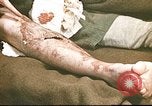
Soft tissue wounds of U.S. soldiers and their recovery after successful surgical operations in Europe during World War II.
A film shows U.S. soldiers being hit by shell fragments and their recovery after surgery in Europe during World War II. A case of soft tissue wound shows a wound on the leg of a soldier who was hit by a shell fragment. Surgery on the wound shows gentle exploration revealing the path of a muscle. The skin incision is enlarged. A blood cord is evacuated. A shell fragment is removed. The wound is dressed. The wound after few days of injury. The wound is ready for skin grafting. The graft being stitched on the wound. Stitches are removed after few weeks and the patient is discharged. A case of multiple soft tissue wound shows a wounded soldier on an evacuation hospital bed. Two wounds on the left arm of the patient. X-rays of the arm of the patient. An incision is made to connect the two wounds. Margins of the wound are divided. Multiple wounds on the hand of a patient. The wound on the left arm after two weeks. The wound is ready for secondary closure or skin grafting. Strapping is done to bring skin margins together. Surgeons operate the same patient. The wound is stitched. The patient shows his hand after healing. A soldier with a wound just below his buttock. A soldier with a scar under scapula. Wounds on right leg and left arm of a soldier. Medics evacuate a wounded soldier. A surgical operation in progress. The soldiers smile after their successful recoveries from soft tissue wounds. U.S. troops during operations of World War II.
U.S. 86th Regiment, 10th Mountain Division soldiers smoke in a village in Italy during the Po Valley Offensive of World War II.
U.S. 86th Regiment, 10th Mountain Division soldiers in a shell torn village in Italy during the Po Valley Offensive of World War II. The soldiers stop to take a smoke after more than three days of intensive fighting. The soldiers drink water from a pump. One soldier turns the hand crank as others drink from the well.
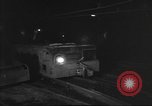
Westland Mine coal miners return to work after end of walkout of 400,000 miners called by United Mine Workers.
At start, the film shows coal miners riding on electric-powered open railway cars at the Westland Mine in Pennsylvania, owned by the Pittsburgh Coal Company. The miners wear hats with lights on them. A train of open hopper cars filled with coal is being pulled by the last railway car carrying miners. Scene changes to above ground where a string of minecarts filled with coal are emerging from the mine into a railroad yard. Closeup of large chunks of coal in the hopper cars. Another view of filled mine carts being pulled out of the mine. View of full-size open rail cars lined up underneath an overhanging wooden tipple discharging coal into them. Closeup from underneath the tipple showing coal dropping into full size open hopper cars. Next, a long train of full hopper cars are seen moving along a railroad track, being pushed by several electric-powered locomotives. They pass on tracks near other cars being loaded with coal. A miner writes: "Mon Dec 9," with chalk on a brick structure. (This is the day the miners returned to work, following announcement by United Mine Workers President John L. Lewis, on December 7, 1946, calling an end to a walkout of 400,000 coal miners that he had called on November 20). Two 2-8-2 Mikado steam locomotives owned by the Montour Railroad pull a long train of coal cars. View in background of duplex homes of the coal town in Westland, Pennsylvania. Next scene shows elevated view of city of Pittsburgh, Pennsylvania, from approximately Duquesne Heights area, with distant view of downtown buildings, and steel bridges over the three rivers area (Monongahela River, Ohio River, and Allegheny River). Next scene shows many industrial smoke stacks emitting smoke. Final scene shows a train of empty hopper cars returning to the coal mines.
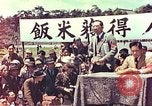
Japanese laborers, agrarians and white collar workers listen to speeches held in the Imperial Park in Tokyo.
Speeches held during May Day demonstrations in Tokyo, Japan. Japanese laborers, agrarians and white collar workers gather and listen to a speaker in the Imperial Park. The speaker on a makeshift stand is Mr. Kenichi Ito, Kanto District Trade Union. People listen to the speaker. A group of girls with red bandanas on their head. A group of people sit on the ground and listen to the speaker. Red Cross Japanese nurses. Another speaker is Mr. Yoshira II, a congressman representing the Socialists party. A Communist congressman speaks to the group of workers.
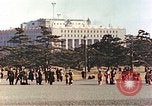
Japanese people bow in front of the gates of the Imperial Palace in Tokyo, Japan.
Japanese people in front of the gates of the Imperial Palace in Tokyo, Japan to bid the Shōwa Emperor a Happy New Year. The front of the Palace Gate shows Japanese people bowing. Dai-Ichi Building (Dn Tower 21, 1 Chome-13-1 Yurakucho, Chiyoda City, Tokyo 100-0006, Japan) in the background. A Japanese family bows in union. Before they bow, coats and hats are removed and laid under the arm. A family of two children and their parents line up and bow. The children are dressed in kimonos. Several girls line up and bow. Three girls walk along a road. A family comprising of a mother, two small children and a boy in a student's clothes take off their coats and bow together. Two women pray and bow. Grounds of the Imperial Palace in Tokyo, Japan.
CRITICALPAST.COM: About Us | Contact Us | FAQs - How to Order | License Agreement | My Account | My Lightboxes | Shopping Cart | Advanced Search | Featured Collections | Website Terms & Conditions | Privacy Policy ©2026 CriticalPast LLC.
License Agreement |
Terms & Conditions |
Privacy Policy
©2026 CriticalPast LLC.