


 Francais
 Deutsch
 Italiano
Refine Your Search
Dayton Ohio USA 1947 stock footage and images
- Showing 4789 to 4794 of 25603 results more
more Hide
Hide
Views of Lexington Main Street and University of Kentucky on 'By Request' program for American soldiers.
Women's Army Corps (WAC) Sergeant in broadcasting studio for the Army Navy Screen Magazine feature called: "By Request." She holds a letter received from 43 American soldiers ("foxhole buddies") in New Guinea. They ask "By Request" to show them scenes from the University of Kentucky, where they trained, and some shots of Lexington, Kentucky. The program continues with motion pictures of the requested scenes, beginning with the Phoenix Hotel and a theater on the Lexington Main Street. Pedestrians on the side walk and cars parked by the roadside. Keith's Bar and Chop House. Bartenders and waitresses serve beer. A roller coaster, known as the Wildcat (after UK's mascot) at the Joyland amusement park, located on Paris Pike north of town. The University of Kentucky campus. GIs and women soldiers on campus. A sign for the University. Soldiers take pictures by the statue of James Patterson on campus. (Given the lack of foliage on the trees, this film was obviously taken sometime between November and March. ) (World War II period).
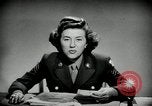
Jill presents 'GI Jive', a jive music section on the 'By Request' program for the American soldiers abroad (WW2)
A female WAAC (Women's Army Auxiliary Corps) presents 'By Request' for the Army Navy Screen Magazine' in the United States during World War II. She reads out a request for music from Ameriacn soldiers in the Pacific Theater. The 'GI Jive' section presented by Jill. She talks to the GIs, plays a jive tune for them and asks them to keep writing in. Pictures, sketches, letters, photographs and other memorabilia sent by GIs from various war fronts. Jive tune plays in the background.

Humorists including Jimmy Durante, Andy Devine and Robert Benchley perform 'Down by the Old Mill Stream' for American GIs.
A woman GI presents 'By Request' for the Army Navy Screen Magazine in the United States. An American soldier in China requests an old song. Character actors, humorists and comedians perform song "Down by the Old Mill Stream" on stage. Performers include Jimmy Durante, Allen Jenkins, Sterling Holloway, Hugh Herbert, William Gargan, Edward Brophy, Andy Devine, Allan Hale, Robert Benchley, and Arthur Treacher. The audience breaks into laughter during the performance. The female GI winds up the show after the performance. She states the program address and asks the soldiers to keep writing in. (World War II period).

Space research about the ionosphere from the ground by the National Bureau of Standards.
Film entitled 'Scatter Radar', from The National Bureau of Standards, United States Department of Commerce. Depicts space research from the ground. The globe rotating. A satellite antenna moves into position. Radio instruments. Red optical instruments used to study the sun. Clouds in the upper atmosphere. Animation: Ionosphere reflects radio waves to the planet. A smoke of cloud rises during the launching of a rocket. An artists' conception of the Van Allen Radiation Belt above the Earth's ionosphere discovered by Explorer I and Pioneer III. A satellite orbits the globe. Men watch as a rocket is erected and fired. A scientist at the National Bureau of Standards works on a formula. A man at the controls of a scatter radar fro space research. Animation: Ionized and neutral particles as well as free electrons that permit long distance communication. free electrons reflect radio energy. Radio waves penetrate the ionosphere. A scientist at the Ionosonde model C4 to measure electron density variations. Electron density model on the monitor. Two Oxygen atoms. An electron detaches and becomes a free electron. Radio waves pass by, the electron and waves oscillate and scatter energy. Animation: Need to excite electrons sufficiently so that their energy radiated can be detected from the ground. The process requires a powerful transmitter, large antenna, and a sensitive receiver.
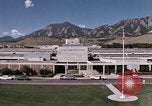
Scatter Radar experimentation with Dr. Kenneth Bowles and his team, and their efforts in Lima Peru
Space research from the ground with a Scatter Radar. National Bureau of Standards laboratories in Boulder, Colorado. The Central Radio Propogation Laboratory. Cars parked outside. Hills in the background. Dr. Kenneth Bowles and a colleague work on a formula. Animation: Incoherent scatter of radio waves by electrons in the ionosphere. Transmission of powerful pulsed radio signal in a narrow beam. The beam penetrates the ionosphere and excites the free electrons. The scatter a weak signal which is detected by a sensitive antenna, and the signal comes back to Earth. Remaining portions of a sensitive antenna at the pioneering field site in Havana, Illinois. Dr. Ken Bowles and other scientists decide on a site. Animation: The magnetic equator and lines of the magnetic field. Pulsed radar signals and lines of force on the monitor. Animation: Chemical composition of the Earth's atmospheric gases. The scientists decide on Lima in Peru, due to its proximity to the magnetic equator and U.S. Lima, Peru: Buildings, guards, churches, plazas and boulevards in Lima including the Government Palace in Lima with guards in front, the Catedral de Lima (Catheral of Lima) and the Plaza Mayor de Lima . Construction work in Lima. Cars on a market street. People on the sidewalk. Shipping and port facilities in Callao, Peru. Workers unload goods. People board a Braniff International aircraft. Housing facility in the Lima suburb of Miraflores.
Communication waves and the relation between power transmitted and received in Space Communications
United States Air Force training film about Space Communications and the related problems and developments. Animation: Planets, remotely controlled unmanned space research vehicles in space. Space communication links between the vehicles and Earth. Radio waves are reflected, refracted and absorbed. An antenna radiates waves that are dispersed. Communication and light waves on the frequency spectrum. Groundwave and Skywave transmission explained. Skywave transmission reflected back to Earth by the ionized layers in the Earth's upper atmosphere. Bouncing of signal in optimal conditions. Spacewave travels from transmitting to receiving antenna, and travels unaffected through the ionosphere into outer planetary space. Depicts laws that govern Line of Sight transmission: Relation between power transmitted and power received, and ideal and regular conditions. Explains the factors involved in the relation between the power transmitted and received. Comparison of communication and light waves. Inverse Square Law explained. The law applied to Space Communication: Signal generated from point source, energy dispersed in shape of sphere, energy spreads over expanding spherical area. Outlines a practical approach to strengthen received power: Directing the radiating energy, and enlarging area of the receiving antenna.
CRITICALPAST.COM: About Us | Contact Us | FAQs - How to Order | License Agreement | My Account | My Lightboxes | Shopping Cart | Advanced Search | Featured Collections | Website Terms & Conditions | Privacy Policy ©2026 CriticalPast LLC.
License Agreement |
Terms & Conditions |
Privacy Policy
©2026 CriticalPast LLC.