


 Francais
 Deutsch
 Italiano
Refine Your Search
Eboli Italy 1944 stock footage and images
- Showing 1579 to 1584 of 7968 results more
more Hide
Hide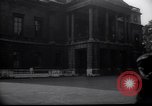
Meeting of European Advisory Commission in Lancaster House London.
European Advisory Commission meeting to sign the protocol between the Allies on the occupation zones in Germany at Lancaster House London. Chairman Feodor Tarasovich Gousev of Russia, Ambassador extraordinary and plenipotentiary to the government of Great Britain; John Gilbart Winant, American ambassador to Great Britain and Sir William Strang, UK representative on European Advisory Commission enter and have a discussion. View of Advisory Commission with Mons. Gousev at head of table and other military advisors with Sir Strang at top left. Diplomats can be seen talking to each other. 12 September 1944. (World War II period).
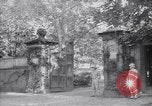
Front of Dumbarton Oaks in Georgetown U.S.
Front gate of Dumbarton Oaks with a car driving inside. A plaque outside inscribed with "Dumbarton Oaks" is there. Front of the building where men with military police walking inside. Exterior of Executive Office Building of State Department. September 1944.
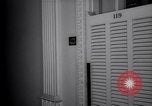
Interior of "department of state press room" in U.S.
Interior of state department building in U.S. A sign - department of state press room outside a room. Reporters sitting inside the room, two of them playing chess, two are typing. Reporters receive a report. September 1944.
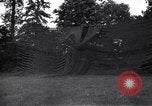
Captain Don M. Beerbower, 353rd Fighter Squadron, and his P-51,
U.S. Army Air Forces 354th Fighter Group in Normandy. Ground crew run to pull camouflage from P-51 at advance air strip Criqueville (A-2) in Normandy during World War 2. The P-51 prop turns,engine starts, and it taxis forward. The name "Bonnie B II" is painted on the fuselage, and 17 swastikas are painted below the cockpit. A Mustang is painted on the tail. It's serial number is 43-12375. The aircraft stops. The name, Captain Don M. Beerbower,is painted below the cockpit. He stands up and climbs out of the airplane, wearing his oxygen mask and helmet. Scene shifts to a loudspeaker in a control facility.A soldier is seen talking on the radio in a plexiglassed enclosure. A flight of P-51s approaches the field. They break off and proceed to buzz the field. (Note concerning Captain Beerbower,of Hill City, Minnesota, seen in this clip. He served as acting Commander of the 353rd Fighter Squadron and was later promoted to Major. He was Commander of the 353rd Fighter Squadron when killed in action, by ground fire while flying his P-51, Bonnie B II, leading an attack on a German airfield near Reims, France, on August 9, 1944. His decorations included: the DSC, Silver Star,DFC (3), Air Medal (26), British DFC, Purple Heart, Distinguished Unit Citation and Campaign Medals.)
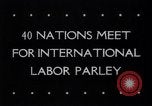
International Labor Conference in Philadelphia; also Funeral of Secretary of Navy, Frank Knox (WW2)
International Labor Conference in Philadelphia during World War II. Exterior of Temple University. A sign reads 'International Labour Conference'. People go into the building. Delegates from 40 nations at the conference. Walter Nash, of New Zealand, the new president of the ILO (International Labor Organization), talks about post war labor problems. Interpreters translate for delegates wearing headphones over their ears. Chinese delegates present. Next portion of clips shows funeral of U.S. Secretary of Navy, Frank Knox on May 1, 1944. The funeral procession along Constitution Avenue, Washington DC. Flag-draped coffin rests on a caisson pulled by horses. Elements of all the three Branches of the military services parade behind the coffin, including women in the WAVES (Women Accepted for Volunteer Emergency Service) and WACs (Women's Army Corps). As the procession enters Arlington Cemetery, an honor guard of U.S. Navy admirals salute. Military pallbearers carry the casket to the burial site and an honor guard of sailors fire rifle salutes. Admiral Ernest King, Chief of Naval Operations, escorts widow, Mrs. Annie Reid Knox, from the scene.
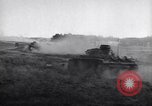
German tanks and rockets fire at Russian positions on Eastern Front. Germans defend against Allied invasion forces in France
German Pz.III, Panther and Tiger tanks firing and Stuka-zu-Fuss rockets firing at Russian positions on Eastern Front, during World War II. Burning vehicle. Panther G of 12th SS Panzer Division (Hitler Jugend) fires on Canadian positions in mid-June 1944, in Normandy. Empty shells.thrown out of tank by German crewman. Scenes of smoke and fire.
CRITICALPAST.COM: About Us | Contact Us | FAQs - How to Order | License Agreement | My Account | My Lightboxes | Shopping Cart | Advanced Search | Featured Collections | Website Terms & Conditions | Privacy Policy ©2026 CriticalPast LLC.
License Agreement |
Terms & Conditions |
Privacy Policy
©2026 CriticalPast LLC.