


 Francais
 Deutsch
 Italiano
Refine Your Search
Eboli Italy 1944 stock footage and images
- Showing 1573 to 1578 of 7968 results more
more Hide
Hide
Mix of dramatized and actual footage: Dramatized German officers describe "Divide and Conquer Policy"; actual D-Day footage scenes in World War 2
A U.S. Army training film titled 'Teamwork' from 1946. Several actors portraying Nazi officers. Nazi officer briefs his officer on their 'Divide and Conquer Policy' for the Americans in a German Headquarters looking building. Actual World War 2 footage is seen at start of film showing the building of the German Reich Ministry of Public Enlightenment and Propaganda in Germany. After that, actual combat footage begins at TC:02:34,with views of the German defenses on the Western Wall, at the coast of France. German soldiers man an anti-aircraft gun in a hill, as others march loosely along the shoreline. Several Allied warships are seen in formation headed toward the camera, during the D-Day invasion, June 6, 1944. Next, numerous warships fire their guns, bombarding the Normandy coast. Numerous landing craft (Higgins boats) swarm toward the coast. View from bridge of a LCI(M) (landing craft, infantry - mortar) as it fires its mortars approaching the beachhead. Explosions from the mortar fire. Rockets being launched from Landing Crafts Tank (Rocket). Higgins boats reaching the shore and troops leaving them for the beach. American troops running from the shore after landing, and taking up positions firing small arms. A soldier placing a demolition charge at a German bunker and running from it as it explodes. Famous footage of American troops being shot as they advance on D-Day. Medics tending to wounded on the shore. Medic caring for a wounded African American soldier as they shelter under chalk cliffs at Normandy beachhead. U.S. troops moving inland from their beachhead.
Saga of the Allied invasion of Normandy in World War II, with emphasis on role of African American soldiers
Opening scene shows U.S. soldiers firing rifles as they advance in the hedge rows (Bocage) of Normandy after the D-Day invasion in World War 2. Lightning is seen as a storm begins. Various invasion ships and boats are seen being pummeled by wind and waves. Some ships are seen tilted against the shore and damage to beachhead installations is evident all across the shore the wake of the storm. Landing craft of various sizes are left where they had been driven by the storm onto the shore. Twisted steel and damaged boats are seen everywhere. Views of U.S. infantry advancing into the interior of Normandy, under fire. A Sherman tank camouflaged with foliage, moves past demolished building. Troops marching single file along the sides of a rural road. At TC: 00: 57, the film continues with enactments of German officers in conference. At TC: 01:06, the actual Normandy beachhead is seen again with troops and war materiel being delivered without port facilities. Amphibious 2 and a half ton trucks (DUKWs) are seen making their way from transport ships to the shore. View of cargoes being lowered from a transport ship to a DUKW. Views of crew on the ship's deck, including an African American operating the cargo hoist. Closeup of cargo net with supplies dropping into a DUKW. Closeup two soldiers (one an African American) riding in a DUKW. Trucks and cranes on the beach. A soldier operates a crane placing ammunition into a truck. Crew member on a transport ship passes Jerry cans of fuel to a soldier in a DUKW. An M36 tank destroyer (90 mm Gun Motor Carriage, M36) filled with soldier, drives from ashore from an LST. Numerous trucks gathered on the beachhead. Closeups of two soldiers at the front. Closeup of M36 tank destroyer moving toward the camera. Aerial overview of a beachhead. Soldiers with shovels fill holes in a roadway as trucks pass. A destroyed railroad yard. A destroyed airfield. A destroyed harbor. Destroyed rail line and communications lines at Valognes, in Normandy, France. African American soldiers using special equipment to string communications lines onto telephone poles. Closeups of them in vehicles designed for that purpose. Closeups of wires being unspooled. American soldiers connecting wires atop a pole. A group of African American soldiers working on telephone lines. Others are seen using mine detectors. An African American soldier operating a mobile crane. African American soldiers installing pierced steel plank (Marsden matting) on an airfield. A team of African American soldiers placing rails in place for a railroad. Others working on pipeline. One uses an acetylene torch to weld a pipe. Fuel gushing from a hose refueling an armored vehicle. The destroyed port of Cherbourg occupied by American troops. View a week later of the harbor in full operation. Cranes unloading a locomotive at the port. View of port operations on July 4, 1944. A German aircraft overhead and bombs exploding. More views of work being done on the port. Stockpiles of supplies at the port. A Sherman tank moving with infantry. Troops moving along sides of a road. An M36 tank destroyer is welcomed by local civilians as it moves through their town. A 75 mm Howitzer Motor Carriage M8 moves through a town 25 miles from Paris. American infantry marching through a town. Heavy army trucks carry supplies. Sign posted for the "Red Ball Express." Columns of trucks carrying supplies from the port of Cherbourg to the front. Mines exploding nearby as the trucks move at night. Closeup of an African American soldier driving one of the trucks.
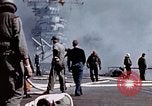
American aircraft carrier burning from Japanese Kamikaze strike, during World War II
World War 2. Damage control party board an American U.S. Navy aircraft carrier off the Japanese coast, fights fire caused by a Kamikaze (suicide dive bomber). Kamikaze aircraft on October 30, 1944 dives toward USS Franklin (CV-13) passing just overhead and crashing into the ship with explosion and flames. Heavy fire and smoke on the deck. Wounded aided on the deck.

Allied forces preparing in England for the Invasion of Normandy.
A dramatized film entitled "Beachhead to Berlin" describes preparations for the Allied invasion of France and the drive toward Berlin. Film combines actors and actual footage. Harbor in Greenway England in July, 1944. U.S. Coast Guard Barracks. Coast Guard men playing cards. One on a bunk contemplating. Chaplain's office: Chaplain typing and smoking a pipe. Audio narration of his letter being read, describing how things transpired at the Normandy beaches during the Invasion of France. Then actual footage of wounded being transported on ships after D-Day Normandy invasion. In England, footage of LCIs, LCVPs, Coast Guard cutters, including the Flying Angel Rescue Cutter. All of these ships participating in "dry run" practices for the actual Normandy landing. Coast Guard crews on decks of ships. Infantry loading landing crafts in England for dry runs. Landing craft arriving on English beaches during dry runs. A jeep drives off a landing craft and gets stuck on metal mesh on the beach. A tank is driven off a landing craft. Men maintaining ships. Scraping rust from the deck, painting identifications on ships, repairing rope ladders, and welding. (World War II period).

World War 2 film promoting public investment in War Bonds and stamps to aid the war effort and temper inflation
World War 2 era film that also includes some World War 1 scenes. Show girls or chorus girls in follies-like show, costumed as U.S. silver dollars and marching to tune and lyrics alluding to dramatic increase of currency in circulation, over the years. Animation with stacks of coins shows increase in national income from $46 billion,in 1933, to $71 billion, in 1939, and $142 billion in 1943. Back to the "follies dollars," a boy asks why, and then scenes of the Japanese attack on Pearl Harbor,are shown, with U.S. battleships being sunk. Wartime arms plants are shown. An M2A3 Light Tank rolls off a production line. Ships being constructed in a shipyard. B-24 Liberator bombers being built in a factory. Artillery shells being produced. Defense workers receiving their pay. The "follies dollars" group themselves to illustrate the fractions of income devoted to taxes and savings. But other spending is curtailed by wartime shortages. A woman talking with clerk in a drug store. U.S. Army troops crossing a pontoon bridge in open trucks, towing 75mm M1A1 howitzers. Infantry on the march. Animation showing industrial production devoted to war materiel and lots of dollars chasing few civilian goods. A grocery clerk offers to sell a woman customer butter for more than the established price, and she agrees. The "follies" performers then introduce the idea of an "inflationary dollar," and some history of past U.S. inflations. Animated examples of price inflation are shown. Glimpses of World War I scenes are seen, circa 1917 -1918, including: a 12-inch railway gun firing; a huge explosion from shell bursting near the camera; various scenes of United States infantry soldiers and French soldiers in battle action, running to bomb craters for cover and emerging from trenches to go up "over the top" into no-mans land during combat. Meanwhile, singing narration refers to the home front inflation due to competition for limited civilian goods. Map shows Europe and singing narration cites rising prices for food in occupied France and other countries suffering ravages of World War II. Montage of scenes showing needy civilians obtaining food in those countries. Animation shows increases, by 1944, in cost of U.S. civilian goods since the Pearl Harbor attack. "Follies" character called "Double-duty dollar," appears explaining he serves the war and curtails inflation on the home front by being saved through investments in War Bonds and stamps.
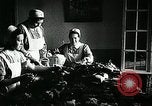
German Red Cross women pack Christmas gifts and German soldiers receive gifts and mail in the front lines.
German women Red Cross workers in Germany. They pack Christmas gifts for the German soldiers for Christmas 1944. The gifts on a table. Scene on front lines as German soldiers receive mail from home. A German soldier reads a letter and looks at a photograph. Separately, clips ends with views of the Allied invasion forces landing in France and German efforts at repulsing them. (World War II period).
CRITICALPAST.COM: About Us | Contact Us | FAQs - How to Order | License Agreement | My Account | My Lightboxes | Shopping Cart | Advanced Search | Featured Collections | Website Terms & Conditions | Privacy Policy ©2026 CriticalPast LLC.
License Agreement |
Terms & Conditions |
Privacy Policy
©2026 CriticalPast LLC.