


 Francais
 Deutsch
 Italiano
Refine Your Search
Elizabeth New Jersey 1952 stock footage and images
- Showing 8203 to 8208 of 8484 results more
more Hide
Hide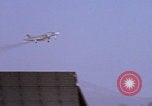
VF-124 squadron support crew engage in various talks at NAS Miramar, California
Grumman F-14 Tomcat fighter aircraft landing at the Naval Air Station Miramar (Miramar Way, San Diego, CA 92145, United States), California. A man walks past a fuel tanker. A mechanic in front of dashboard. Squadron support crew with parachutes. A man communicates from a control tower. Crew shows a new helmet to an airman. A petty officer and a woman system maintenance officer tour the survival equipment room where pilots suit up before a flight. The pilot raises his concern about a mask to crewman.
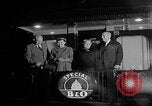
Ohio Senator George H. Bender delivers a campaign speech
Incumbent President Eisenhower with wife Mamie Eisenhower, Ohio Senator George H. Bender, and Bender's wife Edna Eckhardt in Cleveland, Ohio soon after President Eisenhower’s 1956 Republican nomination as president. “Special B&O” sign in front of President Eisenhower and others. Crowds of Republican supporters hold United States flags and signs “Re-elect President Eisenhower” and “Re-elect Senator Bender” in Cleveland, Ohio. Senator Bender delivers a speech in front of the crowds at at Cleveland Public Square (50 Public Square Suite 1700, Cleveland, OH 44113). News van from media such as WSRS radio are seen.
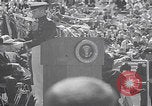
President John F. Kennedy delivers a speech at the United States Air Force Academy Graduation in Colorado Springs, Colorado
President John F. Kennedy attends the United States Air Force Academy Graduation in Colorado Springs, Colorado. An official introduces President Kennedy before the president takes his place in front of the podium. President John F. Kennedy delivers an address to the graduates of the Air Force. (Speech contents: President thanks the Academy for the honorary degree bestowed upon him, discusses his plans for a new civilian aviation program, ensures the graduates of the continued importance of manned aircraft despite increases in automation, and explains that military policy cannot be separated from political or diplomatic decisions.) Cameramen take footage of the president’s speech. Air Force Academy officials and the audience listen to President Kennedy’s graduation speech.
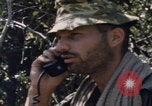
United States Marines assist in Haiti after devastation by Hurricane Inez
A United States Marine Corp (USMC) Marine uses a field telephone. A Marine smoking a cigarette seen from behind. Marines fighting in a jungle. Louis W. Walt, 3rd Marine Amphibious Force Commanding General in 1966, speaks about the Marines in various wars. A Marine with a cigar in his mouth. An impoverished woman with child. A young African girl holding a basket of bread. A United States Marine Corp Sikorsky H-34 helicopter in flight. Marine helicopter squadron 365 moving in from the aircraft carrier USS Boxer (CV-21) to Caribbean countries affected by Hurricane Inez such as Dominican Republic and Haiti. Sikorsky H-34 helicopter takes off from USS Boxer. Aerial view of a town damaged by Hurricane Inez. The Sikorsky H-34 helicopter lands in Haiti. Haitian civilians, including a Roman Catholic nun, talk to United States Marines. Haitian newspaper front page features news about President Duvalier “Le Président Duvalier agit contre les effets du Cyclone” in French. An English translation “President Duvalier acts against the effects of Hurricane Inez” replaces the headline. A Marine medic treats a patient while a Haitian man covers his face from the sun. An injured woman with her child with their heads covered by gauze. United States Marine checks head injuries of hurricane victims and put bandages on patients. Haitian civilians carry an injured man on a makeshift stretcher. Injured Haitian children and a girl with an arm cast. Civilians carry supplies. Children walk in a village destroyed by Hurricane Inez. A Marine carries corrugated aluminum sheet for roofing. Marines help Haitian civilians rebuild houses in the village.
Japanese troops at Marco Polo Bridge in Peking and city of Nanking (Nanjing) during Second Sino-Japanese War
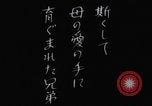
Explosion from bombing during the Marco Polo Bridge Incident at the start of the Second Sino-Japanese War. Sign at Marco Polo Bridge reads “Lu Know Kiao”. A train station near Marco Polo Bridge in Fengtai District, Peking, China. Imperial Japanese Army soldier uses binoculars while hiding in trench. A Japanese Sumida M.2593 (Type 91) armored car. Japanese troops fighting around Marco Polo bridge. The Japanese flag on mast of a battleship. Japanese battleship sailing to China. Japanese troops enter Nanking (Nanjing) after the Battle of Nanking. Soldiers in back of truck. Japanese biplane aircraft in flight. Japanese planes drop propaganda leaflets over Shanghai. Japanese planes dropping bombs. A Japanese newspaper with news on the Second Sino-Japanese War. Naval artillery crew firing guns. Japanese warships firing their guns in China. Japanese soldiers advance in battle. More bombers in flight.
Lyndon B. Johnson speech on Vietnam War; scenes from World War II and Korean War
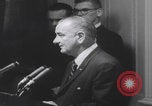
United States President Lyndon B. Johnson delivers a speech at a news conference in July 28, 1965 during the Vietnam War. President Johnson quotes a letter from a woman in the Midwest, "Dear Mr. President: In my humble way I am writing to you about the crisis in Vietnam. I have a son who is now in Vietnam. My husband served in World War II. Our country was at war, but now, this time, it's just something that I don’t understand. Why?”. United States Army soldiers in a Vietnamese jungle. A crying Vietnamese child. A man sits in front of a fire in the middle of a ruined house. Fascist leaders Adolf Hitler and Benito Mussolini during a parade in Munich, Germany. Flags of Nazi Germany and the United Kingdom. British Prime Minister Neville Chamberlain disembarks from in Munich for the Munich agreement. Nazi German guards turn their heads in unison. Adolf Hitler and Neville Chamberlain walk together. Crowd civilians perform the Nazi salute. Hitler and Mussolini in balcony. Neville Chamberlain reads the “Peace For Our Time” speech. “We regard the agreement signed last night and the Anglo-German Naval Agreement as symbolic of the desire of our two peoples never to go to war with one another again” Chamberlain said before smiling. Ruins of a bombarded city in Europe during World War II. Mussolini gesturing strongly during a speech. Cavalry soldiers on horseback in Ethiopia. Royal Italian Army fighting in Ethiopia during the Second Italo-Ethiopian War. Italian soldiers firing with a Fiat-Revelli M14 machine gun and advancing in field. Emperor Haile Selassie I of Ethiopia protests Italian aggression in the League of Nations. A stylized Nazi eagle statue in Austria. Austrian soldiers during the German Anschluss of 1938. Hitler and Austrian politicians perform the Nazi salute in Vienna. Explosions from night bombardment during the Korean War. Communist Chinese People's Liberation Army troops firing with Chinese Type 24 Maxim Water-Cooled Machine Gun and rifles in Korea. Soldiers’ feet climb and jump up uneven terrain in the battlefield. United States Army M46 Patton tanks pointing upwards and firing at enemy positions. An M46 Patton tank and trucks of the United Nations Forces crossing the 38th parallel line in Korea. Sign denotes the 38th parallel line. President Johnson continues his speech at the White House. “Why must young Americans, born into a land exultant with hope and with golden promise, toil and suffer and sometimes die in such a remote and distant place? The answer, like the war itself, is not an easy one, but it echoes clearly from the painful lessons of half a century. Three times in my lifetime, in two World Wars and in Korea, Americans have gone to far lands to fight for freedom. We have learned at a terrible and a brutal cost that retreat does not bring safety and weakness does not bring peace. It is this lesson that has brought us to Vietnam.” President Johnson said.
CRITICALPAST.COM: About Us | Contact Us | FAQs - How to Order | License Agreement | My Account | My Lightboxes | Shopping Cart | Advanced Search | Featured Collections | Website Terms & Conditions | Privacy Policy ©2026 CriticalPast LLC.
License Agreement |
Terms & Conditions |
Privacy Policy
©2026 CriticalPast LLC.