


 Francais
 Deutsch
 Italiano
Refine Your Search
Elizabeth New Jersey 1952 stock footage and images
- Showing 565 to 570 of 8484 results more
more Hide
Hide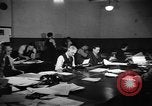
Herbert Roslyn (Bud) Ekins describes plan to fly around the world by commercial craft, including the Hindenburg
Herbert Roslyn "Bud" Ekins and other newsmen and reporters working at desks in the newsroom offices of the New York World Telegram newspaper (Scripps-Howard Newspapers). Ekins smokes while he types. He is going to be a passenger on the LZ-129 Hindenburg as part of his plan to circle the globe entirely by commercial air carriers. The event is sponsored by his employer, the NY World Telegram and Scripps-Howard Newspapers .Elkins describes the planned itinerary. Editor, Roy Wilson Howard, walks in and wishes Elkins good luck, telling him to make the trip in 21 days or less. Elkins puts on his suit jacket and overcoat, and departs for Lakehurst New Jersey, where he will board the Hindenburg for the first leg of his journey.
Factory workers and children wave to a passing train as seen from a train window with troops on board heading for war
U.S. troops entrain at the New York port of embarkation, United States for transportation to the European Theater during World War II. View of cars, a factory, buildings, a river and waving people as seen from a train window, including some in a building with signs, "Electro Dynamic Works Electric Motors, Elco Works Cruisers, Electric Boat Company.:" The citizens and war production workers are waving to the troops on board the railroad train, who are bound for service in World War 2. Factory workers wave from windows to wish the troops well. A suburban rail road station platform. Children near tracks wave to the passing train of troops, including children on steps of East 33rd Street rail station in Bayonne, New Jersey.
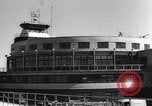
Military and civilian applications of radar and electronics
1946 Film about military and civilian applications of radar and electronics. View of the LaGuardia Airport Administration Building (passenger terminal) in New York, with control tower and various antennas on its roof. A TWA Constellation and DC-3 airplane on the airport ramp, as another aircraft is on the final approach to land. Commercial cargo vessels in New York harbor (Statue of Liberty barely seen in the misty background). A passenger railroad train speeding along the tracks. Radar returns shown on a plan position radar scope, tracking weather returns. Tropical storm hitting a seaside area. Scientists and technicians at work in a laboratory filled with electronic equipment. View of buildings at U.S. Army Signal Corps' Camp Evans, New Jersey. Sign above one entrance reads: "Evans Signal Laboratory." Inside the laboratory, images created by radar signals bounced off the moon are seen on a radar scope, during "Project Diana," on January 10, 1946. View of the Army's GB-4 radio controlled television glide bomb, suspended on a chain inside a building. It rotates around showing various views. Scene shifts to a launching track outdoors at a coastal facility, where a glide bomb takes off raising smoke as it accelerates along the launch path. Next, a GB-4 glide bomb is released from underneath a B-17 bomber in flight. It is seen flying away from the aircraft. Inside the aircraft, a crew member views its progress by means of television images received from a transmitter in the front of the bomb. Glimpse of the television images. View from the ground of the GB-4 bomb gliding to the ground and exploding. Views of a German V-2 rocket at Launch Complex 33, White Sands Proving Ground , New Mexico, where it was being tested by the U.S. Army Ordnance Department in 1946. Inside a control room, an Army technician gives the signal to launch, and the V-2 rocket fires and rises straight into the sky, with its fiery tail visible as it gains altitude. More views of scientists, engineers, and technicians inside a Signal Corps electronics laboratory. Soldiers being trained in radar technology, seated at an electronic array. An army staff sergeant technician working on radar components. A variety of different radar antennas rotating outdoors.
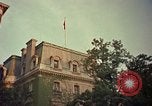
Nikita Khrushchev hosts a banquet at the Soviet Embassy in Washington DC while on a visit to the United States.
Soviet Premier Nikita Khrushchev on a visit to the United States. Exterior of the Soviet Embassy in Washington DC. People at a formal banquet hosted by Mrs. And Mr. Khrushchev. U.S. Vice President Richard Nixon and his wife arrive for the banquet. U.S. President Dwight D. Eisenhower and his wife also arrive. They pose with dignitaries. Khrushchev in a railroad towards New York. Soviet Ambassador to the U.S. Mikhail A. Menshikov and U.S. Ambassador to the Soviet Union Llewellyn E. Thompson with him. The train rushes past rivers, farms, factories, towns and market places. We see his train passing through a station in Newark New Jersey. Mr. Khrushchev waves to people from the window of the train. Khrushchev's motorcade escorted by police escorts rolls through the streets in New York. People on the side of the streets to watch. Mr. Khrushchev addresses people at mayor's luncheon. He talks about peace and relations between the Soviet Union and the U.S. People applaud. New York Governor Nelson Rockefeller welcomes him.
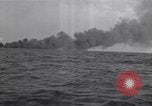
Cloud of smoke emerges from a sinking ship struck by a torpedo off U.S. coast in World War 2.
A cloud of smoke emerges from a sinking ship, destroyed by a German submarine torpedo, off the coast of the United States. The ship is ruptured from its center and sinking gradually. Photographer aboard a New Jersey-based Coast Guard ship captures photographs of the sinking ship, Strong waves rock the observing ship.
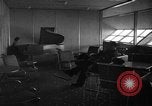
Woman plays piano in lounge of zeppelin Hindenburg
Staged scenes in lounge of zeppelin Hindenburg (LZ 129) while moored at Lakehurst Naval Air Station, New Jersey. A man seated and woman at piano. Close view of woman playing piano and two men relaxing in chairs. Man walks down promenade toward camera and looks out of the airship's observation windows.
CRITICALPAST.COM: About Us | Contact Us | FAQs - How to Order | License Agreement | My Account | My Lightboxes | Shopping Cart | Advanced Search | Featured Collections | Website Terms & Conditions | Privacy Policy ©2026 CriticalPast LLC.
License Agreement |
Terms & Conditions |
Privacy Policy
©2026 CriticalPast LLC.