


 Francais
 Deutsch
 Italiano
Refine Your Search
F-86 stock footage and images
- Showing 1207 to 1212 of 2472 results more
more Hide
Hide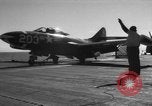
U.S. Navy aircraft are catapulted from the flight deck of the USS Philippine Sea (CVA-47) during the Korean War.
F9F-2 Panther aircraft of VF-112,is catapulted from the deck of the USS Philippine Sea (CV-47) during the Korean War. It is followed by the catapulting of several Reconnaissance F9F-2Ps of VC-61, Unit C. Some more F9F-2s of VF-112 are also catapulted.
President Kennedy watches an Air Force show as Napalm bombs and air to air missiles are demonstrated in Florida.
U.S. President John F Kennedy at an air show in Florida,United States. President Kennedy arrives at the Eglin Air Force Base in Florida. President with the Chief of Staff of United States Air Force General Curtis LeMay. Vice President Lyndon B Johnson seated. Aircraft (F-100's) in formation flight as they drop bombs. Explosions occur and smoke rises. Mass mid air refueling being demonstrated by F-100s getting fuel from KB-50 tanker aircraft. President Kennedy and General LeMay look on. An F-101 aircraft hits a drone plane with air to air missiles. (Narrator mistakenly calls them F-102s.) F-100 aircraft drop Napalm bombs. The bombs flip end over end during descent and explosions are seen as they impact.
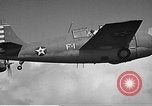
U.S. Navy Lt. Edward Henry "Butch" O'Hare and LCDR John S. Thach, in flight over Hawaii, during World War II.
LCDR John S. Thach, Commander of Navy Fighting Squadron Three (VF-3) is seen flying his F4F (number: F-1) with his wingman, Lt. Edward O'Hare,who is flying F4F number F-13. They fly over Hawaii and environs, with their canopies open. Thach is seen clearly in his cockpit. A change of sequence suddenly shows O'hare flying lead, with Thach flying on his wing. There appear to be only 4 Japanese victory flags painted on O'Hare's airplane. (Note: Lt. O'Hare was the U.S. Navy's first ace, shooting down 5 Japanese aircraft, in World War 2, and was a Medal of Honor recipient.)
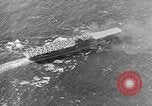
Air Operations aboard the Aircraft carrier USS Enterprise (CV-6) immediately prior to the entry of the United States into World War II
Aerial view looking down at the U.S. Aircraft Carrier USS Enterprise (CV-6) underway below, just before America's entry into World War 2. Her deck is filled with aircraft. Camera view from on the flight deck shows it filled with Grumman F4F Wildcat planes. Pilots are scrambling to some of the planes. Two deck crew sit at the wheels of an 4F4 (as if ready to pull chocks). The engine starts and runs. Several F4Fs have engines running and begin to taxi. One is given clearance to take off and commences its roll with considerable wing flap extension (short takeoff technique). The aircraft takes off and banks right as it clears the carrier deck. Next, two F4Fs are seen in flight above some clouds. Next, a large formation is seen, and individual planes bank and dive from it. Back on the carrier deck, more F4Fs have their engines running. A gunner is seen setting his machine gun into the rear cockpit position of a plane, the narrator calls a versatile scout-bomber. Closeup of the aircraft (a Douglas SBD Dauntless) as engine starts, deck crew pull chocks, and the pilot gets clearance to take off. Next, camera shoots from rear cockpit, with the plane's tail in center of the images. Views cover the complete takeoff and flight away from the carrier. Next an SBD is seen in flight with both front and rear cockpits open. A flight of three SBDs in formation. Closeup of two SBDs in formation. Extreme closeup of SBD with pilot and gunner both clearly visible in open cockpits. The gunner is maneuvering his machine gun. Two SBDs demonstrate rapid descents as in dive bombing. Back on the carrier, an SBD, with wings folded, is maneuvered by sailors, on the hangar deck. Next sailors accompany a Douglas TBD Devastator torpedo bomber on an elevator up to the flight deck. With its wings still folded, they maneuver it into position on the flight deck. An armorer, using a dolly, rolls a bomb to a TBD where two others secure it in a bomb rack under the center of the aircraft. Other armorers distribute machine guns and ammunition to gunners in cockpits of aircraft on the deck. Several TBDs begin taking off. View from hangar deck, of one airborne and departing. A formation of 9 TBDs in flight. (Note: This clip was probably shot in November 1941, based on the aircraft markings in use at the time. Life magazine did a series of stills, and these clips look like they came from that photo session. Enterprise wears Measure 1 camouflage, which she wore from mid-1941 to a month or two into 1942. The flying units aboard are all designated "6" the same as their carrier, CV-6. Thus they are VF-6; VB-6; VT-6, etc.)
American ships of Task force 58 defend against Japanese Kamikaze attacks during April and May, of 1945 in World War II battle of Okinawa.
Film opens with shaky views of Japanese Kamikaze airplane attacking and being shot down by gunners on a U.S. Navy aircraft carrier of Task Force 58, during the Okinawa campaign of World War 2. Burning wrecked aircraft seen on the carrier flight deck. Firefighters run across flight deck with hoses. A landing F4F fighter plane number 59 runs into the flaming wreckage on the deck, and explodes. View from the side of F4F number 58 engulfed in flames as it sits in a pool of firefighting foam. Black flak clouds in the air. A Kamikaze aircraft crashes harmlessly into the sea. Deck crewmen help a pilot out of the cockpit of a fire scorched F4F. View of sailors standing next to a pair of heavy gun barrels on a U.S. warship. Parachuting U.S. pilot seen touching down in the water after bailing out of his aircraft. Sailors running across the flight deck of a carrier. View of the pilot in his life vest being helped aboard the carrier. More views of flak filled sky and a flaming Japanese airplane diving straight down to crash harmlessly in the water. View of American flag at half mast on a U.S. Navy warship. It is April 12, 1945 and President Franklin D. Roosevelt (FDR) has just died. View of sailors on deck in a memorial service for the President. Closeup of mourners singing with hymnals open. Closeup glimpse of FDR. More views of mourners. Scene changes to Japanese Kamikaze being blasted out of the air in pieces, by anti-aircraft fire from a U.S. carrier. The remains fall into the sea. View from U.S. ship, of a Japanese Nakajima L2D transport aircraft with flames coming out of its right wing, as it descends close to the water near the ship, with its landing gear down. View from a more distant ship of the transport plane exploding in the water near a U.S. Escort aircraft carrier. Twin Bofors anti-aircraft guns firing from a U.S. ship. Tracer bullets fill the sky aimed at a Japanese Kamikaze plane. Slates overlay the scene announcing Japanese aircraft shot down: "April 6th: 277 aircraft; April 12th: 100; May 3rd: 97;" Film ends showing more anti-aircraft fire from ships against attacking Japanese aircraft.
101st Airborne Division troops and equipment are loaded onto C-119Fs aircraft during Operation Swift Strike in North Carolina.
Operation Swift Strike in North Carolina. Troops and equipment of the U.S. 101st Airborne Division are loaded onto U.S. Air Force C-119Fs Flying Boxcar transport aircraft. USAF B-57 Canberra bomber aircraft in flight. USAF KC-135A Stratotanker aerial refueling aircraft takes off. Men work at communications console and plot boards. USAF F-105s Thunderchief fighter aircraft peel off. USAF F-100Ds Super Sabre and RF-84F Thunderstreak fighter aircraft peel off. F-100 and RF-84F aircraft in flight overhead. F-100 aircraft in steep climb. C-119Fs aircraft take off and retract landing gear. C-119Fs in flight drop paratroops. USAF Chief of Staff General Curtis Emerson LeMay,USAF Major General Maurice Arthur Preston and U.S. Army Lieutenant General Thomas J. H Trapnell watch from spectator stands. USAF C-130 Hercules transport aircraft drop heavy equipment. Paratroopers descend and land on ground. Troops deploy and move equipment by Army mule. USAF C-123s Provider transport aircraft land and unload troops. Jeeps full of troops move past a line of parked C-123s.