


 Francais
 Deutsch
 Italiano
Refine Your Search
F-86 stock footage and images
- Showing 1219 to 1224 of 2472 results more
more Hide
Hide
Various U.S. Air Force missiles and intercepter aircraft of 1956
U.S. Airmen uncrate an AIM-4 Falcon heat-seeking guided air-to-air missile. Closeup as they remove it from its box. Next, an animated segment shows a fighter interceptor firing such a missile at a high flying bomber. it strikes and destroys the bomber. A Falcon missile on a test stand. It is launched for a short distance and then hits the ground. A brief animated segment illustrates an airborne missile being fired at another airplane, from a fighter aircraft. Glimpse of an Air Force aircraft dropping a parachute delayed bomb. A Convair F-102 Delta Dagger interceptor aircraft parked on a ramp. A MGM-1 Matador Cruise Missile being launched from a test stand. An F-102 interceptor aircraft taking off and in flight. It fires a missile straight ahead. Another F-102 firing a missile in flight, and a target drone tumbling to the ground and exploding. Airmen drive a forklift truck up to a parked F-102 aircraft, and remove a crate containing a Hughes AIM-4 Falcon missile. They remove it and place it in a firing test stand. A suspended net target in the desert is destroyed by a missile passing through it. Air Force mechanics work on an F-102 aircraft. A MGM-1 Matador Cruise Missile being fired. It travels some distance before breaking up. View of Matador Cruise Missile in flight. A drone target aircraft being struck by a missile in flight, and falling to earth.
Documentary of United States Air Force capabilities
Documentary. Numerous U.S. Air Force aircraft in operation, including: F-100s; B-47s; B-52s; F-106s; and F-105s. U.S Air Force alert crews run from barracks in response to Klaxon horn signal. They board their aircraft in snow. An F-100 makes takeoff with rocket boost. F-100s fire rockets. Wide variety of rockets fired from USAF aircraft. A Saturn rocket launch.
U.S. aircraft in flight over USS Valley Forge (CVS-45) in the Caribbean.
USS Valley Forge (CVS-45) during Operation Springboard in the Caribbean. A U.S. Grumman S2F tracker aircraft dives and fires a rocket. The target is towed by USS Valley Forge and hit is made by an S2F. U.S. Navy Douglas AD Skyraiders aircraft in a dive bearing a rocket. The S2F in flight and fires a rocket. The S2F drops a 500 lb unarmed rocket. An S2F squadron in formation. Douglas AD Skyraiders fly in a formation over the ship.
The battle of Khe Sanh in the Vietnam War.
Film begins showing two U.S. Air Force McDonald Douglas F4 Phantom jet fighters in flight. Narrator says American intelligence reports on January 29, 1968, of a 4th North Vietnamese Regular Army Division in the Khe Sanh area, bringing total enemy strength to about 40 thousand regular troops. View of photo interpreter rolling large wet film taken by Air Force surveillance aircraft. Map of Hue, area of South Vietnam, showing disposition of American forces in the region. American Marine Colonel David E Lownds, Commander of Khe Sanh garrison, describes North Vietnamese offensives against some American held positions. Views of North Vietnamese attacks being repelled by artillery and air strikes as well as organic infantry weapons like the A1 millimeter mortars, 3.5 rockets, and M79 machine guns. U.S. aircraft drop munitions on enemy positions. Infantry firing guns mounted on vehicles. An F4 Phantom drops napalm that creates a swath of fire. Closeup of North Vietnamese newspaper warns that the Americans face a defeat comparable to that of the French at Dienbienphu. American newspapers express concerns about the fate of the Marine Garrison at Khe Sanh. U.S. Army General William Westmoreland, Commander of U.S. troops in Vietnam, is seen and heard expressing confidence that American forces would win the battle of Khe Sanh. American troops listen as he speaks. Marines in briefings and in combat, including African American Marines. American artillerymen load and fire a 175 mm field gun at Camp Carrol, and a location called the Rock pile with a network of trenches. Inside that base, are seen Ontos M50A1 multi barrel anti-tank tracked vehicles armed with 105 mm recoiless rifles. A marine fires a 4.2 inch mortar, and another fires a recoiless rifle. Marines firing a 155mm howitzer. Scene shifts to deck of an aircraft carrier. View of Navy F4J phantom fighter aircraft being launched from the USS Ticonderoga (CVA 14) (Note: this may be an anachronism. Reportedly, the F4J was not operating from aircraft carriers in the Vietnam until after 1968). F-4 Phantom fighters taking off from an Air Force base. Aerial view of a U.S. Air Force B-52 bomber dropping conventional bombs on North Vietnamese targets. View from the air of bombs exploding on the ground over battlefield terrain. A C-130 transport plane dropping supplies to U.S. marines on the ground. View from below of the parachutes descending with supplies. Closeup of C-130 dropping mail from above. More views of parachute drops from C-130 aircraft to Khe Sanh. C-123 transport landing at a Marine base and a C-130 taking off. Another C-123 landing. Another having load delivered by low level extraction. Marines on the ground at Khe sanh opening packages of supplies and using a tractor to transport large boxes. On February 13, Marines suffered casualties when a platoon was ambushed just outside the base perimeter. View of Marine on a litter. Heavy black smoke rises at the base from shelling by North Vietnamese artillery. A C-123 aircraft takes off with dense black smoke in the background. Another napalm attack by a U.S plane creates a large conflagration. View from above of a B-52 dropping bombs only yards outside the Khe Sanh perimeter. Marines patrolling close in the base. More views of B-52s bombing North Vietnamese targets. View of nighttime bombing operations. A Marine plotting enemy movements on a plexiglass chart. Marines manning machine guns as enemy rockets and mortars continue to pound the garrison. Officers are seen in CINCPAC Command center. Continued U.S. bombardment and air strikes appear to prevent massing of enemy forces for an assault. Marines controlling hills in the area. A UH-1 Iroquois (Huey) helicopter flying low over the base. During a lull in battle Marines fill sand bags, maintain their weapons, play cards, and keep occupies as they sit and wait. Some play basketball with an outdoor improvised backboard and net. Some marines select books from a library. A marine plays a guitar as some others listen. Closeups of Marines in trenches including white and African American Marines. Marines doing their wash and having a meal of C rations. Marines preparing their own combinations of ingredients into meals being cooked over open fires. Views of many marines eating the various mixes of C-rations they called "casseroles." Marines in trucks pursuing retreating elements of North Vietnamese on Highway 9 that had been opened by Marine engineers. U.S. Army First Air Cavalry reinforcements arrive in operation Pegasus. Marine engineers working to restore bridges and roads needing repairs. Soldiers detecting and neutralizing mines. Bell UH-1 helicopters ferry troops. Captured enemy arms and ammunition. Surrendered North Vietnamese soldier prisoners of war marched under guard.
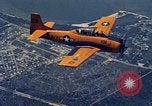
Film showing the type of Naval aviation training and kinds of assignments experienced by U.S. Marine officer, John Glenn, before his service as an astronaut.
Film that illustrates the kind of aviation training and early career experiences of American Astronaut John Glenn. Narrator discusses this throughout, but there are no images of John Glenn, himself in the film, which begins showing a formation of North American T-28 training planes from the U.S. Navy flight school at Pensacola, Florida, flying over water. Closeup of one doing a roll. Glimpse of instructor discussing Navy Mark 8-A Weems navigational computer in a classroom.. Cadets at Corpus Christi, Texas, in Altitude Chamber experiencing the effects of high altitude flight and learning about their individual symptoms of hypoxia onset. A cadet in the cockpit of an airplane as instructor standing on its wing points out features of the aircraft controls. A cadet using a sextant to shoot sun lines in daylight. Cadets engaged in calisthenics, and playing volley ball on a court set up on a flight line. A line of Navy Douglas AD Skyraider aircraft, with folded wings are parked in the near background. Cadets in dress whites leave a chapel following a service. Graduation parade and exercises in which the cadets are awarded their Navy wings of gold. A formation of four Navy Grumman F9F/F-9 Cougar aircraft in formation, viewed from above. Closeup of pilots in several parked Vought F4U Corsair aircraft, followed by Formation of several in the air ostensibly blasting enemy targets below, raising white smoke. A U.S. Navy Lockheed T-2V Seastar jet training aircraft performing a roll in flight at high altitude with condensation trails visible behind its wingtip tanks. Brief views of air combat during the korean War. Navy Vought F8U supersonic Crusader aircraft in flight. An X-15 aircraft being dropped from underneath a U.S. Air Force B-52 jet bomber. It rockets away rapidly from the Bomber.
U.S. Navy Task Force 58 defends against Japanese Kamikaze attacks and bombards Okinawa during Operation Iceberg
A glimpse of Navy gunners firing Bofors anti-aircraft guns from battle station on a U.S. aircraft carrier is how this film begins. Next, black flak clouds fill the sky and tracer rounds are seen in a nighttime battle as ships of U.S. Task Force 58 (TF-58) battles attacks from Japanese aircraft, including Kamikazes dispatched from Mainland Japan, during World War 2. View of Japanese attacking aircraft subject to relentless tracer bullet fire, until is is hit. It continues toward a target ship, but misses and crashes into the sea. A flaming Japanese aircraft moving overhead in daylight, amidst many black flak clouds. It crashes into the sea. Another nighttime scene shows numerous tracer rounds flashing through the darkness as hundreds of land--based Japanese warplanes attack ships of Task Force 58. Explosions are seen in the air as attacking planes are hit by anti-aircraft fire. View of a Japanese attacking aircraft diving from overcast skies, banking to its left and crashing into the water. Gun camera views from American aircraft shooting down a Japanese multi-engine bomber from the rear and one from another aircraft shooting a Japanese fighter head-on. It veers off in smoke as the American plane passes to its left. The Japanese plane crashes into the sea with a huge explosion and fireball. Another gun camera view of large Japanese aircraft being shot down from the rear. Scene shifts to column of 5 "old" U.S. battleships underway. Views of guns firing from newer battleships of the line. Glimpse of foreign correspondent Ernie Pyle aboard a warship. The battleship USS Pennsylvania (BB-38) seen silhouetted against moonlit sky. (She was damaged by hit from Japanese aerial torpedo, off Okinawa on April 12th, 1945.) Views of fast battleships and other ships of TF 58,firing their naval guns. View on Okinawa as their shells explode, supporting advance by U.S. Army and Marine advancing forces. The U.S. troops running across fields as they advance. Burning buildings on Okinawa. US troops advancing through rice paddies. A soldier calling for close air support on a field radio. View of two Escort carriers providing air support. View air control officers aboard the Command ship, heavy cruiser USS Indianapolis (CA-35), as they order air strikes in support of the troops. F4F fighter planes carrying bombs take off from a carrier. Formations of U.S. aircraft in flight overhead. Their bombs exploding on Okinawa. frontal view of an F4F firing rockets. Wider views of F4Fs firing rockets.