


 Francais
 Deutsch
 Italiano
Refine Your Search
F-86 stock footage and images
- Showing 1795 to 1800 of 2472 results more
more Hide
Hide
Former U.S. President Truman, 4 Presidential hopefuls, and Democratic leaders at a dinner of Democratic Party in Washington DC.
Top Democratic luminaries at a $100-a-plate fundraising dinner of the Democratic Party in Washington DC. Democratic politicians at dinner tables with their wives at the venue. View of former United States President Harry S. Truman. The dinner is also attended by four front running Presidential hopefuls. View of Senator John F. Kennedy. Speaker of the House Sam Rayburn; Governor Robert Meyner of New Jersey; Democratic party Chairman Paul Butler talking to Senator Hubert Humphrey; Senator Lyndon Johnson with Jacqueline Kennedy seen on his right at a table; Senator Stuart Symington seen at a dais.
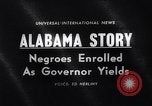
African Americans Hood and Malone admitted to Univ of Alabama after President Kennedy overrules Governor Wallace's opposition
Newsreel, "African Americans enrolled as Governor Yields." Tight security at the registrar office of the University of Alabama in Tuscaloosa. Governor George Wallace confronts a deputy United States attorney and doesn't allow admission to the University for two African American students- James Hood and Vivian Malone Jones. An officer arrives and talks to Governor Wallace about President Kennedy's integration orders. Governor Wallace bows to Presidential authority and walks out. Students James Hood and Vivian Malone enter the registrar office for registration at the University. United States President John F. Kennedy addresses the nation from White House in Washington DC, regarding civil rights, saying the country is facing moral crisis.
British Royal Air Force warplanes engage German Luftwaffe bombers in dogfights over England, during World War II.
German Luftwaffe aircraft on bombing runs over England during Battle of Britain blitzkrieg in World War 2. British plane spotters in office. Royal Air Force plotting room with officers planning to combat German bombers during blitz. Aerial view of German Heinkel He-111 bombers in flight. Royal Air Force Spitfire warplanes in formation. The Spitfires engage in dogfights with German planes over England. R.A.F. Hurricane aircraft pursues a German bomber. Pilot hand seen pressing button to fire guns. Gun camera footage from British RAF aircraft shows the German Luftwaffe bomber aircraft as it is hit and crashes into the English Channel. Multiple aerial battle and dogfight scenes between British and German aircraft are seen. Guns on RAF planes fire. Anti aircraft gunners and plane spotters on a post in England. A civilian spotter writes swastika symbols on chalk on a wall, representing German aircraft downed. Scenes inside a control room where spotters are relaying German enemy aircraft sightings to controllers deploying British defenses. Smoking ruins of buildings in London during the Blitz in the Battle of Britain. Prime Minister Winston Churchill seen touring the streets with citizens and being cheered by citizens. Narration on clip is in Japanese.
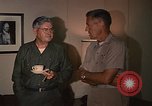
General Curtis Lemay discusses with Rear Admiral Swanson and Vice Admiral Bringle during his fact finding visit to USS America.
General Curtis E. Lemay arrives for a fact finding visit to the United States Ship America (CVA-66). General Lemay, Rear Admiral Leroy V. Swanson and Vice Admiral William F. Bringle in the Chief of Staff cabin. General Lemay holds a coffee and cigar and chats with Swanson. Pictures of naval commanders on cabin wall behind. Plate over door reads 'Chief of Staff Cabin'.
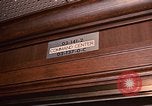
General Lemay discusses with commanding officers and observes radar photos during his fact finding visit to USS America.
General Curtis E. Lemay arrives for a fact finding visit to the United States Ship America (CVA-66). Officers in a cabin with plaque over doorway 'Command Center' written on it. Books in shelves at the cabin. Name plate over door reads 'Flag Room'. Admiral Leroy V. Swanson escorts General Lemay to the Ready Room and introduces officers to General Lemay. Vice Admiral William F. Bringle watches as Commander Wayne Smith of Air Wing 6, talks to General Lemay, who smokes a cigar. General Lemay autographs some issue from Commander. He listens to Commander Charles B. Hunter, Commanding Officer of VA-85, in ready room. Tag on a wall map reads 'Hanoi is defeated'. General Lemay and officers observe a large board containing display of radar photographs. He shakes hands with other officers in ready room.
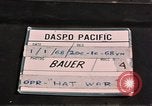
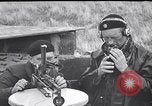
Soldiers of Long Range Reconnaissance Patrol (LRRP) wearing black berets, during a class on AK 47 in Lai Khe, South Vietnam.
Opening scene shows closeup of a member of the U.S. Army First Infantry Division Long Range Reconnaissance Patrol unit (LRRP) wearing a black beret with parachutist's badge. In background,LRRP members watch as an instructor demonstrates how to field strip a Soviet AK-47 assault rifle. Scene shifts to viewpoint of soldiers watching the instructor. Tents are seen in the background. Closeups of instructor show master parachutist badge on his black beret. Scene shifts again to a large sign containing a large painted logo with a picture of a Vietcong in the center, surrounded by images of black berets. The combat infantryman badge is shown at the top and 1st Infantry Division and MACV recondo badges appear at opposite sides of the sign. (Note: LRRP Units were Airborne, Special Forces. The LRRP Unit of the 1st Infantry Division, shown in these scenes, on January 1st, was, at that time, designated: Company F of the 52nd Infantry Regiment.) (Vietnam War period).