


 Francais
 Deutsch
 Italiano
Refine Your Search
F-86 stock footage and images
- Showing 2245 to 2250 of 2472 results more
more Hide
Hide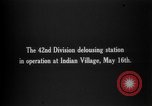
American Expeditionary Forces, 42nd Infantry Division, delouse clothing and watering horses in France, during World War I
Activities of the U.S. 42nd Infantry Division (Rainbow Division) American Expeditionary Forces (A.E.F.) in France during World War 1. Soldiers delouse clothing in large steam cabinets at an encampment dubbed "the Indian Village," in France. Soldiers are seen carrying their cleaned clothing. Other soldiers bring horses to water, as a soldier washes his clothes in a nearby outdoor wash facility
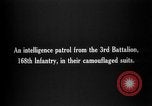
Intelligence Patrol of the U.S. 3rd Battalion, 168th Infantry Regiment, reconnoiters in France during World War I.
An intelligence patrol of the American Expeditionary Forces (A.E.F.) 3rd Battalion, 168th Infantry Regiment (42nd Infantry Division) reconnoiters during World War 1.They are completely covered in camouflage clothing, as they crawl amongst trenches and earthworks of the battleground to observe conditions in "no man's land."
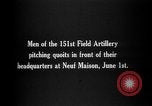
Men, of the U.S. 151st Field Artillery Regiment, pitch quoits in Neuf Maison, France during World War I.
Soldiers of the American Expeditionary Forces (A.E.F.) 151st Field Artillery Regiment (42nd Infantry Division) pitch quoits at their headquarters in Neuf Maison, France during World War 1. Some of their comrades watch the match from behind a wooden railing.
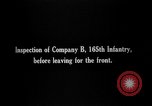
U.S. 165th Infantry soldiers are inspected, issued clothing, and paid, in France during World War I.
Officers inspect troops from Company B, 165th Infantry Regiment (42nd Infantry, Rainbow Division) in France during World War 1. The soldiers are lined up in front of their pup tents, in a field. Captain K. C. Siebert, Lieutenant R. Doris and Lieutenant F. W. Carter inspect strong dugouts of Company A, in a hillside just behind the front lines, at Chasseurs, France. Officers walk out of the passageway of an adjoining heavy stone structure (Headquarters?). Scene shifts to U.S. Machine gun battalions firing French Hotchkiss M1914 heavy machine guns. At each position, one soldier feeds a strip of 8mm Lebel cartridge ammunition while the other fires the weapon. Slate states that the firing is toward a German town 2,800 meters away. Men of a machine gun company are seen lined up to receive issues of personal clothing from Quartermaster. Soldiers of the 165th Infantry receiving pay from paymasters at an outdoor table near a hillside dugout. One counts out a soldier's pay and another annotates a pay ledger.
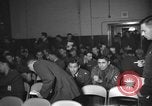
B-47 SAC unit is briefed about a mission at Brize-Norton Air Force Base in the United Kingdom.
SAC unit arrives for a briefing session at Brize-Norton Air Force Base in the United Kingdom. U.S. Air Force B-47 Stratojet SAC(Strategic Air Command ) unit members arrive in a room for a briefing session. An officer with long mustaches holds papers in his hands. A paper kept on a desk. Members seated on chairs. Men stand at the base. A medical van arrives and they get in the van. Vehicles move in the background. Buildings in the background. A sign reads 'Brize Norton, R.A.F. Station 3920th Air Base Group, Welcomes You'. SAC members take notes. Colonel Kunkle uses a pointer to point out an aerial route for the unit. He passes the stick to next officer Major Hess. He attaches maps onto another map, and describes the mission to the bomb wing. The crew members take notes.
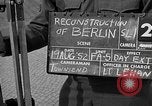
Shoppers shop at Kurfürstendamm street and a building under construction in post-war Germany under reconstruction.
Reconstruction of Berlin, Germany after World War 2. Quonset hut type barracks buildings in an area of Berlin. Buildings on Meringdam street. Buildings on Kurfürstendamm street in the British Zone including the heavily damaged Kaiser Wilhelm Memorial Church (Breitscheidplatz, 10789 Berlin, Germany) in the center of the Breitscheidplatz. Civilians walk in the streets and shop. Traffic on the streets. Cars parked in the background. A sidewalk displays a box. A building under construction. A hotel. Civilians ride bicycles on the road. The Rathaus Schöneberg (John-F.-Kennedy-Platz, 10825 Berlin, Germany) and civilians on the street.
CRITICALPAST.COM: About Us | Contact Us | FAQs - How to Order | License Agreement | My Account | My Lightboxes | Shopping Cart | Advanced Search | Featured Collections | Website Terms & Conditions | Privacy Policy ©2026 CriticalPast LLC.
License Agreement |
Terms & Conditions |
Privacy Policy
©2026 CriticalPast LLC.