


 Francais
 Deutsch
 Italiano

Refine Your Search
Goodenough Island New Guinea 1943 stock footage and images
- Showing 7699 to 7704 of 13663 results more
 Hide
Color Sound
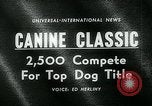
Westminster Kennel Club Dog Show event at Madison Square Garden.
View at Westminster Kennel Club's event of Dog Show at Madison Square Garden in New York. Many varieties of dogs walking. Crowd watching the show. For the first time a Springer spaniel is best in show at the Westminster kennel club dog show event. Wakefield's Black Knight, the new top dog, the new best dog is a Black Knight. Crowd applauds. Photographers taking photos.
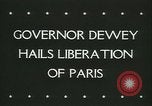
Speaking from the NY State Capitol, Governor Thomas Dewey hails the Liberation of Paris by the Allied forces in World War II.
New York Governor Thomas E. Dewey hails the Liberation of Paris by the Allied forces. The New York State Capitol building (State St. and, Washington Ave, Albany, NY 12224, United States) in Albany, New York. Governor Dewey addresses the nation regarding the Liberation of Paris in World War II. He states that the incident is an inspiration to others still under the Nazi German occupation. He talks about the contribution of Allied forces to the cause, America's war efforts and the goal to defeat Germany and Japan.

Some scenes showing politicians involved in the U.S. National and state elections of 1938
Film starts showing President Franklin D. Roosevelt at a polling place during the 1938 U.S. National Elections. Next, Mrs. Eleanor Roosevelt, the President's wife is also seen there with him. Glimpse of an unidentified politician. Another unidentified politician shaking hands with people in a crowd. New York Democratic Governor, Herbert H. Lehman, stands with his wife and family on the occasion of his re-election. Brief closeup of Governor Lehman himself. Scene shifts to the Republican candidate for New York Governor, New York County District Attorney (Manhattan), Thomas E. Dewey, who is being interviewed. (He lost the election to Governor Lehman, but only by 1.4%.) Closeup of Thomas Dewey, smiling. Two unidentified men are seen sitting by a radio. One is recording election results on a tally sheet.

Franklin D Roosevelt wins the Presidential election in United States.
Franklin D Roosevelt's election as the President of the United States in 1932 . Alfred E Smith, the former Governor of New York and his wife walk amidst a large crowd on the Election Day in New York, on the way to their polling place. Smith is wearing his familiar brown derby hat. Franklin D Roosevelt awaits the result of the polling. People celebrate in the streets of New York as Roosevelt wins with a landslide over Hoover.
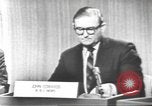
U.S. Vice President Nixon speaks about U.S. foreign policy towards Latin America prior to the presidential elections in the U.S.
The fourth presidential election debate held between Democratic nominee Senator John F. Kennedy and Republican nominee U.S. Vice President Richard Nixon in New York, United States on 21st October 1960. News correspondent John Edwards asks Senator Kennedy if he can give the names of three or four Americans whom he can appoint as the Secretary of State. Senator Kennedy replies to the question and says that this decision can only be made by the president and not presidential candidates. He says that he has made no judgment about who should be the Secretary of State. News correspondent Quincy Howe asks Richard Nixon to comment. Nixon says that it would be the responsibility of the next president to appoint the Secretary of State. Vice President Nixon speaks about a previous comment made by Senator Kennedy regarding Fidel Castro's regime. He says that President Eisenhower's administration appropriated five times as much for Latin America as was appropriated by the previous administration. He speaks that Democratic Congress has cut eighty million dollars off of the Voice of America appropriations to Latin America.
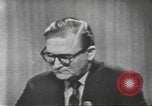
Vice President Nixon and Senator Kennedy debate in the U.S. over a summit conference between the U.S. and the Soviet Union.
The fourth presidential election debate held between Democratic nominee Senator John F. Kennedy and Republican nominee U.S. Vice President Richard Nixon in New York, United States on 21st October 1960. News correspondent John Edwards ask Vice President Nixon about the conditions to be met before meeting Soviet Premier Nikita Khrushchev at Vienna Summit of 1961. Nixon replies that an agenda should be prepared which should delineate those issues on which there is a possibility of some agreement or negotiation. He says that U.S. President should not go to the conference unless they have such an agenda, unless they have some reasonable assurance from Khrushchev that he intends seriously to negotiate on those points. News correspondent Quincy Howe asks Senator Kennedy to comment on the topic. Senator Kennedy says that the U.S. should not go to the summit until there is some reason to believe that a meeting of minds can be obtained on either Berlin, outer space or general disarmament including nuclear testing. He mentions the failure of the conference on May 15th 1960 in Paris, France. He further says it is important that they maintain their determination, that they indicate that they're building their strength, that they are determined to protect their position and that they are determined to protect their commitment.
CRITICALPAST.COM: About Us | Contact Us | FAQs - How to Order | License Agreement | My Account | My Lightboxes | Shopping Cart | Advanced Search | Featured Collections | Website Terms & Conditions | Privacy Policy ©2026 CriticalPast LLC.
License Agreement |
Terms & Conditions |
Privacy Policy
©2026 CriticalPast LLC.