


 Francais
 Deutsch
 Italiano

Refine Your Search
Greek-Civil-War stock footage and images
- Showing 13897 to 13902 of 27563 results more
 Hide
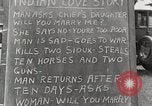
American "Indian Love Story" translated into Indian sign language by Richard Sanderville
A story called,"Indian Love Story," is written out in chalk, on a blackboard. Scene shifts to Richard "Dick" Benedict Sanderville, interpreter at the Blackfeet Agency in Browning, Montana,seated on a chair,outdoors. He translates the story into Native American Indian sign language, as follows, while the camera records his movements: Man asks chief 's Daughter Will You Marry Me? She Says No. You're too Poor. Man Is Sad. Goes To War. Kills Two Sioux. Steals Ten Horses And Two Guns. Man Returns After Ten Days. Asks Woman Will You Marry Me? She Says-Yes! Man Says-No!! You Don't Love Me-You Love My Horses'. The signs: 1. MAN ASK CHIEF HIGH (head-chief) CHILD WOMAN , YOU ME MARRY; which translates to: A man asks the head-chief's daughter: "Will you marry me?" 2. WOMAN SAY , NO YOU POOR; which translates to her saying: "No, you are too poor." 3. MAN SAD (heart heavy), GO-TO-WAR; which translates to: The man is sad (his heart is heavy, falls on the ground). He goes to war. 4. KILL TWO SIOUX (3 missing sign), STEAL TEN HORSE, TWO BOW; which translates to: He kills two Sioux, steals ten horses and two bows. 5. GO-TO-WAR COME TEN NIGHT; which means: The man returns (from war) after ten days. 6. SEE WOMAN, SAY YOU ME MARRY; which means: He (visits and) asks the woman: "Will you marry me?" 7. WOMAN YES, MAN SAY NO; which translates to her saying: "Yes!" The man says: "No!" 8. YOU FOND HORSE , YOU HEART FOND (love) FINISHED. Translation: You love (my) horses, ( I ) don't love you anymore. Editor Commentary: The second GO-TO-WAR sign is much shorter because it is part of a compound sign, and the emphasis is now on COME. The actual going to war has already happened. Also, in the last sentence the first YOU is the subject, but the second YOU is the object, and the subject is missing. Finally, in the first sentence the HIGH sign (index finger pointing up above head) is almost unnoticeable, and means "standing high above all others" or "above all, superior, high above the others".
American women at home and work in the context of WW2
Graph compares the number of female factory workers to men during World War II. Factory workers producing war materiel in the United States. Workers using lathe. Welders welding machines. Tanks are loaded onto rail freight cars. Railroad freight yards and shipping. Posters advertising war jobs for women. Women interviewed for war jobs by men. Alarm clock rings as tired woman wakes up in bed. Women in front of Sterner's Department Store and buying fur coats. Women reading newspapers while smoking. Crowd trying to get onto an overcrowded bus. A mother comforts her boy who has skinned his knee. Men and women leaving a factory. Interior of World War 2 airplane factory. Soldier examines broken radio on battlefield. Wounded American soldiers carried on litters. A telegraph is delivered to a woman by a girl. Woman reads the telegraph. Woman crying in bed while reading the telegraph that announces her husband's death, while her son comforts her. Close up photo of deceased husband. Montage of graveyards with gold star of service superimposed on image. Newspaper headline "All Job Deferments Face Drastic Review" View of men inside Selective Service local board 226 office. Some men being drafted then in 1944 are shown, including older men, more fathers, and men who had been doing essential industrial work. Man working with metal lathe. American soldiers climbing mountain in snow in Italian mountains. American soldiers wade through deep water in a jungle region of the Pacific. View of a sinking ship or merchant ship, and two crew members jumping off the sinking ship into the water. View of London England blitz damage and devastation, and people digging through piles of rubble from bombing. Dead bodies of adults and children from war in Europe. Crying women, London Blitz. Woman holding boy in arms. Woman kissing girl. Old woman sewing in factory to help with the war production effort. Women picking crops to help with farming and supply of food for soldiers.
U.S. Army Colonel Black and Major General Reckord during the Army-Navy 'E' Award ceremony in Edgewood Arsenal, Maryland (WW2)
The Army-Navy 'E' Award ceremony at the Edgewood Chemical Warfare Arsenal in Maryland, United States during World War II. A car led by motorcycle escorts driven on a path lined by soldiers holding guns. An officer standing on the side of the path saluting. A motorcade follows the car. The officers on the side of the path saluting. Civilian workers of a war plant walking on the path between the soldiers. View of the Post Recreation Hall and soldiers lining the path to the hall. A car arrives and high ranking army and navy officers emerge from the car. Several civilians and officers gathered in the area in front of the hall. Officials and dignitaries going up the steps onto a stage inside the hall during the Army-Navy 'E' Award ceremony at which companies would be conferred awards for excellence in production of war equipment. Several views of the crowd seated. The army and navy officers, officials and dignitaries seated on the stage. Master of Ceremonies Colonel H. M. Black Chief of the Arsenal Operations Department, Edgewood Arsenal, stands in front of a microphone and announces the award by Undersecretary of War Robert P. Patterson. Colonel Black reads out from a note from the Under Secretary. The note says that the army and navy is conferring upon the workers of the Edgewood Arsenal War Plant the Army-Navy 'E' Award for their contribution in the production of war equipment. Major General Milton A. Reckord Commanding General Third Service Command standing behind a podium and speaking into microphones. The Major General praises the workers of the war plant who won the award. The army and navy personnel, officials and dignitaries seated behind the Major General.
Brutalities against prisoners, officials gathered in 1949 in Palace of Nations for Third Geneva Convention; discussion of Geneva Conventions.
Film from 1965 shows scenes that span from early 1940s through mid 1960s. Film opens showing armed conflict in Laos and South America. Soldiers firing rifles in jungle areas. Armed men running across a field and in a town in Cyprus. Heavy armor engaged in conflict and buildings burning in undisclosed location. Riots in Congo with a crowd of men beating another man. Armed Republic of South Vietnam soldiers (ARVN) moving through jungle in Vietnam War. A Viet Cong fighter shot as ARVN troops attack a hut. People fleeing in streets of Cuba as government soldiers engage armed revolutionaries under Castro. A civilian woman suffering a seizure as Red Cross workers attempt to carry her. Burned body of dead tank crew soldier atop a tank. Medical corps persons moving wounded on a stretcher. Various views of ARVN with captured Viet Cong in Vietnam. Narrator discussion about Geneva Conventions and Counterinsurgency. View of the Palace of Nations building in Geneva Switzerland. Scene shifts to inside, in 1949, where delegates of 59 nations are gathered to develop new rules expanding the original 1929 Geneva Conventions, in order to better protect prisoners of war, wounded prisoners, noncombatants and others caught up such internal conflicts. View from ground of German paratroopers during World War 2, jumping from Junkers Ju-52 trimotor transport planes. Closeup of German soldiers leaping from a plane and descending in parachutes. Japanese soldiers surrendering to Americans on a Pacific Island in World War 2. Several scenes of massacre victims lying on the ground, victims of Nazi German brutality in Europe during World War II. Survivors of a Nazi concentration camp near the time of its liberation in 1945. A U.S. Army medical corpsmen help one to a stretcher. Executed prisoners of war. Courtroom of the Nuremberg trials. Seen in the front row of Nazi leaders are: Hermann Göring, Rudolf Hess, Joachim von Ribbentrop, Wilhelm Keitel, Ernst Kaltenbrunner, Alfred Rosenberg, Hans Frank, Wilhelm Frick, and Julius Streicher. Seated behind them are: Karl Dönitz, Erich Raeder, Baldur von Schirach, Fritz Sauckel, Alfred Jodl, Franz von Papen, Arthur Seyss-Inquart, Albert Speer, and Konstantin von Neurath. Scene shifts to the postwar trial of Japanese Lieutenant General Masaharu Homma, in the Philippines. Prisoners with hands bound, in an unidentified Asian conflict, being herded into an open truck. Views of the document constituting the 3rd Geneva Convention of 1949, addressing treatment of prisoners and of parts directed to "conflicts not of an international character." Views of a traumatized civilian driver wounded and a female passenger killed in in his car (appears to be in Cuba or Latin America). Armed gunmen have the man leave the car. A man lays the body of the woman beside the car. Scene shifts to a group of surrendered Vietcong fighters with their weapons stacked. Wounded combatants being carried on stretchers. American survivors of a Japanese prison camp receiving a good meal after being rescued - this is possibly in the Philippines in 1945. Many of the American prisoners are gaunt and emaciated and malnourished. Narrator recites list of activities prohibited by Geneva conventions, as images show these activities: A ditch filled with victims of massacre. Hostages being taken in an internal conflict in an African country. Prisoners being beaten by non-uniformed civilians in and humiliated in public. A recently liberated prison with a former prisoner in striped uniform beating a man as a group is marched away (likely a World War 2 concentration camp with a liberated prisoner beating a former Nazi guard). Death sentences being rendered without due process. A court in Cuba. A boy pointing at a lineup of prisoners. A prisoner shot.

U.S. President Richard Nixon addresses people in the United States on withdrawal of remaining U.S. troops from Vietnam.
Television broadcast of U.S. President Richard Nixon's speech from the White House in Washington DC, United States on the withdrawal of remaining U.S. troops from Vietnam on 29th March 1973 during the Vietnam War. The White House. The Seal of the President of the United States. The President talks about that period of the Vietnam War when he joined the office and speaks about the program he initiated to end the war. He says American prisoners are on their way from Vietnam and people of South Vietnam are now free to choose their government. He says North Vietnam is not complying with few provisions of the Peace Agreement. He says that they should honor all those American soldiers who died during the Vietnam War. He refers to the difficult days of the war including the moratorium to end the war which was organized on October 15, 1969 when millions of Americans took day off from work and schools to participate in local demonstrations against the war. Nixon refers to the period of April 1971 when he ordered attacks on Communist bases in Cambodia. He talks about the period of May 1972 when he ordered air strikes in North Vietnam and the period of December 1972 when he ordered more air strikes.
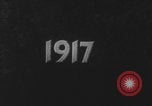
Scenes from WW1 include Woodrow Wilson, Franklin Roosevelt, troop deployment, munitions factory, ship building, WWI battle, and Armistice Day.
A title reading “1917”. An American ship sinks down in the Atlantic Ocean after it was torpedoed by a German U-Boat during World War I. United States President Woodrow Wilson signs the United States declaration of war on Germany. President Woodrow Wilson at work in his desk. A United States soldier blows a trumpet. United States soldiers crowd the deck of a ship sailing to Europe during WWI. The American Expeditionary Forces are waving as the ship sails away from the port. Franklin Roosevelt during World War I. American troops disembark from their ships after arriving in Europe. American women working in military supply factory. Women manufacture bullets using hand drills. A woman assembles munitions. Men building battleships at shipyard assembly line. Allied soldiers running in the battlefield to avoid being hit or bombed by the Germans. Bombs explode in the battlefield in Europe during World War I. Soldiers avoid bombs. A railway gun fires. An biplane falls in smoke after being hit. Explosion from tank in battlefield. Soldier rolls down to a trench. Explosion beside a rolling tank. A German soldier ducks in trench. An Allied soldier fires from a trench. A soldier behind him throws a grenade. Soldier with machine gun ducks from a trench. Tank rolls and fires in battlefield. Black explosion in battlefield. Soldiers run and avoid explosions. German soldiers fire a machine gun and throw grenades. Surrendered German prisoner soldiers march out as prisoners-of-war. American soldiers celebrate Armistice Day. View of the United States flag. Allied soldiers march in victory through ruined city. Americans celebrate Allied victory in World War I, filling with crowds in New York City. Americans hold banner saying, “Germany Surrenders”. Celebrating Americans in New York City, hold American flags and their hats triumphantly after Allied Victory in World War I.
CRITICALPAST.COM: About Us | Contact Us | FAQs - How to Order | License Agreement | My Account | My Lightboxes | Shopping Cart | Advanced Search | Featured Collections | Website Terms & Conditions | Privacy Policy ©2026 CriticalPast LLC.
License Agreement |
Terms & Conditions |
Privacy Policy
©2026 CriticalPast LLC.