


 Francais
 Deutsch
 Italiano

Refine Your Search
Greek-Civil-War stock footage and images
- Showing 13909 to 13914 of 27563 results more
 Hide
Opening statement of the prosecution at the Nuremberg Trials; flashback scenes of Nazi crimes and starving civilians in 1945
Events related the Nuremberg Trials held at the Palace of Justice in Nuremberg, Germany. Flashbacks of a variety of Nazi crimes against humanity during World War II. Europe during 1945. War devastation: buildings and cities laid in waste, people in hunger and despair emerge from shelters searching for the causes of the war and of the immediate human suffering. Deprived children and adults weep, starve and beg on the streets. November 21, 1945, Nuremberg, Palace of Justice, seat of the International Military Tribunal. List shows the names of the convicted Nazi criminals. Chief prosecutor from the United States, Robert Houghwout Jackson, makes the opening statement of the prosecution. He presents Count 1 of the indictment a conspiracy to commit war crimes and crimes against peace and humanity. He makes the statement that criminals who have done injustice to the laws of humanity must be brought to justice. Stenographers wearing headphones take down notes. Defendants stand in their dock including Herman Goring, Rudolf Hess, Joachim von Ribbentrop, Wilhelm Keitel, Karl Donitz, Erich Raeder, Baldur von Schirach and Fritz Sauckel. Faces of the convicted criminals. Scenes from mass burial of victims from German bombing of Coventry, England. Scenes from the end of World War 2, with women weeping and civilian victims of war in Europe, including Germany, seen scavenging on streets for food. Women and hungry children scrape out trash cans and metal lids for bites of food. Desperate civilians cut down remaining tree stumps from formerly tree-lined streets to use for fuel. A group of men and women struggle in a food relief line in Italy.
Supplies are being loaded onto ships in the United States and a U.S. convoy at sea; recruitment film for Merchant Marines
A World War II recruitment film bulletin 'Wanted: Men for Merchant Marine' asking men to join the United States Merchant Marines and go aboard Liberty Ships and other cargo ships supporting the United States war effort during World War 2. A World War II American ship convoy at sea. An official works in Ship Personnel Office aboard a ship. Merchant seamen board a ship. A group of engineers, seamen, radio telegraphers, cooks, bakers and mess men during a training. Supplies are loaded onto a ship. Tanks, bombs and locomotive are hoisted by a crane and loaded onto the ship. Seamen work aboard the ships. Narrator speaks of military materiel delivered by ships and a series of images of American military equipment in action in Europe during World War 2 is shown: Line of camouflage U.S. army tanks fire. U.S. Army Air Force bomber aircraft at an airfield including one with a damaged nose. U.S. Army tractor hauls a long artillery piece on war torn streets of a European city. U.S. Army tank moving by fast on a European paved roadway. A merchant ship at sea. A ship convoy at sea.
Scenes of Washington DC, and people working inside various Federal buildings and government offices in Washington DC (WW2)
A World War II documentary titled 'Boomtown DC', a part of 'This is America' series, compares Washington DC to an industrial boomtown where the big business is government. 1930's and 1940's cars parked along a tree-lined street in a Washington DC neighborhood with homes visible. A cat jumps down from a wall behind a neighborhood home, with the U.S. Capitol seen in the background. Scene changes to U.S. Capitol building exterior close up. Close up views of souvenir stand trinkets in Washington DC, including banners, snow globes, and postcards of buildings and monuments of the city. View on the National Mall in Washington DC toward the Lincoln Memorial, interrupted by temporary wartime elevated walkways erected between buildings of the rapidly expanding Navy Department on either side of the National Mall. Smoke stacks from the chimneys of a factory superimposed over various images of buildings in the city. A woman exiting a voting booth, followed by a man entering the same voting booth and closing the curtain. A US Army guard standing outside the White House. Exterior view of the newly completed Department of State building (then called "Main State" and later known as the Harry S. Truman building housing the State Department.) Exterior of the newly built Pentagon War Department building in Arlington Virginia. Sign "War Department" on the War Department building at 21st and Virginia Avenues. Exterior view of a Navy Department building, then exterior view of the Treasury Department building. Close up view of hands holding and flipping through a stack of IRS individual tax return documents, then of hands sorting through a stack of U.S. government bonds. View of the Justice Department, and then view of sign on the Federal Bureau of Investigation. Scientists in a laboratory operate various equipment and run tests. A scientist near some beakers and test tubes in the lab. Scientists look through microscopes. View of underground rifle range in the FBI building as personnel practice marksmanship. View toward shooters on the range during firing, and toward targets. US Army guard in front of the Executive Office Building (also housing some State Department functions at that time). Exterior view of the Department of Labor building and sign. View of the U.S. Office of War Information building (OWI) with sign "US Information" inscribed in large letters on the top of the building (possibly the "Temporary V Building" of the OWI?) Exterior view of the Supreme Court Building. View of Declaration of Independence document on display. Exterior view of U.S. Capitol, then view of House of Representatives in session. U.S. President Franklin Delano Roosevelt seated at a desk signs a document. Citizens and workers walking on streets of Washington DC. Some people enter the Department of Agriculture building. Men and women enter the Office of War Information. Civilian and military hats being hung on a hat rack. Hand reaches for a 1940's era telephone. Women filing papers, views of filing cabinets. Close-up of 1940s era typewriters in use.

American POWs march to their compound; German soldiers try captured American beer and cigarettes (WW2)
A large group of captured United States Army soldiers during the Battle of the Bulge, or the Battle of the Ardennes, in World War 2. As the prisoners march under watch by German soldiers, the camera focuses on captured African American soldiers who are prisoners of war. A smiling German soldier. The prisoners of war march through the forest. Weary faces of Black soldiers are juxtaposed with their smiling, laughing German SS guards. A German Panzer IV tank passes a muddy hillside road where many U.S. Army prisoners of war are seated on the ground in the background. A soldier rides a horse drawn wagon in front of another tank where a group of soldiers are seen standing on top. The captured Allied prisoners of war are herded toward the road below to their compound. A German soldier eats a chocolate candy bar. He nods his head enjoying his candy bar. German soldiers trying out captured American beer and cigarettes. A German soldier drinking a bottle of American beer. Some German SS soldiers wearing camouflaged uniforms, one of them carries a light M34 machine gun with a circular magazine on his shoulder. A dozen German soldiers are seen sitting atop a moving tank. A tank drives through a village. Crewmen on top of a moving Sturmgeschütz III (StuG III) assault gun. One of the crewmen rides astride the gun barrel, while another mans the machine gun. Next is a a series of several German Panzer V ("Panther") tanks moving through the village. Clip contains many closeup views of faces of German soldiers and closeup views of faces of U.S. Army soldiers, including African American prisoners of war.
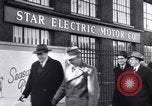
British working men on exchange visit to America question members of a Labor-Management Committee in New Jersey (WW2)
British working men and their American counterparts on exchange visit in the United States. The group enter a building of the Star Electric Motor Company. Inside they are seen sitting in on a labor-management committee meeting. The British workers ask whether the company's worker suggestion program is successful. The company managers say it has and helped increase war production. The British ask about having any deadlocks in labor-management relations, affecting war production, and are told the U.S. War Production Board would be called upon to resolve such a matter. The issue of continuing such labor-management cooperation after the war is discussed. (World War II period)
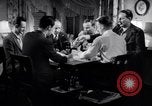
British factory worker and his American counterpart on an international exchange visit to the Lockheed aircraft plant in Los Angeles (WW2)
A British guest on labor exchange program visit to the U.S. is staying as a house guest of his counterpart American in Los Angeles, California. We see him with several friends of his host, who also work at the Lockheed aircraft plant. They are teaching him the card game of poker. The leave to attend a meeting of District Lodge 727, International Association of Machinists and Aerospace Workers, AFL-CIO (Lockheed-California Company). There the British guest is allowed to ask questions of the union. He and his American counterpart are seen at a podium as the Briton asks about the strength of the union inside the Lockheed plant. The local union Secretary responds that they have 45 thousand members in the Lockheed plant and, noting that the British man was a shop steward back in England, mentioned that the local also had 3000 shop stewards in the Lockheed factory. The British visitor asked how the union would be affected after the war, when labor requirements would be reduced. A member answers that the first action would be to return to a 40 hour work week (from the wartime 50 hour week). He states that some workers would return to pre-war work and jobs. Finally, he says they expect Lockheed to expand the scope of its manufacturing to include consumer goods. The union is asked about accommodating workers returning from the military and answers that it is covered in the union contract, which calls for their seniority to continue to accrue while in service. The union also provides for war injured handicapped workers to return to work, and sponsored legislation to provide post-service education opportunities for all returning veterans. Asked about women now employed in the plants, one woman union member stated that many would return to their homes. But the immediate need is to employ more women to the help the Allied forces win World War II as soon as possible. Regarding the prospect of post-war employment, one union member noted the national need to convert from wartime production to the manufacture of consumer goods. The union members favored the idea of continuing labor union exchange visits between the Allied countries in the future.
CRITICALPAST.COM: About Us | Contact Us | FAQs - How to Order | License Agreement | My Account | My Lightboxes | Shopping Cart | Advanced Search | Featured Collections | Website Terms & Conditions | Privacy Policy ©2026 CriticalPast LLC.
License Agreement |
Terms & Conditions |
Privacy Policy
©2026 CriticalPast LLC.